
As we’ve seen over the years, Disney-Pixar often make use of a variety of sources, whether directly or simply through mere allusion, when creating their films. Oftentimes, it’s easy to see what inspired a particular film, whether it be an existing text, a social idea or the most abstract concept. However, while watching their latest offering, the delightful Luca, I was struck by the parallels that exist between this and arguably one of the most formative texts of queer literature ever written, Anne Carson’s Autobiography of Red, a prose novel that tells that reimagines the story of Geryon, the infamous monster that served as one of the Twelve Labours of Heracles, as a contemporary tale of a young man growing into his sexuality, told through his gradual acceptance of his true-form, which was that of a monster, feared by society, causing him to hide who he truly is. Perhaps claiming that Carson’s text served as the foundation for Luca is a tad far-fetched, but considering both are stories centring on complex young men who venture out into an uncertain world, hiding their true identity from any hostile onlookers that might reject them, is a curious connection, and one that enriches this film in a number of ways. It’s not often that we find connections between a film targetted at younger children merging with the dense text of queer-oriented literature, but considering how far the animation studios have come in terms of making a concerted effort towards inclusion, it’s not impossible to imagine the general idea of using the idea of “monsterism” as an allegory for queer identities would’ve factored into the creation of the film.
Even putting aside this deep subtext, it’s difficult to deny what an absolute triumph Luca manages to be, serving as one of Pixar’s finest films in years (their best since Coco in 2017), telling a compelling story and accompanying it with some of the most stunning animation ever produced by the company. It’s an unexpected entry into Pixar’s top tier, gradually inching its way to that position through its heartful emotion, genuine humour and ability to incite some fascinating conversations along the way. One of their most visually arresting films (which seems to be a regular piece of praise asserted on their films – they clearly do develop in inventive and unexpected ways with each new film), as well as a return to form in terms of telling a very simple story that is driven less by high-concept ideas and convoluted, vaguely experimental ideas, and more by emotions and the intricate sensations associated with the deepest recesses of the human condition. At their best, Pixar’s films manage to touch on deep and honest issues with a kind of precision that allows many of their projects to stand shoulder-to-shoulder with the greatest works of animation ever committed to film. They’re undeniably playing in a slight minor key with Luca, but only in terms of the general ideas that went into its creation – director Enrico Casarosa and screenwriters Jesse Andrews and Mike Jones were seemingly given free-reign to tell the story on their own terms, and the result is a small and intimate comedy with an abundance of heart, and a fascinating approach to deeper discussions that aren’t predominant enough to be considered to drive the narrative, but rather gently guide it along, taking us on an immersive, unforgettable journey into the heart of Italy, as filtered through a gorgeous coming-of-age story that will undeniably speak directly to many viewers who see themselves reflected on screen in some way.
The preamble to this review makes it appear as if Luca is entirely focused on exploring the queer identity of the main character, when in reality it is never directly spoken about as such, instead leaving it all open to interpretation. While an argument could be made towards it being about a young man discovering his sexuality, as well as the unfortunate perceptions of the general public towards those with supposedly deviant identities, it isn’t particularly explicit about it, and instead frames it through the more universal story of two young men who are forced to hide who they are, in the fears of running into danger when encountering those who don’t quite understand that, despite being different, they’re not people who should be feared. Luca is a resounding film about acceptance and embracing one’s identity – the queer overtones can’t be ignored, and while it may be tempting to overlook these qualities as just being the product of reading too much into the story, Pixar and Disney have been genuinely trying to work towards including a broader spectrum of identities – so it’s more than likely that the impetus for Luca, rather than it’s driving factor, was to be a rousing call-to-arms for any young person who has ever felt like they don’t belong, showing that everyone has their place in the world, even if it takes some time and effort to find it. We all fit in somewhere, it’s just a matter of looking for the people and places that are ready to embrace who we are. This is an important discussion that is very cleverly woven into the fabric of the story, and unlike other instances of more progressive subject matter in their films, Luca doesn’t use it as a moment of tokenization, but rather develops it into the foundation of the story and builds some wonderfully insightful opportunities to comment on shifting mentalities in the process.
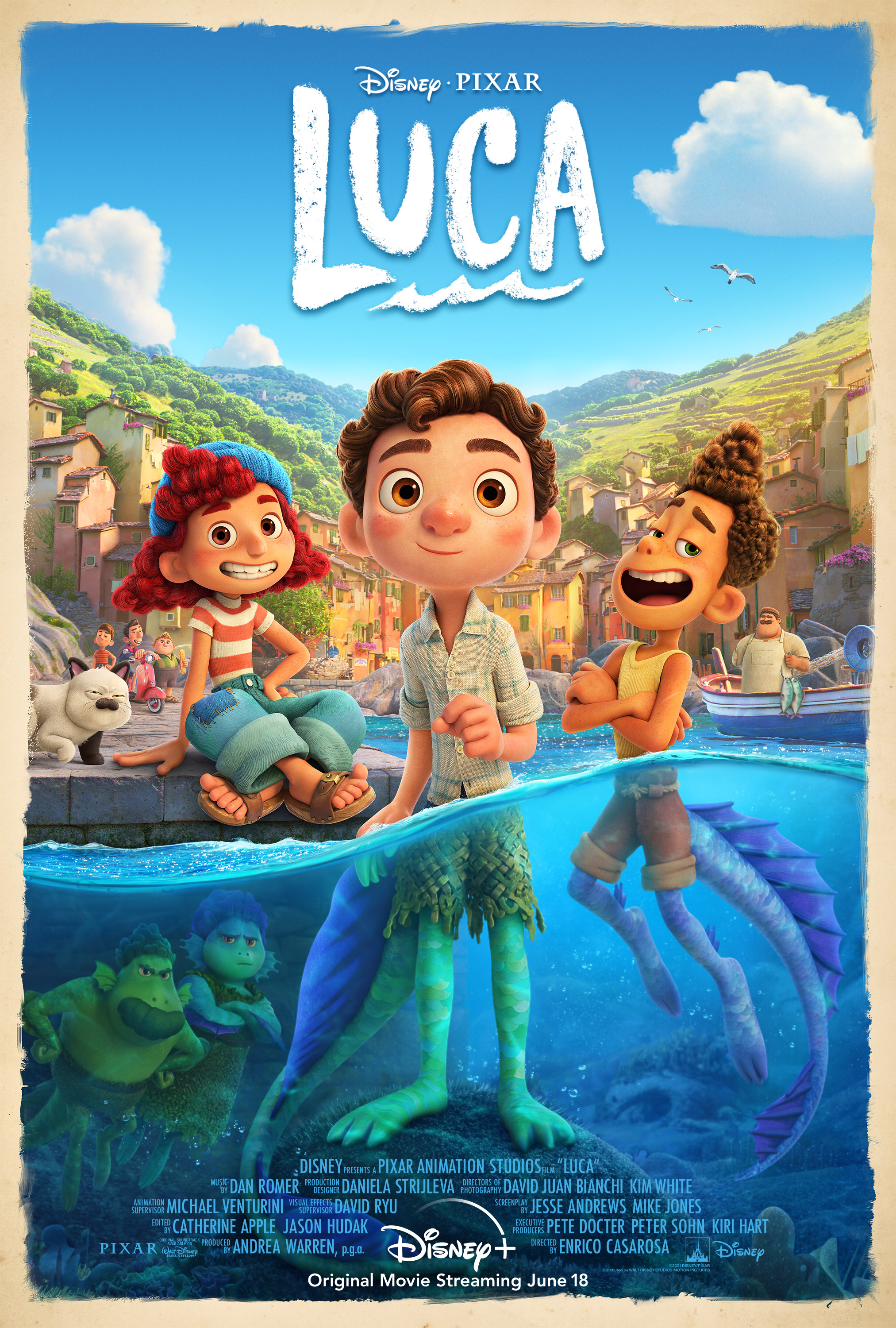
The aspect that prevents Luca from falling into the familiar trap of doing too much with a very simple premise, as well as the part that allows it to soar higher than many recent animated films, is that this is a work that prioritizes emotion rather than bold ideas. Looking solely at the narrative, the film is relatively straightforward – the premise centres on two sea monsters who find themselves falling in love with the outside world, so much that they don’t want to return to their underwater homes. Other than the necessary process of framing their journey through an upcoming sports event that serves to be the climax of the story, the film focuses more on establishing a particular atmosphere, setting a mood from which Luca can comment on a range of ideas. It bounces from scene to scene, exploring the growing friendship between these two boys, who gradually work their way closer to the forbidden realm of the “real world”, a paradise of endless opportunities that they genuinely believe can’t be found below the surface. A great deal of what makes this film so captivating comes in the director honouring his Italian heritage by situating everything within a small Mediterranean village, making Luca as much a film about paying tribute to the culture of the country as searching for one’s identity. The seaside hamlet of Porto Rosso (perhaps a homage to Hayao Miyazaki’s arresting Porco Rosso) is rendered with such stunning authenticity, we feel as if we have been transported into this particular time and place – and it’s not surprising that this is a quality of all of Pixar’s greatest works, especially those that blend universal stories with specific social nuances, making for films that both pay tribute to the multitudes of cultures that occupy our world, and showcase the fact that, despite having different backgrounds, we’re not nearly as different as we have been led to believe.
Luca is a terrific film, and a monumental step forward for Pixar, who prove that not every film needs to exude depth, and that there are instances where the most simple approach is often the most effective. It’s not a particularly difficult film, but it does conjure up some deep conversations surrounding the concept of identity, which is prominent in the film, but in a way that is more subtle and nuanced, rather than being heavy-handed or needlessly sentimental, especially when it becomes very clear that there is more to this story than meets the eyes. It’s an easygoing, straightforward story of friendship, as well as a poignant look into the gradual challenges those questioning their identity have to endure when venturing into a hostile environment that may not be as accepting as deviance from the status quo as perhaps they should be. On a purely visual level, Luca is just as much a stunning achievement – the animation pushes new boundaries, but instead of an endless array of moments of visually striking splendour, the film instead focuses on the small details, using the story as not only a chance to convey the premise, but also add in fascinating nuances into a world that has previously been mostly untrodden when it comes to Pixar’s films. On all levels, this film is sumptuous, poignant and heartfelt, and has the exact blend of artistic merit and emotional resonance that we have come to expect from a company whose entire brand has become an increasingly obsessive attempt to move audiences to tears – and Luca may be one of the first times it actually succeeded without needing to be overwrought, refusing to play on our emotions through heartbreaking situations, but instead being a beautiful celebration of life and the unexpected virtue of realizing one’s ability to be unique. As contrived as it may be, Luca proves the merit of striving to stand out in a world designed for everyone to fit in.
 The Postmodern Pelican
I embrace the wit and wisdom of A.O. Scott who eloquently summed up this film with the quip, “Calamari By Your Name.”