
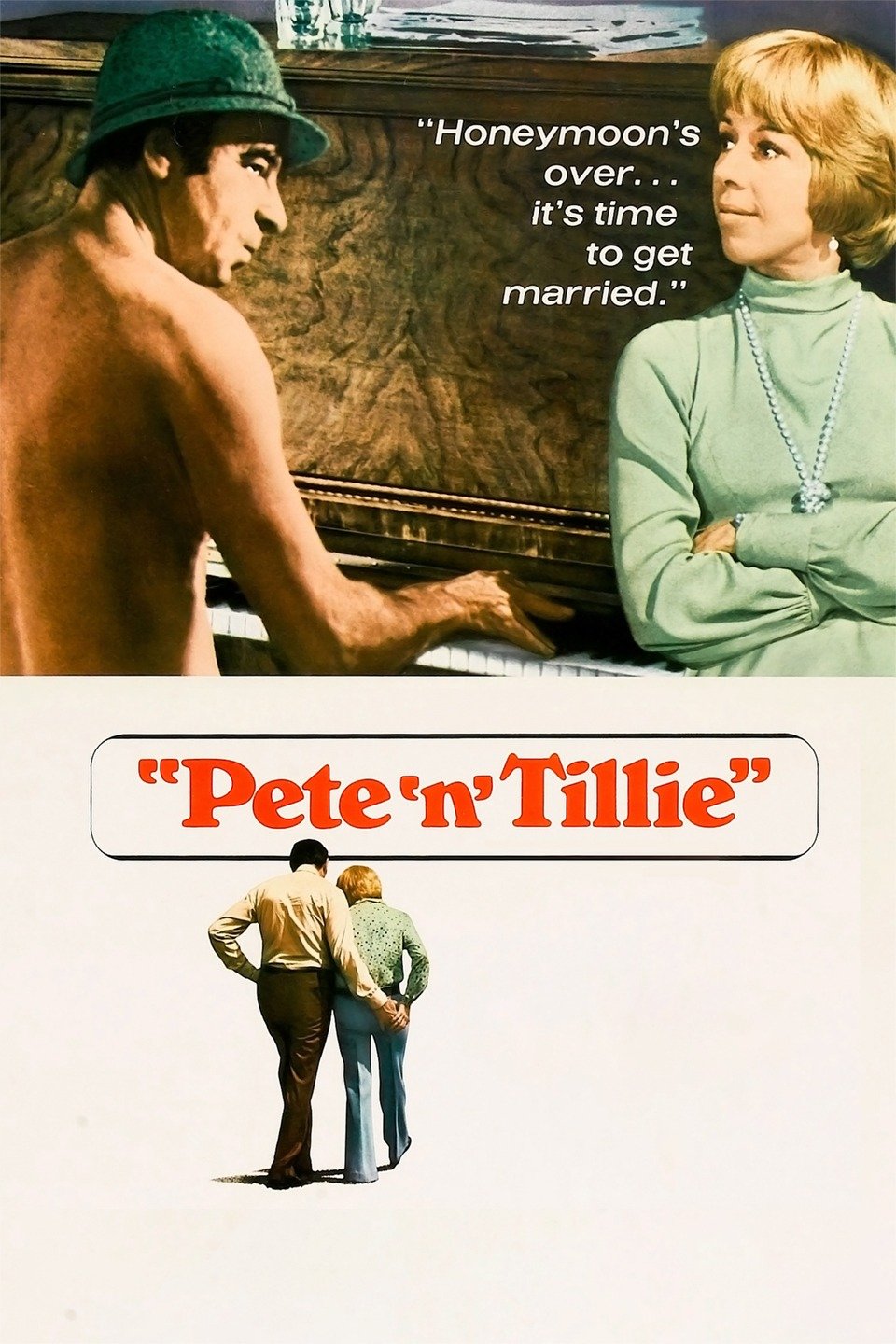
The promotional material for Pete ‘n’ Tillie, Martin Ritt’s ambitious adaptation of a short story by iconic provocateur Peter de Vries, stated boldly that “the honeymoon is over, time to get married”. There have not been many films that have been quite as sharp in exploring the trials and tribulations of a couple throughout their marriage, as the passion ebbs and flows, and hostilities arise as a result of a variety of external factors. While it may not carry the prestige of some of the more notable arthouse explorations of a declining marriage, Pete ‘n’ Tillie is still a terrific film, a romantic comedy with an acidic edge, and a melancholy that undercuts the humour in pivotal places, creating an unforgettable tapestry of two people falling in love, and realizing the trouble comes when they have to try and maintain this relationship, which is slowly deteriorating as they fall victim to a number of seemingly insurmountable challenges. Ritt is a director I have professed admiration for on many instances, and while he may have been essentially just a director hired to bring the script of notable writers to the screen, he had a keen sense of understanding of many of these concepts, so much that one has to wonder how much authorial voice he actually did have, since his control of his material suggested he was far more than just an ordinary, run-of-the-mill director. Pete ‘n’ Tillie is a challenging work, and while it may not reach the heights of films like Hud or The Long, Hot Summer, there is a warmth to this film that keeps it engaging and enthralling, even when it is strident in looking into the upbeat joys and harrowing tragedies that afflict the two protagonists on their journey to realizing the depth of their own romance.
Those expecting a happy-go-lucky romance without any depth best steer away from this film, which shows itself willing to have some very difficult discussions, particularly in the later parts, where the subject matter gets excruciatingly bleak, perhaps more than most would’ve bargained for, tackling some subjects that are not normally found in charming comedies, at least not the kind that Pete ‘n’ Tillie was apparently aiming to promote itself as being. This is a story of two people who meet, fall in love and then get married, and along the way suffer every possible crisis a couple could experience, including serial infidelity and the death of their child, which comes at a time when both of them were already at their most vulnerable. Ritt had a particular gift for telling profoundly human stories, and while his films could certainly take the form of colour-by-numbers melodramas, there is an edge to a film like Pete ‘n’ Tillie that keeps it from ever fully surrendering to the shortcomings associated with this kind of story. Whether it’s the warm sense of humour that persists throughout it, or the unflinching humanity that governs most of the film, Pete ‘n’ Tillie is very special in its own way. There is a truly magical element that prevents the film from falling apart into a bundle of hysterical scenes, which can be seen in a number of areas – the performances by the main cast, the witty (but profoundly moving) script by Julius J. Epstein, and the general ennui that ties it all together and makes it such a compassionate glimpse into the lives of two ordinary, wayward souls finding each other at a time when they both needed it, even if they didn’t realize it, and depending on one another through their individual journeys.
Logically, the pairing of Carol Burnett and Walter Matthau seems very promising from the outset, since they both make sense – they’re incredibly versatile performers who are naturally very funny, but also capable of hitting incredible dramatic depths that we may not expect in many of their films. Pete ‘n’ Tillie makes wonderful use of their multitudes of talents, especially since the majority of the film focuses on them, whether individually or in tandem, which means that there isn’t much space for them to hide. Their performances here are absolutely impeccable – Matthau is as charming as ever, playing Pete, a man who is rough around the edges but has a heart of gold, with a conviction that feels incredibly genuine, especially in the moments that call for him to shed the irreverent persona (which the film weaves into this character beautifully), and take on the more serious aspects of the character. However, it’s Burnett that really comes to impress here – at the time of production, she was a television veteran known for her iconic, self-titled variety show that shattered boundaries and revolutionized television. Yet, the concept of taking on as major a role as this, one that not only saw her venturing into a medium in which she had virtually no experience (having only had a minor role a few years prior in low-budget Dean Martin sex comedy), but also playing to her dramatic side, which audiences had not really been witness to prior to this. However, Burnett has always been the consummate professional, and her skills as an actress came into full effect here, playing the part of Tillie with a beautiful fragility. Matthau may command the screen with the more distinct character, but Burnett holds her own, and delivers a stunning performance that is brimming with staggering moments, such as a monologue late in the film after her son’s demise, where she truly shows how far she is capable of going when the material is strong enough bring out her inherent dramatic skills.
The performances given by Matthau and Burnett are incredible precisely because they’re able to keep up with the rest of the film, which shifts between tones quite regularly, but never once comes across as inauthentic or needlessly jagged, as is often the case with comedies that contain sojourns into the realm of the dramatic (or vice versa). Equal-parts romantic comedy and melodrama, Pete ‘n’ Tillie is a challenging film, and one that carries with it a sense of authenticity. Life may be filled with challenges, but there are moments of joy scattered liberally throughout – this was clearly what Ritt and Epstein were seeking out, and in taking some risks in terms of the story and the form it took, they successfully created something that feels genuinely complex, even when it is at its most simple. We feel like we have come to know these characters for ourselves, working our way into their psychological states and seeing the world through their perspective – and the ability to curate a story so that the viewer feels genuine empathy (without even a trace of pity), is remarkable. Ritt knew the intrinsic patterns that come with human stories, and he successfully portrays them on screen here, finding the perfect balance between comedy and drama. Any film that can elicit honest, howling laughter in one scene, and then draw out tears of sadness in the next, is immediately going to be worthwhile. Finding such a perfect balance is an accomplishment worth noting, and while there may be a slight deficiency when it comes to resolving every plot point (there’s a subplot involving the wonderful Geraldine Page that seems like an afterthought), the film achieves its goal where it matters, and gradually unveils a set of unimpeachable truths about the human condition that feels incredibly genuine.
Everything in Pete ‘n’ Tillie comes with a sense of melancholy lingering over it, meaning that even at its most outrageous, it shows restraint and dignity, never going too far to invalidate the very real emotions that underpin it, but rather is strong enough to take us on an emotional journey that is both heartbreaking and oddly uplifting. The film delivers an abundance of laughs, and no shortage of heart-tugging melancholy alongside it, finding the humour in the most difficult situations. There is a depth to this film that can’t be understated – the elegance of Epstein’s screenplay affords Ritt the shame to craft a gritty, hard-hitting drama that often takes the form of a lovable comedy, oscillating effortlessly between a number of different conventions, all of them impactful and unforgettable in their own unique way. Grounded by masterful performances by Walter Matthau and Carol Burnett (who are both doing some of their best work here), and executed with a precise vision that puts this far and above the overwrought melodrama that may have come from this premise. By the end of it, we’ve been both delighted and shattered by Pete ‘n’ Tillie, taken on an insightful journey into the lives of two people falling in love, and trying to keep the spark alive in the face of some disconcerting challenges. Beautiful, poignant and heartwrenching, this is a stunning work, and an absolutely essential piece of comedy from the peak of the New Hollywood era, where even the most irreverent stories had enough nuance to enter into some very serious narrative territory – and all of this converges into the beautifully poignant experience that is watching a striking deconstruction of a marriage that works through every imaginable crisis to remind us of the value of the simplest moments in life.
 The Postmodern Pelican
Let’s not mince words. Pete ‘n’ Tillie stinks. The maudlin marriage drama seeks realism but has aged badly.
Marvelous director Martin Ritt has made a serious error here. He brings together two top comedians and explores their brooding serious acting chops. The comedic highlight of Oscar winner Julius Epstein’s lousy screenplay is a knock down cat fight between Carol Burnett and supporting actress nominee Geraldine Page. The fight goes on far too long and is brutal. Burnett’s first slug is a broad swipe with her heavy purse that slams Page’s tit. The actress grabs her breast in obvious pain, and we involuntarily grunt at the altercation. Much more entertaining is the knock down cat fight in the 1970s in The Turning Point between Shirley MacLaine and Anne Bancroft on the rooftop of the Dorothy Chandler Pavilion in downtown Los Angeles. Here the fight is quick and evolves from fury to funny in a moment.
Burnett shows her complete inability to function with a stiff line delivery and her arms folded across her chest for much of the movie. A much better transition from television comedy to the big screen in the 1970s was made by fellow tv icon Mary Tyler Moore who excelled in the similar tale, Ordinary People. Moore was riveting. We felt her anguish though she never folded her arms across her chest.
Matthau plays a serial philanderer. He is unmannered and unattractive. Ritt attempts to charm us by showing the Oscar winner nude on a piano stool with his aging, sagging ass flopping off both sides. When Tillie reconciles with Pete after a stay in a sanitarium, Ritt gives us a final shot of the two embracing and walking away. Matthau’s big paw is planted on Burnett’s right buttock. The sight is not endearing. In the 1970s Matthau played attractive schlubs in much better romantic comedies with Glenda Jackson.
If you discover a videotape of this film in the clearance bin at the Salvation Army, don’t be tempted. Put it back.