
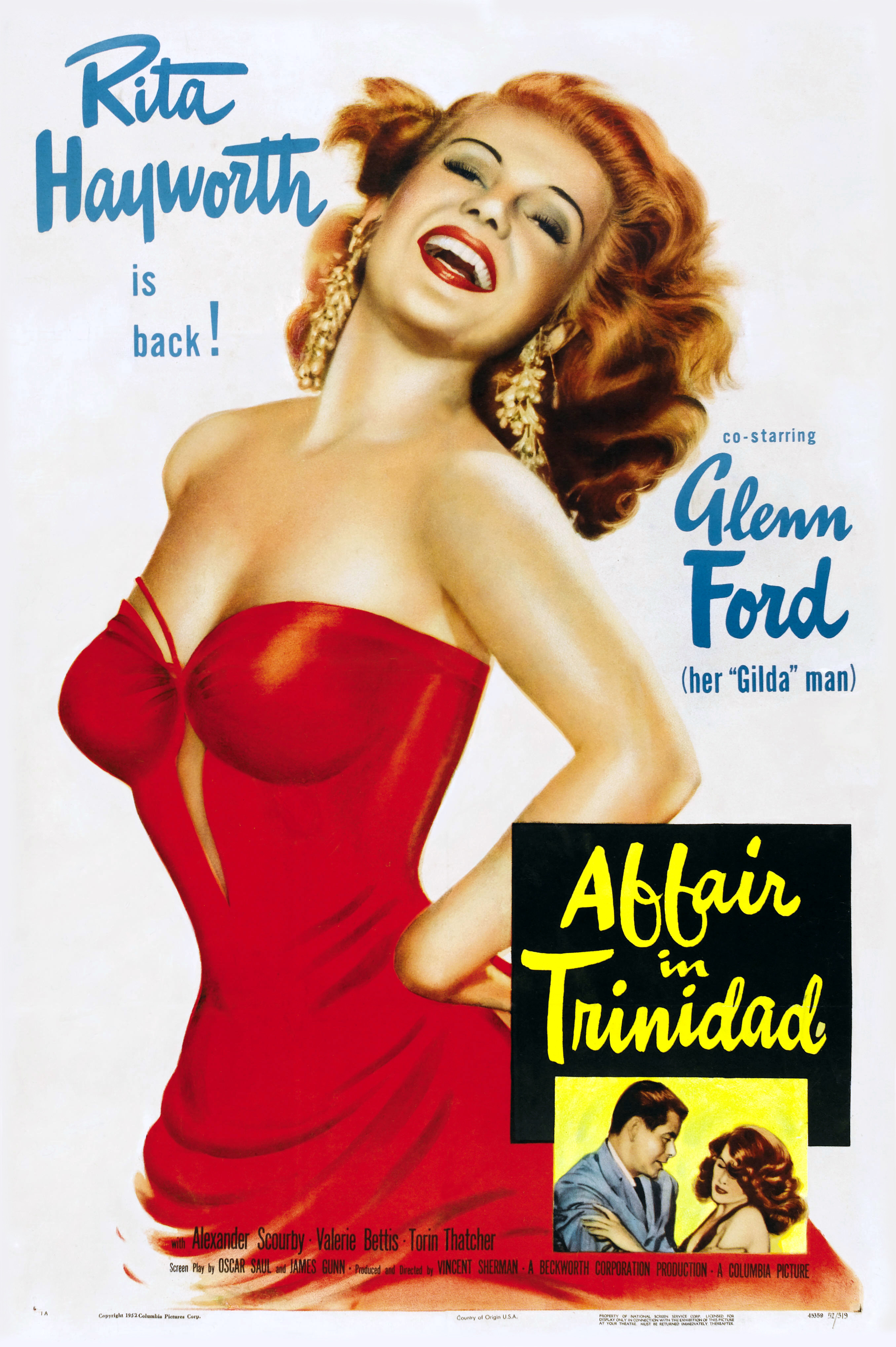
The reasons for the creation of Affair in Trinidad aren’t too abstract – years after burning up the screen in the iconic film noir Gilda, Rita Hayworth and Glenn Ford were in fierce demand, especially in collaboration with one another. It didn’t take too long for the on-screen (and off-screen) lovers to reunite in the form of Vincent Sherman’s fascinating Caribbean-set crime thriller, in which they play a freshly-minted widow, and the brother of her deceased husband, respectively. It’s not a perfect film – in fact, most of what makes this such a notable piece of cinema comes from the fact that it was merely an excuse to reunite the two stars on screen, several years since their last iconic partnership. However, it does deviate from the more cheaply produced films noir being made at the time, easily evading cliche in a way that feels oddly genuine, despite the very simplistic nature of the story, and the relatively unremarkable filmmaking. Affair in Trinidad is a pretty conventional film, but one that knows exactly what it needed to be in order to succeed, which it does with an odd amount of aplomb, telling the story of an unexpected romance set to the backdrop of a vicious murder and the criminal cartel that has been causing a string of deaths as a result of meddling civilians. It’s very entertaining, and boasts two terrific performances from its leads (as well as a peculiar supporting cast), which all works towards situating this film as a slightly unheralded entry into a genre that has certainly not lacked content, but rarely showed itself to be daring, which seemed to be a legitimate concern for Sherman in the creation of this film, even if he may not have succeeded as often as he might have believed at the time.
Undeniably, Affair in Trinidad was designed as a vehicle for Rita Hayworth, and it makes very little effort to disguise this fact. However, when you have someone as captivating and charismatic as her, you’d be foolish to not devise an endless array of projects that make use of her talents. It’s far from the complex, layered work she did in Gilda, or her more serious forays into deeply dramatic material, but if there was ever a film that showed how Hayworth could rise above the most mediocre material, and elevate the entire film in the process, it’s certainly this one. It pays enormous tribute to the actress and her style of acting by showcasing the full spectrum of her talents. Sherman, not a particularly well-known director, but still someone whose work is somewhat interesting, does something in his collaboration with the iconic star that many other directors could’ve taken a cue from: he set the camera on Hayworth and allowed her to do whatever she felt most natural, being guided by the strong script by Berne Giler and James Gunn, but also inserting her own unique perspective on the character. The result is a well-composed star vehicle that has the two fundamental qualities of a successful film centred around a particular film icon – it serves as a good introduction for those who are new to her work, as well as being yet another unforgettable entry into her career of fascinating performances. She’s joined by Glenn Ford, who isn’t always a good actor, but somehow managed to consistently turn in his best work when acting across from Hayworth, who extracts all the most likeable qualities from the journeyman performer and allows him the space to develop his own character very well. Their pairing is obviously an attempt to reignite the spark they fiercely lit a few years prior, and while Affair in Trinidad is undeniably an inferior film, it would be foolish to claim they don’t have the same unforgettable chemistry that made their initial partnership so magnificent.
Recapturing the magic of Gilda was a difficult task, but it was very clear that a great deal of effort was done to once again find that special spark. Like the previous film, Affair in Trinidad is set in a foreign, exotic location (in this case, it’s Trinidad and Tobago, rather than Buenos Aires in Argentina), and makes very good use of the change of setting, a conscious choice, considering how so many films in this genre tend to limit themselves to mostly Los Angeles or New York City, profoundly cinematic cities that are perfect locations for a film noir, but can be the subject of a lot of contrived filmmaking when they become over-saturated with this kind of flaccid detective story. For every instance that it tries to replicate the previous film’s success, there is a moment where Affair in Trinidad seems to deviate, whether intentionally or by complete accident, allowing it to stand on its own at many points, for better or worse. The story itself isn’t necessarily groundbreaking – it does the bare minimum insofar as simply taking a straightforward plot focused on a deceased man who clearly dealt in the more illegal side of the business world, and the various people around him that were either complicit in his death, or frantically seeking an escape from the chaos he may have inadvertently left behind. The death of the main character’s husband is the starting point of Affair in Trinidad, but it’s far from the main propellant of the story, with Sherman making sure that every moment is leading up to something more meaningful. There’s a depth to this film that isn’t evident at the start, but rather gradually emerges as the film progresses, giving us some fascinating insights into the lives of these characters, and the various psychological quandaries they endure as a result of the murder that kickstarts the film.
There’s an argument to be made that Affair in Trinidad isn’t actually a genuine film noir, based solely on the fact that it uses the tropes of the genre to set a foundation, from which it eventually abandons, and takes on a life of its own, functioning as less of a detective story (mainly through the lack of real detectives, with the position being filled by two ordinary people investigating a murder close to them), and more of a psychological thriller with broad overtures of romance. This is precisely where Affair in Trinidad makes itself known as a very worthwhile film, since it doesn’t seem to be overly focused on the same hackneyed qualities of the film noir genre, instead using them as the basis for the story, and gradually moving away from it as the story becomes more developed. Such a reading makes the film all the more compelling, since we start to focus less on how Sherman seems to struggle to make sense of the convoluted plot machinations, and instead on how he blends genres together in a way that is both creative and incredibly subversive. This is a film noir for people who are more averse to the genre, but don’t want to dive straight into the more revisionist takes on the genre, which can often be extremely intimidating in their efforts to deconstruct the genre and its many tropes (and in the early 1950s, these films weren’t always particularly noteworthy, since experimental forays into the genre rarely yielded strong results). It’s a good middle ground between pure noir and more experimental fare, particularly in the storytelling, which focuses less on the actual crime (which turns out to be something of a MacGuffin in and of itself), and more on the growing sense of paranoia that exists between these two characters, making for an oddly riveting character study in the form of a simple crime thriller that uses romance and international politics to set some fascinating boundaries.
Affair in Trinidad is a solid film, but it’s understandably not as well-known as some other works from this era. It may be somewhat lacking when it comes to the narrative, but it more than makes up for it in other areas, such as in positioning the tremendous Rita Hayworth front and centre, allowing her to develop her character in a way that felt incredibly authentic – there are two show-stopping sequences where Hayworth performs a song, and while she was dubbed by Jo Ann Greer, the dancing is all her own, and the way she moves her body and tells a story with the most subtle motions is more than enough to justify this film’s existence, at least in terms of looking at projects that showcased everything Hayworth could do. Ultimately, Affair in Trinidad isn’t much more than an opportunity to place Hayworth at the forefront of a film, with the reteaming of her with one of her most iconic co-stars not only proved to be tabloid fodder, but also enough to draw audiences into the theatres to witness the reunion for themselves. It’s unlikely that anyone who enters into this film for those reasons will leave disappointed – for all of its flaws, Affair in Trinidad is a decent effort when it comes to delivering what it promises, and it has the logic to not overstay its welcome (at a mere 98 minutes, it’s extremely economical), but instead to enthral the audience and leave us thrilled but not demanding more, since the resolution is solid enough to conclude the film in a way that is satisfying, rather than ending on an ambigious note, as was common for films noir at the time. It’s a thrilling film that knows how to deliver suspense and intrigue without becoming convoluted, and considering how this was a regular criticism for even the most acclaimed films in the genre, it’s a noteworthy achievement that this relatively small film managed to defy the odds and be rather successful in telling a story that entertains and stirs though in equal measure, a particularly difficult combination to pull off in any instance.
 The Postmodern Pelican