
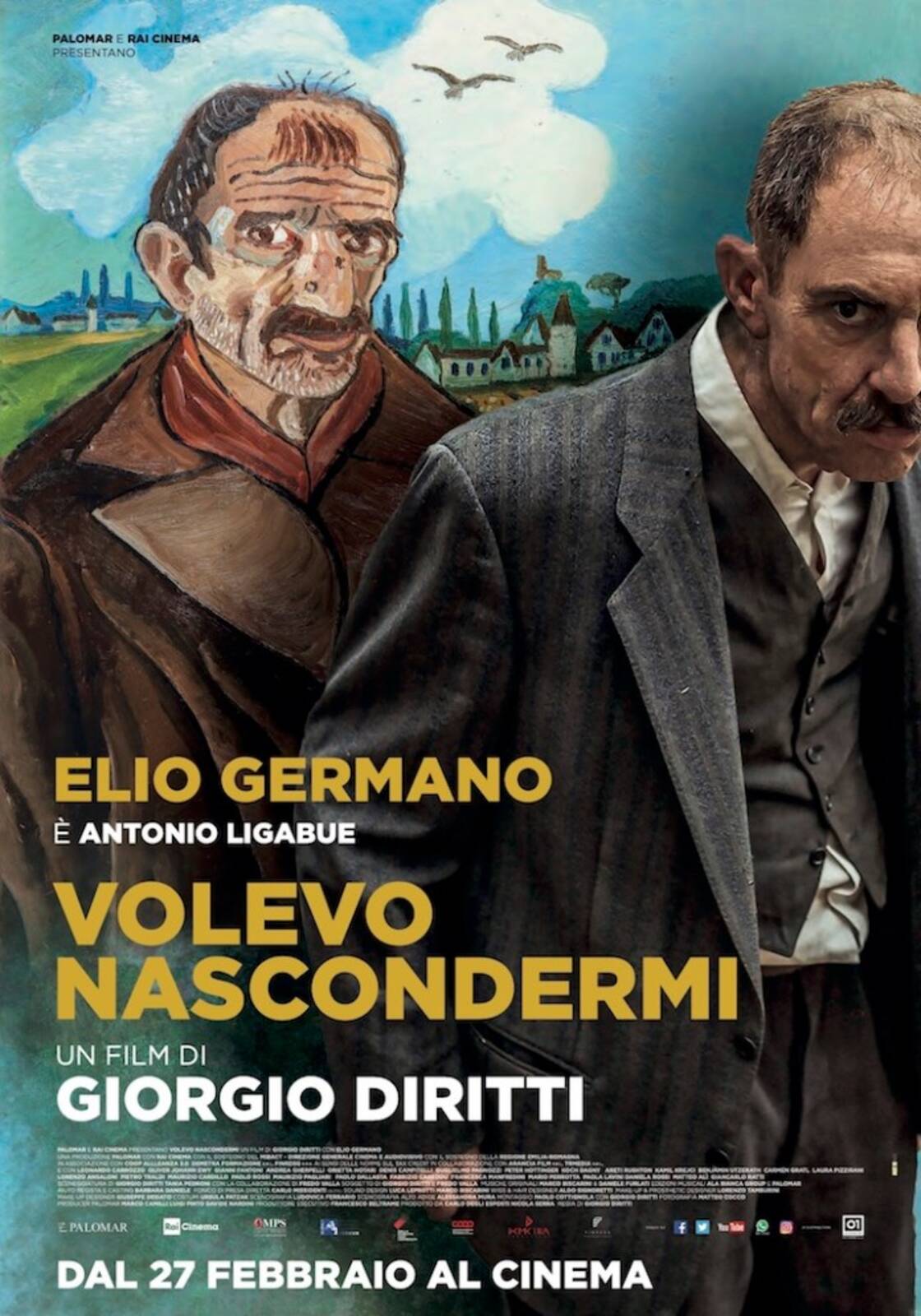
If you have never heard the name Antonio Ligabue, you are not alone. Despite being an incredibly gifted artist whose talents seemingly knew no bounds, his life was notoriously plagued with personal problems, with his physical ailments preventing him from leading a functional life in pre-war Italy, and his mental disorders being the cause of a lot of mockery and rejection, leading him to live a very reclusive existence, hidden away from a world that seemed intent on making him feel like he didn’t belong in proper society. Ligabue is the subject of Hidden Away (Italian: Volevo nascondermi), the beautiful biographical account of the painter’s life, written and directed by Giorgio Diritti, who weaves together a gorgeous narrative centring on the trials and tribulations that Ligabue experienced throughout his life, spanning the first half of the twentieth century.This film is a remarkable achievement – a work of art in itself, Diritti immerses the audience into the world of one of the most fascinating artistic figures of his era, a man whose creativity was more than enough to make his story historically resonant, but whose long life of suffering and despair caused him to become an almost folkloric figure, whose most significant contribution to artistic history is found in his rejection from society, all due to a series of illnesses that prevented him from leading a normal life, and which ultimately resulted in his unfortunate desire to walk away from whatever ragged version of society he was accepted into, and hiding away in the obscurity many wished he would return to. A work of unimpeachable, heartfelt brilliance, and driven by one of the most impressive performances of the year, Hidden Away is a staggering achievement, the kind of cinematic biography of an artist that stands as an impressive work on its own terms, and warrants every bit of acclaim, not only for its creativity, but for the soulfulness residing squarely at the core, making it far more complex than we could possibly imagine based on a cursory glance.
Any discussion about Ligabue has to start with a reference to the fact that, from his birth, he was out of place. He was born of Italian heritage, but was raised in Switzerland – and due to his abnormalities, he was the subject of constant ridicule earlier in life, to the point where neither of his home countries wanted to accept him as their own. Instead, he was constantly caught between worlds. This is reflected consistently throughout Hidden Away, with the filmmaking being as jagged and erratic as its subject – it is non-linear, jumps from one decade to another and back without any real sense of direction, and doesn’t always give us all the answers that we seek. However, this was all clearly a conscious decision on the part of Diritti, who made sure that every frame of this film reflected the inner state of its protagonist, being bold and filled to the brim with melancholy that keeps us captivated, provoking thought in a way that only something produced by an artist with a sincere respect for the subject matter could’ve done. Hidden Away is not an easy film by any means – it’s challenging in both form and content, the style of the film being quite unconventional, and the portrayal of the main character and his situation being beyond harrowing. Yet, we can’t resist nestling into the warmer recesses of the film, since it exudes a kind of pleasant warmth in between sequences of suffering. We’re given unrestrained access to the life and times of Ligabue, his every action put on display for us, but in a way that is undeniably respectful, and paying tribute to a man who was misunderstood throughout his entire life. Prior to this film’s production, Ligabue was seen as just a minor representation in the school of Naïve art, an outsider to the world whose work was pedestrian in style, but supplemented by his personal problems that made him a firm constituent of the often vulgar sub-genre of outsider art. If there was anything Diritti and his cohorts were intent on doing with this film, it would be extracting the legacy of Ligabue from the shadows, and telling his story with respect and the vigorous honesty it deserved.
Diritti crafts an exceptional film, but the person that deserves the most kudos for bringing Ligabue’s legacy to life has to be Elio Germano, who turns in one of the most impressive performances of the past decade. This isn’t so much a portrayal of the artist as it is an unhinged transformation – with the use of subtle but extremely clever prosthetics, Germano turns himself into Ligabue, changing his posture and expressions to fit in with what we know of the artist, and committing himself entirely to the pursuit of the character and the challenges that defined his life. This is a truly staggering performance, and even moving beyond the physical aspect, the very nature of what Germano was doing on this journey to interpret the various trials and tribulations of the artist stands to be amongst the most compelling of recent years. The sign of a great performance is one that compels us to never want to look away – and Germano holds out attention like very few actors have been able to, mesmerizing us with his unforgettable portrayal of a man who may have had a multitude of problems, but who still had a strong sense of individuality. Ligabue was a man often defined by his imperfections, and the film doesn’t ever deviate from showcasing them in the most vivid detail – it just knows how to draw the line between harrowing honesty and outright exploitation, and whether it’s the director setting these boundaries, or Germano ensuring that his entire performance comes across as thoroughly authentic, this is one of the most fascinating and heartwrenching examples of a tortured life put on screen in years. It’s an astounding glimpse into the life of a significant artistic figure, as filtered through the stunning gaze of a gifted actor who had a clear sense of where he wanted to take the character, and a director with the skilfulness to harness this raw, unrestrained energy that Germano was providing, and moulding it into an unforgettable, meaningful demonstration of the human condition.
Like the artist’s life, Hidden Away is filled with sadness and hardship, which is keenly reflected in every moment we’re witnessing Ligabue’s daily challenges. However, it’s impossible to perceive this film as anything less than compassionate, since Diritti is so intent on giving a thorough and meaningful account of the artist’s life, he submerges himself into the perspective of the character, and never once presents his story as one ripe for exploitation, which is quite a rare occurrence, even by modern standards, since the film industry has a tendency to go too far when dealing with the mental and physical sufferings of certain individuals, almost to the point of parody. This is a work built from a solid foundation of nothing but ardent admiration and love for Ligabue – everyone involved clearly has undying respect for the artist, and while they don’t ever neglect to show the more negative aspects of his character (as we see throughout the film, he did tend to have quite a sinister streak), the general intentions of this film was clearly to provide a clear and concise picture of who Ligabue was, and the various avenues he traversed throughout his life, whether physical, psychological or artistic. He lived a challenging life, and nearly every moment was populated by some kind of anguish – whether it be his physical and mental challenges that prevented him from leading a normal life, or the social stigma associated with his ailments, he was not someone who was readily accepted into society. The film does very well to make us feel nothing but empathy for Ligabue, who proves that the fiercest heroism doesn’t always come in the form we’d expect, since even the most physically meagre and psychologically challenged individuals are capable of showing the best of humanity when we pay attention to their stories, rather than the peripheral details of their lives.
For Antonio Ligabue, the entire world was his canvas, and he made sure that, regardless of the challenges he faced, that he had a paintbrush in his hand, until he literally could not function anymore, ensuring that every moment of his life was reflected in his art. He may not have been the most gifted painter in comparison to some of his contemporaries, but his art had a sense of soulfulness that hinted at unprecedented depths within the artist, whose desire to hide from the world came from many years of suffering, both at the hands of his own ailments and through the rejection he felt by a society that shunned absolutely anything that they felt went against the status quo, even if it was simply a young man trying to make his way through a hostile world. This is keenly reflected throughout the entirety of Hidden Away, a film that manages to be incredibly compassionate without becoming saccharine, turning into an exceptional piece of art in itself. On a creative level, this film is absolutely magnificent – the director’s assured vision, coupled with the stunning cinematography by Matteo Cocco, allows the film to appear like a painting in several instances, with some of the shots being works of unimpeachable beauty all on their own. In terms of the narrative, Hidden Away pays sufficient tribute to the life of its subject, never being too heavy-handed about his struggles, but also not neglecting to build a relationship between the protagonist and the audience. We feel as if we’re accompanying Ligabue on this journey, watching him relay his experiences to us in incredible detail, and showing us the various paths he took throughout his life, some of them perilous, others bringing him a sense of satisfaction. Hidden Away is an incredibly sad film, since it never deviates from showing us the harsh realities the artist experienced throughout his life – but beneath the distress and pain, there’s a sense of hope, with the film not only being a fascinating account of Ligabue’s life, but a steadfast celebration of artistic expression, which has been proven to be far more than just putting paint on a canvas, but also a way of liberating someone from the shackles of their life, and allowing them to tell their story on their own terms, setting it down for future generations to see the world through the beautiful and unconventional gaze of a truly inspiring artist, and someone who has earned not only his place in history, but our undying respect and admiration.
 The Postmodern Pelican