
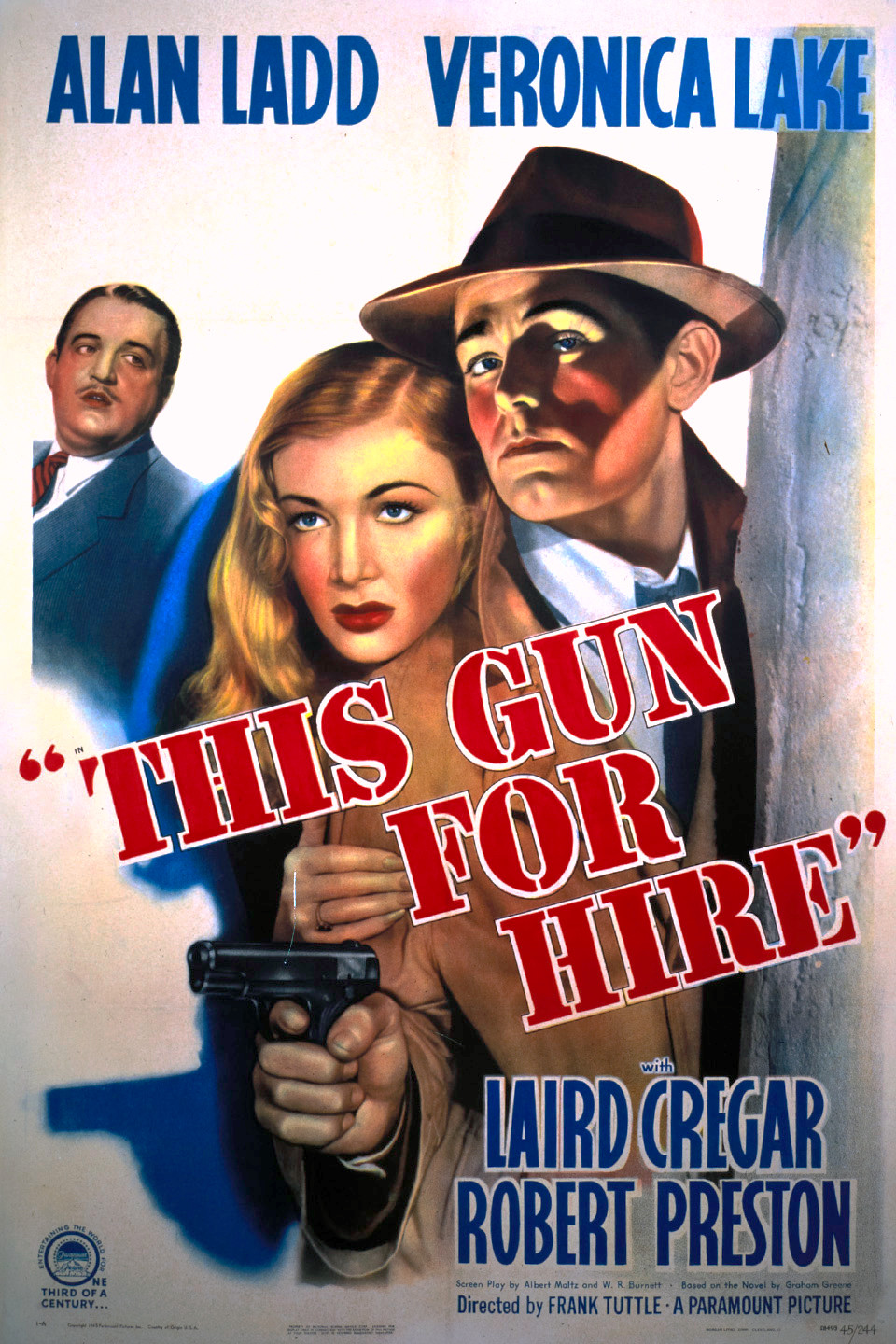
This Gun for Hire isn’t a particularly great film, but it certainly knows exactly what it needs to be. As a film noir, it is relatively conventional – a solid thriller with an abundance of twists and turns, and a bunch of charismatic individuals peppered throughout it. Frank Tuttle did well in adapting the novel by Graham Greene, bringing the author’s notoriously labyrinthine style to the screen in such a way that it decoded the complexities, while still offering the audience a relatively entertaining experience. However, for those who are agnostic to the genre, or perhaps seek out films noir that are less conventional, This Gun for Hire may be something of a chore. Rather than being poorly-made or unconvincing, this is a film hopelessly bound by its traditions, while still somehow being aware of the possibilities that are well within its reach. Produced during the peak of the genre’s popularity, but just before it became a fashionable to subvert expectations in the process of telling such stories, Tuttle struggles to rise above some needlessly convoluted storytelling, which is neither the fault of him as a director, or Albert Maltz and W.R. Burnett in their capacity as the screenwriters tasked with turning Greene’s pulp fiction novel into a film, which is not an enviable task, since many of these crime fiction writers tended to use the medium to spin some bewildering stories that don’t translate to film particularly well (and when they do, they can be seen as defiant to logic, as in the case of The Big Sleep, the gold-standard for the genre). The result is a film that’ll likely be very endearing to those who adore the genre, passable to those who are ambivalent, and impenetrable for anyone who may not see the appeal. However, for all the flaws embedded in its fabric, This Gun for Hire is still relatively entertaining, and does exactly what it needs to do, even when the viewer has to strain to make sense of some of the content that could’ve been otherwise clarified with only slightly more effort.
If we have to indicate one major problem with This Gun for Hire, it’s that it adheres too closely to the rules, to the point where it becomes somewhat uninteresting. To its credit, this was a film not actively avoiding originality, and actually does seem interested in trying to extend itself beyond the confines of the genre. Greene’s novel is a worthwhile piece of crime fiction, but it isn’t something that easily works on screen, especially with as pedestrian an execution as it got. This film is one that should’ve been made at least a decade later, when we saw a rise in films noir that ventured outside the restrictive boundaries, and could be much more experimental. This Gun for Hire contains a premise that is practically begging for a more assured directorial vision – had this occurred at the same time as a similarly themed film like Kiss Me Deadly, which contained a nearly identical subplot centred around nuclear warfare, there’s very little doubt that this film could’ve used the heightening tensions of the Cold War and the threat of nuclear warfare to its benefit. At the time of its creation, This Gun for Hire was only served by the backdrop of the Second World War, and while this was still a harrowing world event, it didn’t bring with it the paranoia and intrigue that later films would. Perhaps it’s not a particularly valid criticism to say that a film being made at the wrong time was a hindrance (since no one could anticipate what was to come), but looking back, it’s easy to see where this particular story could’ve been improved, especially in how it handles some of the trickier social and political commentary, which is essentially ill-served in how it doesn’t seem to have been nearly developed enough to make much of an impression, becoming more of a footnote to an otherwise conventional film.
This Gun for Hire contains some radical ideas that are stifled by the execution – but they’re still present, and can make for oddly captivating viewing if we focus on them. One of the most compelling components of the film is the performance given by Veronica Lake, who was already having a remarkable year with the release of her star-making turn in I Married a Witch. In this film, she’s turning in a very strong performance, especially since she’s subverting expectations in her capacity as the femme fatale of the story – she’s neither broody nor overly seductive, and is developed beyond simply being a mere archetype. She’s complex, captivating and grabs our attention from the first moment she appears on screen – Lake was such a gifted actress, using her historically resonant beauty as a booster for some fascinating performances, rather than having it define her as an actress. Robert Preston is also very good as the moralistic detective, avoiding the same characterization of the tortured, immoral private investigator that we mostly get from these films, and actually showcasing a real sense of awareness to the strong principles we expect from a detective (the tendency for films noir to focus on individuals who sacrifice their ethics for the “greater good” is peculiar, but still very interesting). Alan Ladd, in his breakthrough performance, ats as the de facto lead, the criminal with a soul, while Laird Cregaris the main villain, a robust and cheerful antagonist with a penchant for manipulation (and his promising career was cut short only two years later, a true shame considering how much potential he showed). There are many flaws in This Gun for Hire, but none of them are found in these characters, since they are all fascinating and well-developed, far more than the film around them. They deserved to be in a better-executed version of this story, rather than bound to the middling, frantic execution that we were subjected to.
However, as critical as this all may be, This Gun for Hire is somewhat decent, only lacking in the areas that would elevate it beyond being a simple, conventional film noir. It adheres too closely to traditions, and struggles to find its voice in the process – attempting to layer on components of romantic comedy and melodrama into an already complex story only served to dilute the impact even further, leading to an unstable and inconsistent tone that didn’t work out all that well. There’s certainly a lot of very interesting material embedded in the story, and it is constantly trying to burst out, being kept contained by the insistence on playing by the rules. Had this film been allowed to flourish into the strange, unconventional thriller it could’ve been, it’s likely that it would be a much more significant entry into the genre. It takes some knowledge of film noir to fully appreciate where this differs from other films in the genre, because a surface-level reading doesn’t return anything particularly noteworthy. This may be a merit for those who are accustomed to the genre, but for more casual viewers, or those who may be well-aware of the intricacies of such stories but yearn for something more original, This Gun for Hire isn’t the most exciting project. It’s a worthwhile effort for those seeking out a reliable crime film (and at only 81 minutes, it’s a breeze to get through), but it doesn’t break any new ground, and stands as being merely competent, which is only made worse by the fact that it could’ve been so much better, especially since it clearly had the potential to be a rousing success, but settled for being merely adequate.
 The Postmodern Pelican