
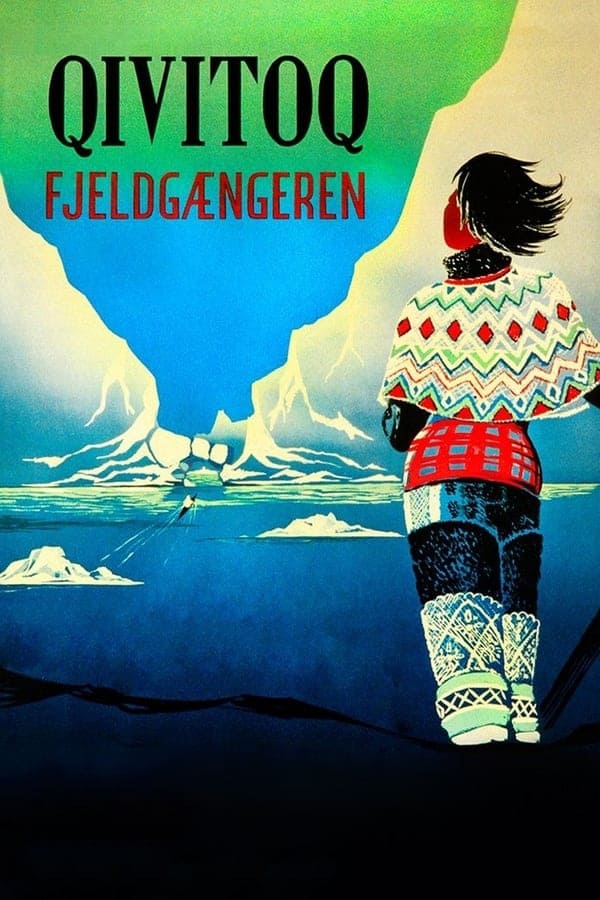
Cinema affords every viewer the opportunity to be both a time-traveller and a world explorer, giving us the chance to see different cultures through the lens of many notable artists from around the world. The process of experiencing something we have never seen before is incredible, especially when the film surrounding it is so strong. This is the case for Qivitoq – Fjeldgængeren, a groundbreaking collaboration between Denmark and Greenland, and one of the finest works of fiction produced during this era. A stunningly beautiful romantic drama that takes us on an unforgettable journey into the villages and fjords of Greenland, the film is truly an astonishing achievement, and the kind of underrated gem that doesn’t grow to be particularly well-known, but rather one stumbles upon almost by accident, and transported into a hidden world that we may have not realized existed, but are still thoroughly enthralled to be included. However, as wonderful as it is to discover this film, Qivitoq isn’t one that deserves to be kept secret, and warrants widespread praise, since director Erik Balling produced one of the most memorable dramas to come out of this period, one filled with charm and heartwarming comedy, as well as a soaringly romantic story of two people trying to make a meaningful connection in a time and place that doesn’t quite appreciate who they are, or what they stand for. In no uncertain terms, Qivitoq is a masterwork of Scandinavian cinema that deserves to rise from relative obscurity and find its way into the hearts and minds of the global audience, who will certainly be enthralled by the stunning story of hope contained within this quaint but meaningful drama.
Pinpointing this film to a particular region is difficult, since it takes on the qualities of both nations that served as its foundation, blending Danish and Greenlandic cultural practices into a single story of overcoming adversity. Balling finds the beauty in absolutely every moment, both emotionally and visually, and each frame of Qivitoq is brimming with nothing but the most exquisite filmmaking imaginable. Had it not been made clear beforehand that this film was made in 1956, you’d struggle to believe that it was produced half a century ago – the filmmaking is just impeccable, and the work Balling does (along with cinematographer Poul Pedersen) in capturing the splendour of the natural world is just unprecedented. It has a very simple visual approach – it is never striving to be the most gorgeous portrayal of rural Greenland, but rather one that realizes that it is taking place in a beautiful corner of our planet, and is putting in the effort to bask in the beauty around it. There is an argument to be made that one of the primary intentions of this film was to promote the two countries and provide them with the exposure to the rest of the world, since they had not been able to achieve the same level of attention as other European locations – but rather than being a result of ulterior motives, this side of the film only adds to the overall effect, since every moment is filled with a sincerity, since Qivitoq is clearly made by artists who genuinely loved these cultures, and wanted the world to encounter them, even if only through the guise of a film. It gives the film an intimacy that can only come from those who have a personal connection to the material, and the willingness to work through all the obstacles to present their vision as vividly and honestly as possible.
What propels Qivitoq forward isn’t only the filmmaking, but rather the underlying humanity. This is a profoundly moving film that can best be described as reality purely condensed into two unforgettable hours. Realism is difficult to fully represent on film, since there is always a tendency to veer towards the profoundly cinematic – when you have the resources, it’s tempting to just surrender to the medium and heighten reality in a way that is entertaining. Despite the incredibly beautiful visual palette he was working with, Balling is more focused on telling a very human story, focusing on the lives of two profoundly lonely people who find each other by accident, and realize that there is a connection between them that both have been craving all their lives, and which their previous relationships (professional or personal) never seemed to satisfy. The subtitle of the film, “fjeldgængeren”, roughly translates to “the mountain wanderer”, and is used to refer to the wayward spirit of someone who has become disillusioned with life, so they venture into the wilderness to become a “qivitoq” (which is explained in a striking scene towards the middle of the film, one of many unforgettable moments that give us insight into the culture), and the film does exceptionally well in blurring together reality with folklore, sampling from both in effective and meaningful ways, showing that a firm understanding of both can allow us to have hauntingly powerful encounters with the customs many of us may not have been aware of. Beneath all of this is just an incredibly poignant love story through which some wonderfully fascinating cultural and social details are channelled, making Qivitoq an undeniably multilayered film.
In the process of making a simple love story set to the icy backdrops of the Greenlandic wilderness, Balling inadvertently did something even more compelling – he captured the intricacies of a culture in extraordinary detail. Qivitoq isn’t only a wonderful romantic drama, but an active text in which Greenland in the 1950s has been preserved. We may be suitably enamoured with the central premise, but what makes this film all the more endearing is how it handles its portrayal of the people who populate it. We’re transported back in time, to a simpler era that is built on community values and a more straightforward of life, which is not something that has been entirely lost (so to imply that this film captures a dying culture is wrong, since there still are many people around the world that lead these lives, they’re just not ever in the spotlight), but rather exists outside of the worldwide consciousness. The fact that we have such a thoroughly captivating documentation of their culture, especially one in which the narrative is often guided by the natives themselves through the demonstration of their oral traditions and various artistic practices, is only more reason to celebrate Qivitoq as more than just a simple drama about people falling in love. We may be allured to the promise of a melodrama set on the fjords, but what keeps us captivated is how Balling and everyone involved portrays the intricacies of the culture, and gives the people the respect they deserve, while still spreading their history far and wide, where the homes we see are actually inhabited by natives, the words we hear spoken in the genuine languages (which is often a rare occurrence when looking at films that focus on under-represented cultural groups), and the stories derived from centuries of traditions.
Qivitoq is a work of undying humanity, and the experience of seeing the impeccable work Balling and his collaborators did to bring this story to life is extraordinary. This is a clear labour of love, and every moment of this wonderful film exudes nothing but passion and forthright dedication. There is such an immense sincerity to this film that simply can’t be the product of anything other than a genuine love for a place and its people – and throughout the film, we are given unforgettable insights into the everyday life of ordinary people, who are living on the margins of society, but happily within their own cultural niche, which the film documents beautifully. Filmed stunningly, and written with a poeticism that is incredibly rare, Qivitoq is extraordinary. It can veer towards being somewhat banal at certain moments, but instead of being a weakness, these deviations into the more simple sides of life contribute a sense of authenticity that punctuates a beautifully melodramatic love story. The narrative itself may be slightly predictable, and we can easily figure out where it is heading – but this doesn’t make the emotional resonance of the film any less powerful, and instead helps us see the various creative ways Balling carefully curates this genre and produces something quite spectacular without needing to be excessive. Simple but effective, and truly magnificent in scope, Qivitoq is a true gem of a film, and one that deserves to be seen by contemporary audiences, who will likely be just as enamoured with this film as viewers were when it was initially produced all those years ago, meaning that it has only gotten better with age.
 The Postmodern Pelican