
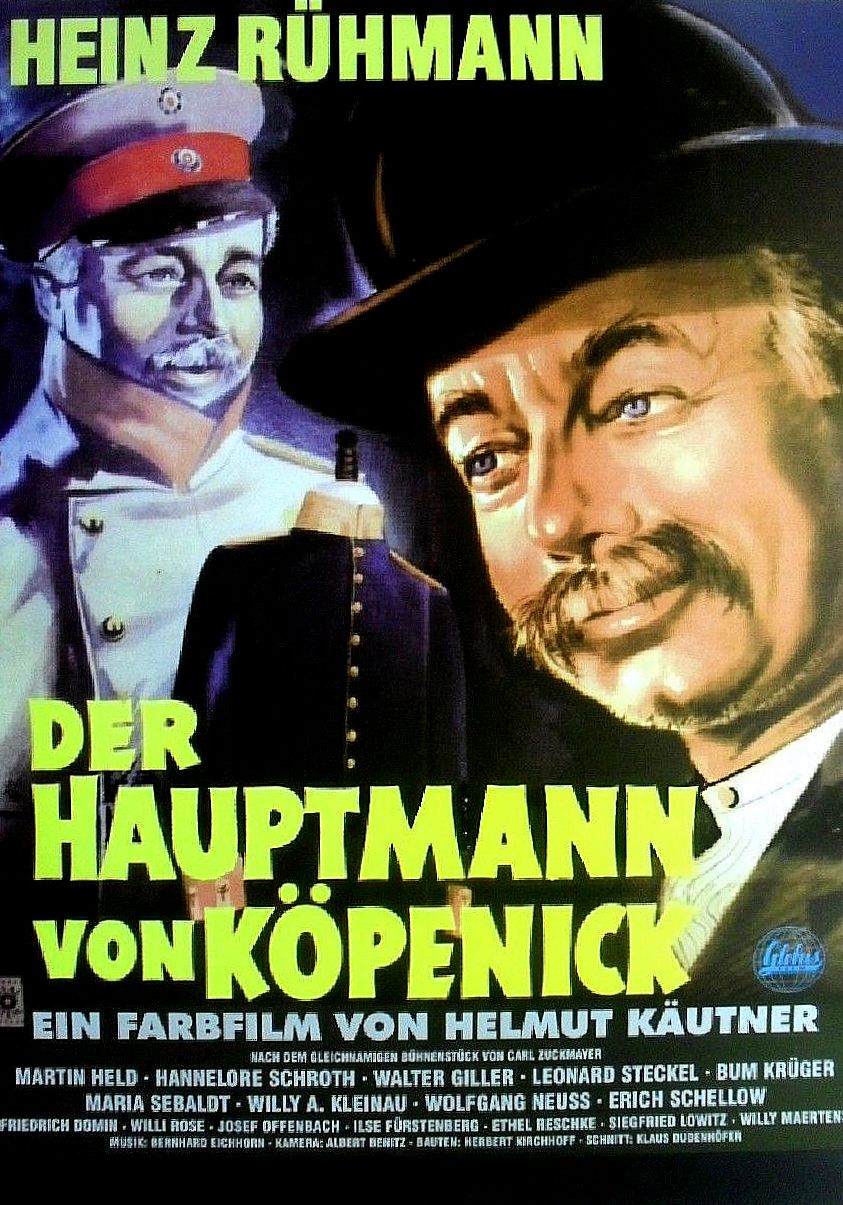
We’ve seen many works of fiction that present us with the most unconventional protagonists – vile and malicious career criminals that are portrayed in a slightly more positive light, their reputations almost being entirely repurposed to be vaguely heroic. One of the more captivating examples of this comes in The Captain from Köpenick (German: Der Hauptmann von Köpenick), the hilarious comedy by Helmut Käutner, who directs a masterful account of the life and times of Wilhelm Voigt, a man in turn-of-the-century Germany (back then, referred to as Prussia) who made a living from breaking the law. Some of it was his fault, some of it wasn’t – but what he is most known for, other than being a regular occupant of any of his nation’s prisons, is his final heist, whereby he bought a stolen military officer’s suit, and marched with a small army of troops to the town of Köpenick, where he managed to swindle the authorities of a huge amount of money, with no one being any the wiser. It’s a common joke that if you want to be taken seriously, just walk around with a clipboard – Voight took this a step further and proved that a clean uniform and a strong sense of conviction is more than enough to qualify someone to take control – and if it’s not a cautionary tale, its at least the kind of irreverent, true-life comedy that proves that reality is often stranger than fiction. Beautifully-made, and written with a precision that both pays tribute to this iconic figure in German lore, and introduces viewers who may not be aware to this incredible true story, and gives us the chance to see it represented on screen in a way that is both entertaining and insightful, which is a quality that all works based on reality should strive to be.
The Captain from Köpenick is a film that could’ve gone any number of ways, particularly through the fact that it is rooted in reality. The story of Wilhelm Voight is one that is quite depressing, if we look beyond his tendency to cause trouble (and how this film, and the play from which it is adapted, focus more on presenting him as some unconventional hero). A penniless shoemaker who had to resort to petty crime in order to survive, but was frequently caught and sent away to prison for his transgressions, is not a particularly amusing premise. However, his story is formed into a delightfully offbeat comedy that finds the humour in the situation, and gives a platform to one of the most fascinating civilians in German history. The writer of the original stage production, Carl Zuckmayer, did remarkably well in creating a version of this story that doesn’t neglect the realities of Voight’s life, but rather presents it in a way that is entertaining and meaningful at the very least. Dividing the focus between Voight himself and the suit that he would come to own (to the point where the latter takes on the status of being a character in its own right, playing as integral a role in the development of the plot as the individuals who wear it throughout the story) was a smart decision, as was choosing to relay these events through a comedy-of-errors, where the majority of the humour is broad and visual, but punctuated by sharp satirical jabs that only serve to supplement the story and lend it more depth. It’s a masterful combination of tone, atmosphere and intention, which all come together beautifully throughout the film, which is oddly more captivating than a more serious version of the story would have been in the hands of someone who didn’t realize the comedic value that underpinned Voight’s life and activities.
If we look beneath the upbeat humour of The Captain from Köpenick, and instead focus on the intricacies of the story, we see that the film portrays a very disconcerting image of Germany at this point in its history. Europe was still a few years away from the start of the First World War, and the nation was relatively peaceful under the power of its leaders, to the point where everyone was conditioned to simply follow authority, even if it means going against our better judgment. Partially a cautionary tale about questioning what we are taught to blindly obey, the film understands the value of conveying a deeper message without becoming too heavyhanded about it. Unfortunately, Käutner was someone whose career was at its peak during the peak of Nazi ideology, so his work is indelibly tainted by his association with the kind of brutally oppressive system he is critiquing here. However, it doesn’t mean that it invalidates the message of this film, which is less concerned with attacking one side or the other, but functioning as a rallying call for logic and reason, which is something far too many politically-minded films seem to forget. The director has a masterful control of form and content, and uses his platform extremely well in order to adapt a cherished play, which feels oddly authentic under his direction, rather than just a cheaply-made stage-to-screen adaptation. There is meaning behind every choice made in this film, which enriches the experience of seeing this fascinating true story reflected on screen – and whether it’s our first encounter with Voight’s story, or just another version in our understanding of his mischievous antics, there is immense value in what the director is doing with this captivating tale that manages to be both intriguing and riotously funny.
The Captain from Köpenick is a terrific glimpse into European history of the 20th century, especially in terms of pre-war discourse. Too many films that focus on Germany at this time tend to look at the spectre of Nazism and the Weimar Republic, which serve as foundations for nearly all of them, but not always as interesting as they would lead you to believe in a lot of cases. This film gives insights into the machinations of the era in which the Kingdom of Prussia was one of the most dominant global forces, a fact that has been obscured in more recent historical analyses that offer general insights into the history of the continent. However, the film very cleverly refuses to get too wrapped up in the discourse surrounding the socio-political machinations of the era, instead being a more relatable story about authority, and the blind obedience that many of us are conditioned towards, which can be both an effective way of maintaining order, but also the cause of decline – encouraging blind compliance with a system can lead to its own downfall, and while The Captain from Köpenick presents these events in a more lighthearted matter, there is some serious gravity to these representations that shouldn’t be ignored. This film is one that uses comedy strategically – primarily, it is hoping to entertain the audience, but it also makes use of humour to uncover some darker commentary on the nature of social order, and how disobedience can sometimes be beneficial to a society that isn’t accustomed to defiance.
Smartly written, beautifully filmed (the recreations of the major towns of Prussia in 1910 was absolutely extraordinary), and shepherded with precision and genuine curiosity by a tremendously gifted filmmaker who is doing some of his most exceptional work here, The Captain from Köpenick is an absolute triumph of a film. It may not appear to be the most serious film at a cursory glance – after all, what is it other than an irreverent comedy that portrays a notorious career criminal as a deeply compelling hero that we feel nothing but sympathy towards? However, there is always something deeper underpinning the film, flowing through it and giving the story a sense of nuance that would otherwise be missing in more straightforward representations of history, where the focus is less on the human level, and more on providing a sweeping overview of a place and the people who populate it. Käutner finds the perfect balance, and manages to get away with making a rousing call-to-arms that promotes defiance, albeit only in cases where it is both necessary and harmless. Channelling this message through an exuberant comedy about someone stealing to survive may not appear to be the most positive message, but through giving the audience the benefit of the doubt and the credibility to actually extract the underlying meaning from the overall story, the film manages to be incredibly effective. Not as well-known as it arguably should be, The Captain from Köpenick deserves another assessment, because what it lacks in sophistication it makes up for in forthright audacity, and the clear and concise knowledge that what it is doing is absolutely worthwhile, even if it takes some time to acclimate to it.
 The Postmodern Pelican