
When looking at Cruella, we need to ask a few questions. Was a deep-dive into the younger years of one of literature’s most iconic, sinister villains necessary? Not at all. Did director Craig Gillespie and his cast do the best they could with the material? That one is up for debate, but I personally lean towards the affirmative, with hesitations. No one necessarily asked for this film, but in order to capitalize on the recent spate of insightful attempts to humanize certain characters, it seemed inevitable that we’d reach Cruella De Vil. The film doesn’t feel so much a fully-formed piece of storytelling as it does a two-and-a-half-hour sketch, a vague parody of the exact kind of films that have been the subject of mockery by those who have made the keen observation that Hollywood is becoming so unoriginal, it is almost collapsing onto its own foundation – The Walt Disney Company has been the subject of a great deal of disdain for remaking their own productions, thus making even more money with very little effort towards originality – and now trying to not only retell these already cherished stories, but also to shed light on the trials and tribulations of some of its most malicious antagonists. However, for what it’s worth, Cruella is a fun time at the movies, and very little else. Perhaps the wrong director was chosen to helm the film (had Disney opted to hire someone with a bit more visual panache, the film might’ve worked better), and the story couldn’t been tightened a bit, but for all of its problems, there is a charm to this film that makes it very entertaining, if only for the sake of seeing certain components which shine much brighter than the more contrived aspects that serve to dull it from time to time. There are flaws embedded deep within Cruella, some of them absolutely unworthy of any defence – but taken as a whole, the film serves its purpose, which is quite an achievement for a film that not many people were actually clamouring to see produced.
Origin stories of beloved works can be effective when done well – we’ve seen many artists tackle older works, either looking at the events that they believed occurred prior to it (consider Jean Rhys’ absolutely exceptional prequel to Jane Eyre, the marvellous Wide Sargasso Sea, or the many resonant attempts to give nuance to certain aspects of older works of fiction), or focusing on a smaller or supporting character, showing their backstory. We’ve seen instances of this done to villains many times before, and while they’re rarely all that impressive – after all, these characters are constructed to be forces of evil, not people that we necessarily want to sympathize with – they do manage to be quite interesting on occasion. Cruella fits into this format very well – as far as anyone is concerned, the two adaptations of Dodie Smith’s The One Hundred and One Dalmatians were quite remarkable in how they portrayed the infamous, bloodthirsty fashionista – the merciless, spoiled embodiment of pure evil, with a wicked laugh and a glimmer of pure malice in her beady eyes. There’s a reason why Cruella De Vil remains one of the most effective villains in all of literature – she was just allowed to simmer in her evil ambitions, and receiving her well-deserved comeuppance by the end of it. Cruella tries to look behind the curtain and offer something else, a new glimpse into the past of this malicious woman, and an attempt to humanize her, embodying the cliched concept that “she’s not evil, she’s just misunderstood”, which is as hackneyed as it is unnecessary. The impetus of this film is its biggest problem – it feels like someone had a wayward idea, and it just flourished into a film that just didn’t need to be made. However, hammering in the point serves very little purpose, and it does distract from the fact that, while not particularly worthwhile, Cruella is still a rather entertaining film, one that demands very little from the viewer, and gives us a lot more than we may have bargained for. It’s far from a masterwork, but it does what it needed to do, which is enough to justify its existence, even if that’s still somewhat questionable.
There are two reasons to watch Cruella, and they’re unsurprisingly both named Emma. If there is something that this film does right, it’s utilizing two of the most interesting performers working today, giving them roles worthy of their talents. Emma Stone was the absolutely right person to play the role of the younger Cruella (here going by the original name “Estella”), since she has more charisma than nearly every young actress working today, and that vaguely enigmatic streak that makes her such a captivating performer. She’s having fun with the role, which reflects in everything moment she is on screen. This is a performance being given by someone who truly understood the assignment, and she comes dangerously close to eclipsing the middling material she was working with, which is just a firm example of her ability to elevate mediocre material – she certainly doesn’t come close to Glenn Close’s iconic portrayal of the character (which stands as the epitome of purely delightful malice represented on screen). Across from her for much of the film is Dame Emma Thompson, an actress who has ascended to almost god-like status, proving herself to be perfectly capable of conquering all sides of cinema, as well as being a generally brilliant, charming entertainer in general. The role of The Baroness is not a particularly good one – she’s understandably the kind of villain a film like this would concoct, but having the main antagonist of the film essentially be a carbon copy of the later version of Cruella De Vil, seemed incredibly lazy. As good as Thompson may be (and she’s truly the embodiment of glamour in this film), her performance is stifled by the fact that she’s just playing a different version of Cruella, rather than someone unique. This wouldn’t be much of a problem had the entire thesis statement of the film been something other than a misunderstood young woman rebelling against a malicious matriarchal figure, since this is exactly the path Cruella goes down herself, rendering the entire concept of her revenge far too weak.
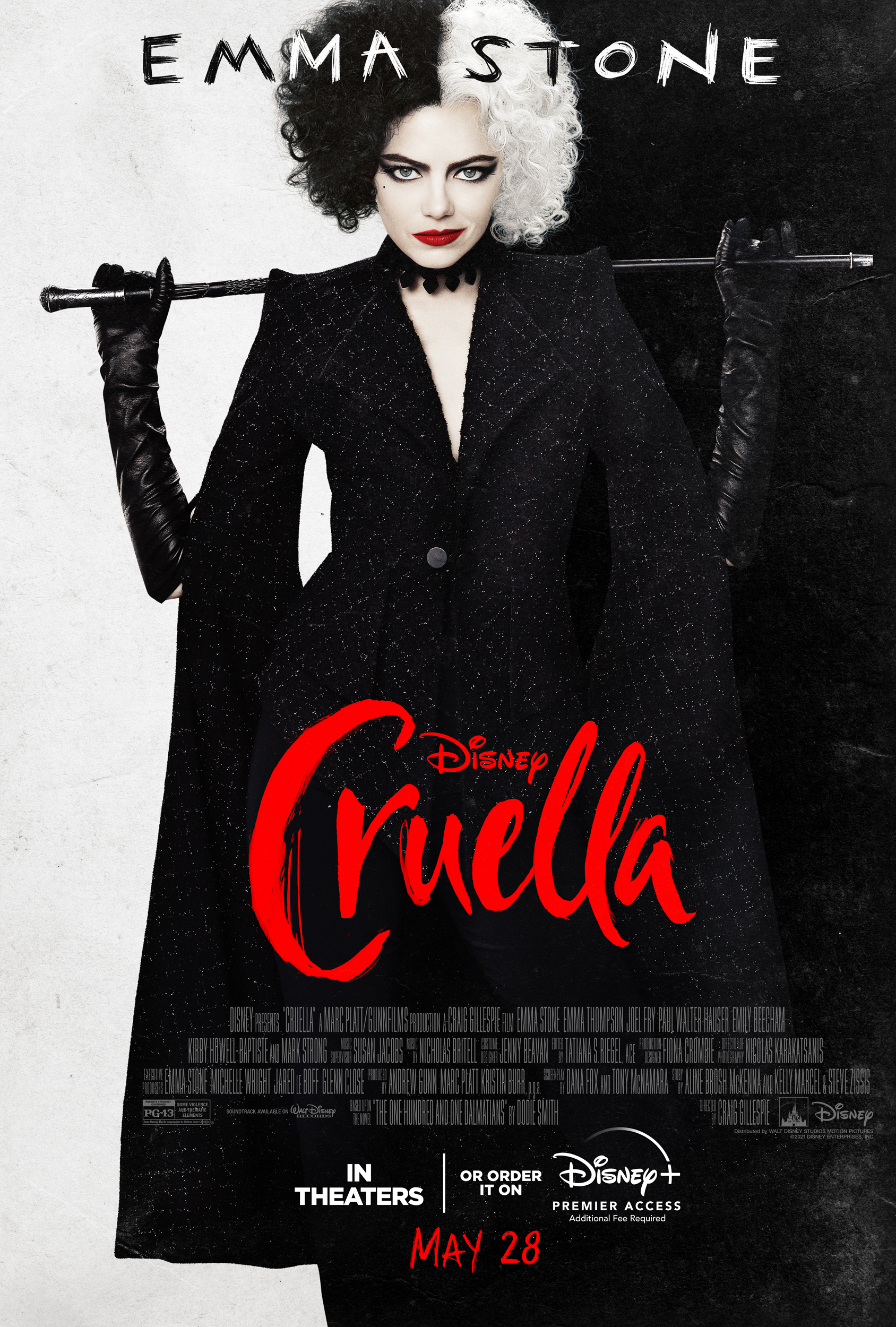
For what it’s worth, Cruella is a very stylish film, which is impressive considering the director. Gillespie is not a bad filmmaker, but rather someone who isn’t necessarily defined by a particularly strong authorial voice, functioning more as a journeyman filmmaker who makes reliable, solid films, rather than artistically-resonant masterworks. However, when working under Disney, it’s clear that the director is merely an accessory to the company’s intentions, and their decision here was to render the origin story of Cruella De Vil as some punk rock-inspired dark comedy, with an abundance of comical crime scenarios and a great deal of rebellion thrown in for good measure. This entails the film doing exactly what it promises – the costumes are absolutely stunning (so much that I wish a more artistically-minded filmmaker had been put in charge of bringing this story to life, since Jenny Beaven’s costumes are so gorgeous, one just wants the camera to linger on them for a few moments more, in order to take in the full effect of this incredible couture), and the actual filmmaking is impeccable – dozens of well-used needle drops are peppered throughout the film, as well as an unforgettable use of Iggy Pop’s “I Wanna Be Your Dog” in a fashion show scene that could rival the one in Federico Fellini’s Roma (the previous gold-standard for incredible uses of fashion in an otherwise dismal film). Ultimately, the moments in which Cruella is most effective are those where it understands what it needs to be, and where it needs to deviate from the previous films – and even though this is really just an attempt to employ some deflated, half-baked Vivienne Westwood fantasy into the world of Disney, it does make for a decent couple of hours when we can surrender to the strange charms of the film, which do momentarily distract from the more unconvincing cliches that occur throughout the story.
Cruella is a fine film, and taken for what it is, it doesn’t seem to be all that bad – it just didn’t manage to ascend to the status of being a fascinating character study of an iconic villain, instead settling for something a lot weaker, but probably more accessible for the target audience. Kudos must be given for the active attempt to do something different here – the film does try its best to make the transition from the scrappy, ambitious young Estella, to the bitter and vitriolic Cruella as natural as possible (and Stone helps a lot, never being afraid to come across as unlikable, which is what made many of her performances in the past so captivating, since she doesn’t mind playing a villain), and this is one of the first times in years that Disney has put conscious thought into making a film that doesn’t pander to children – in fact, there’s an argument to be made that Cruella is targetted at much older audiences, since some of the subject matter is questionable for a children’s film. The question isn’t if this is a good origin story for Cruella De Vil – all things considered, Gillespie and his collaborators did their best with the assignment, with most problems coming from the structural components (there isn’t any good reason for this film to he have been 135 minutes – half an hour at least could’ve easily been shaved off the film). The issue is that this is a very entertaining film at the start, but it reaches its peak far too early, and becomes considerably less fun, which wouldn’t be much of an obstacle had there been a clear purpose to the film as a whole. The resolution is weak – Cruella succeeds, but at the cost of becoming a character that we loved to hate in the past, which invalidates the entire purpose of giving her an origin story. It’s a complex, almost philosophical issue of character motivation that I don’t think quite works out all that well. This film isn’t going to shatter boundaries, and it is clearly targeted at specific groups rather than the general population, but on its own merits, we can easily appreciate the work that went into its creation, and understand that while it may not have been necessary, it at least managed to be captivating, which is more than enough for a film like this, which delivers what it promises, and leaves us entertained enough to consider it a somewhat positive experience. It may be all over the place and have difficulty finding its voice, but it still has a strangely hypnotic charm that makes it a passable effort.
 The Postmodern Pelican
A reported $200 million was widely reported as the cost for this interminable, bloated bore. Don’t bother.