
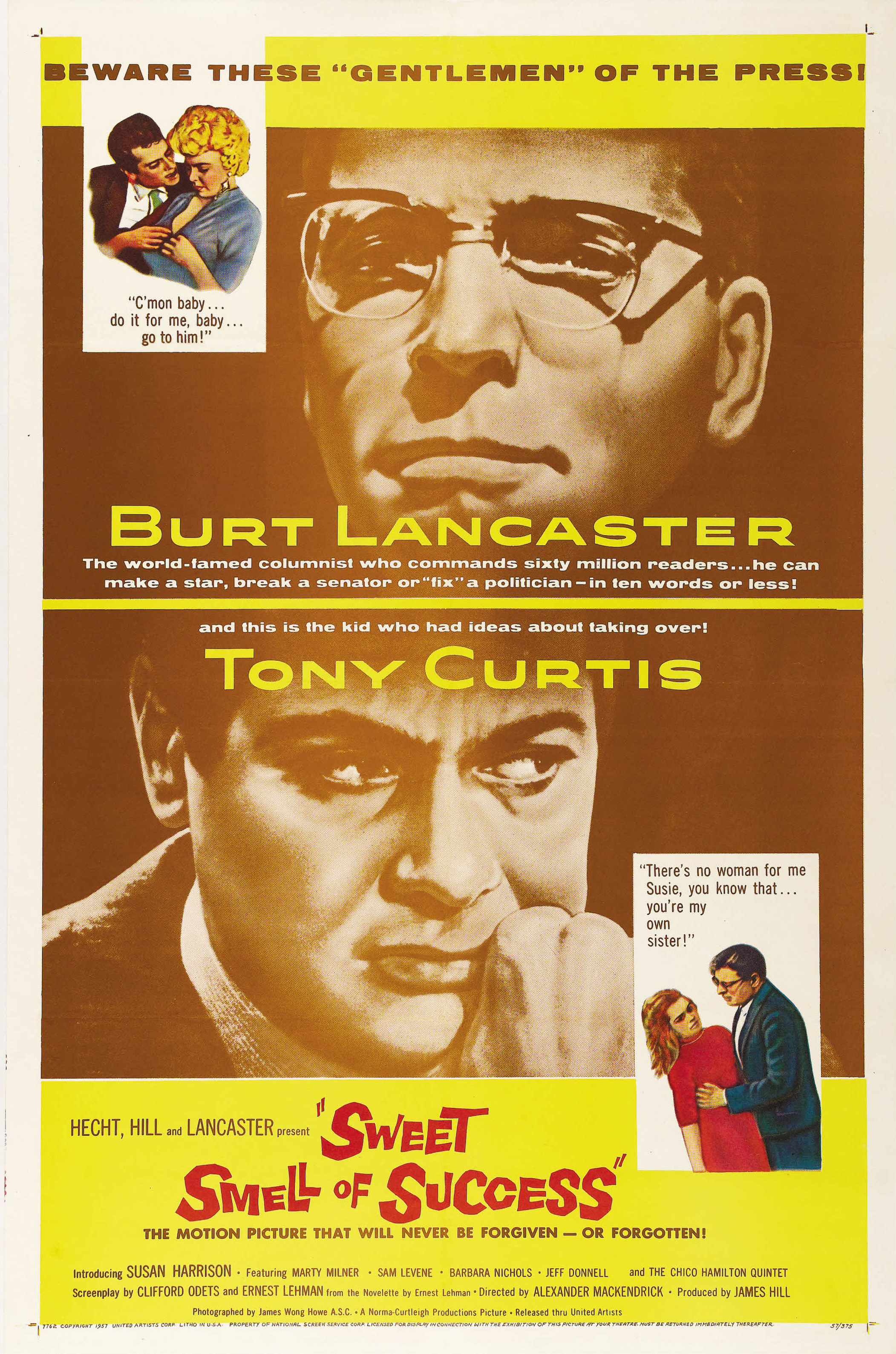
Few films define the 1950s better than Sweet Smell of Success, which is quite bizarre in retrospect, considering how reviled it was at the time. Directed by Alexander Mackendrick (who had mostly found success across the pond with a series of very successful British comedies), the film was considered an enormous failure when it premiered, and only acquired its acclaimed status in the succeeding decades, when audiences finally came around to its brilliance. However, it’s somewhat understandable why this film may not have fared as well as some might’ve expected, since it is the epitome of an artistic work that is way ahead of its time. Produced at a time when viewers were more accustomed to rather traditional stories that have likeable protagonists and a satisfying payoff, Sweet Smell of Success dared to be a grimy, unsettling satirical drama that makes the audience feel just as repulsive as the characters we’re seeing on screen. Yet, with a razor-sharp script (often considered one of the finest in film history, a claim I was increasingly bullish on in the past, but a recent revisiting swayed me towards starting to think the same), and a pair of incredible leading performances by two actors who are playing against type in ways that were entirely unconventional – and perhaps even damaging – for leading men at the time, Sweet Smell of Success is a resounding triumph, and a masterful work that blurs fiction and reality together in ways that are both riveting and profoundly disconcerting, which all add to the deceptive charms of this incredibly complex satire.
Perhaps the most significant obstacle that stood in the way of Sweet Smell of Success becoming an instant classic is how it had the fearlessness to be different and show a side of society that was unsettling for many at the time, and continues to be quite discomforting by even the most progressive standards of the present day. Mackendrick was a fiercely gifted filmmaker who had a remarkable aptitude for , but even his most valiant efforts couldn’t save this film from falling victim to the growing tensions at the time, where anything that dared to criticize the idealistic American way of life was instantly written off as being in poor taste at best, a betrayal to old-fashioned values at worst. If there was ever a film that showed the most hideous side of society without resorting to explicit depictions of violence or bigotry, Sweet Smell of Success has that cornered, and is a difficult act to follow, despite many films in following years trying (and sometimes succeeding) to replicate the bleakly satirical charms of this otherwise twisted dark comedy that dares to show a different side of society, one that is far more prevalent than many of us would like to admit. It exposes the seedy underbelly of a world that has always appeared so alluring – but even through its most significant efforts to show it as something that should not be entertaining, there’s a gritty glamour to this film that never quite abates, regardless of how far it is willing to go to strip this story and its characters of any redeeming qualities, which is perhaps why its stands up as such an unimpeachable classic to the present day.
Certainly one of the reasons Sweet Smell of Success was at least an enticing enough proposal in theory was due to the presence of Tony Curtis and Burt Lancaster in the lead roles. Both of them were defining stars of the 1950s, and usually managed to bring audiences into the theatres in droves, especially when they were playing the dashing heroes they were known to play. However, as many of the viewers would soon discover, neither was doing what they were known for, instead taking on roles that are far more despicable than they would normally play. Curtis is a slimy, sycophantic press agent who will do absolutely anything to get his clients in the newspapers, while Lancaster is an embittered columnist whose influence has incited in him the most absurd delusions of grandeur. The power dynamic between the two leads is incredible, and both of them are doing impeccable work that proves the value of giving actors the chance to step out of their comfort zone and give performances that we’d not normally expect to find coming from them. They prove their mettle as masterful character actors, and gradually unravel into grotesque caricatures of real-life figures that are grounded by the actors’ refusal to play to the rafters, but instead stay well within the confines of the often manipulative but thoroughly captivating narrative that brings out the very best in the two leads. The rest of the ensemble cast falls by the wayside under the might of what Curtis and Lancaster are doing, which is hardly even noticeable in contrast to how the two anti-heroes command the screen and turn in truly impressive performances that rank as some of their very best.
As entertaining as it may be to watch Lancaster and Curtis sparring for a generous 92 minutes, Sweet Smell of Success is much more than just an acidic, dialogue-driven dark comedy, and serves as one of the most cutting satires of its period. Seeing a film that exposed not only an entire industry that was supposedly as trusted and reliable as those who work in publishing news, but also the hypocrisy of those who blindly believe everything they read, is revolutionary even by modern standards. In taking on the screenplay by Clifford Odets and Ernest Lehman (with the latter writing the novella on which the film was based), Mackendrick is venturing into the challenging territory, unravelling the story in such a way that the meaning only becomes more clear the more we’re enraptured in the unsettling charms of a film that seems to exist solely to make us uncomfortable, and cause us to question our own understanding of how we consume information, and the extent to which we trust those supposedly reliable sources. Coming the same year as A Face in the Crowd (another similarly-bleak exploration of the shortcomings of the media, and how it can be an evil entity when given too much power), 1957 was a year that exposed the darker side of consumerist behaviour, showing that giving too much influence to a small group of people can result in a frenzy from which there is very little escape – and before long, this hysteria has caused the entire world to go mad, which is not too far removed from some contemporary events that have shown that clearly, whatever lesson was being conveyed by this film needed to somehow be stronger, since it proves that reality can sometimes be stranger than fiction.
Sweet Smell of Success is a classic, and for good reason – there aren’t many films that manage to capture our attention and cause us to feel the burden of seeing our own behaviour reflected back at us, let alone one that doesn’t have a typically happy ending, or one where there is redemption for the more unlikeable protagonist. The film grows steadily bleaker and upsetting the more we work our way through it – the comedy starts to erode, and the disconcerting message becomes more clear in the process, with the director making sure to evoke a particular kind of nihilism, even in the few moments where there isn’t any dialogue (credit must go to James Wong Howe, whose stunning cinematography anchors the film and gives it a sensation of a film noir, with the use of shadows and lighting indicating the prevalence of secrets governing the lives of these characters). Sweet Smell of Success is a masterful achievement, and a film that has only gotten better with age. It may be impenetrable at first (and the rapid-fire dialogue can be bewildering to viewers at the start), but it gradually becomes more effective once we acclimate to the style, and come to understand the intricate details, which all converge into a masterful exercise that proves that satire doesn’t always need to be funny, but can be profoundly disturbing at times as well.
 The Postmodern Pelican