
The absolute gall that Joel Schumacher had in naming this film Flawless, when it is anything but free of shortcomings, would be frustrating had it not been a work that had a lot of soul to it. I’m very divided on this film – on one hand, it is an overwrought and inconsistent story that doesn’t manage to get a firm grasp on any of the genres it is sampling from. On the other, it’s a film written and directed by an openly gay director who was telling a story that clearly meant something to him, using his status as someone who could wrangle nearly any significant star and convince a major studio to release his work without much effort, due to his reputation as a filmmaker who could bring audiences into theatres in droves, after years of working in some memorable blockbusters. Flawless is a strange film – not necessarily in premise, since it is admirable in how it tackles some very pertinent issues a while before they became more widely found in mainstream art, but rather in how it handles its material on a genre and thematic level, going in many different directions, and trying to remain moving while still having all the qualities of a film that will appeal to a wider audience, not just those that are seeing their lives reflected on screen. Perhaps it is the fact that this is a film that exists in the shadow of The Birdcage, To Wong Foo, Thanks for Everything, Julie Newmar!, and an array of other queer classics, without actually being able to stand out on its own terms due to poor narrative decisions – but the film just falls short far too often, and becomes convoluted, uneven and fails to deliver on the promise of being a work that opens the eyes of those who may not have been particularly interested in this kind of story. A film with its heart in the right place, but its skills lacking, Flawless needed a great deal more work, to the point where not even the shining merits can distract from the messy filmmaking and constant refusal to hold onto every bit of potential it had at the outset.
Flawless isn’t a bad film, but rather a severely disappointing one. Schumacher did seem to be slightly out of his depth here, even though he clearly had some attachment to the stories being represented on screen. A modern libertine with a peculiar joie de vivre, the director was never afraid to express himself creatively and assert his own fascinations with society into even the most mainstream works (how else can we explain the modern camp classics Batman Forever and Batman & Robin, which are near-masterpieces if we look at them as queer-coded texts by a master of artifice and intentional camp?). Flawless is a film that sees the director working at a much smaller scale, crafting an intimate comedy that takes the traditional structure of the odd couple comedy and turns it into a parable of tolerance and acceptance. This is the part of the film that is quite good, and makes for exceptionally compelling viewing, and had it remained solely on this aspect of the story, there’s no doubt that this would’ve been a much better film. The problem comes in the parallel plot (which is far too dominant to be considered even a sub-plot, since it envelopes the film by the end of it), which is a tonal disaster, with Schumacher showing an inability to abandon the studio-curated belief that a film needs to have wall-to-wall action and an abundance of tension, or else audiences will grow weary of seeing characters interacting. This is one of the rare cases where half of a film could’ve easily have been elided and resulted in a considerably improved piece. Ultimately, Flawless is a film that comes across as hopelessly imbalanced – when it hits its target in terms of the touching, interpersonal story between the two main characters, it is wonderful. It’s in the heavy-handed underlying themes where it loses itself completely, and considering the film veered towards prioritizing this side of the story over the aspects that actually worked, it’s hardly surprising that it didn’t succeed in any significant way.
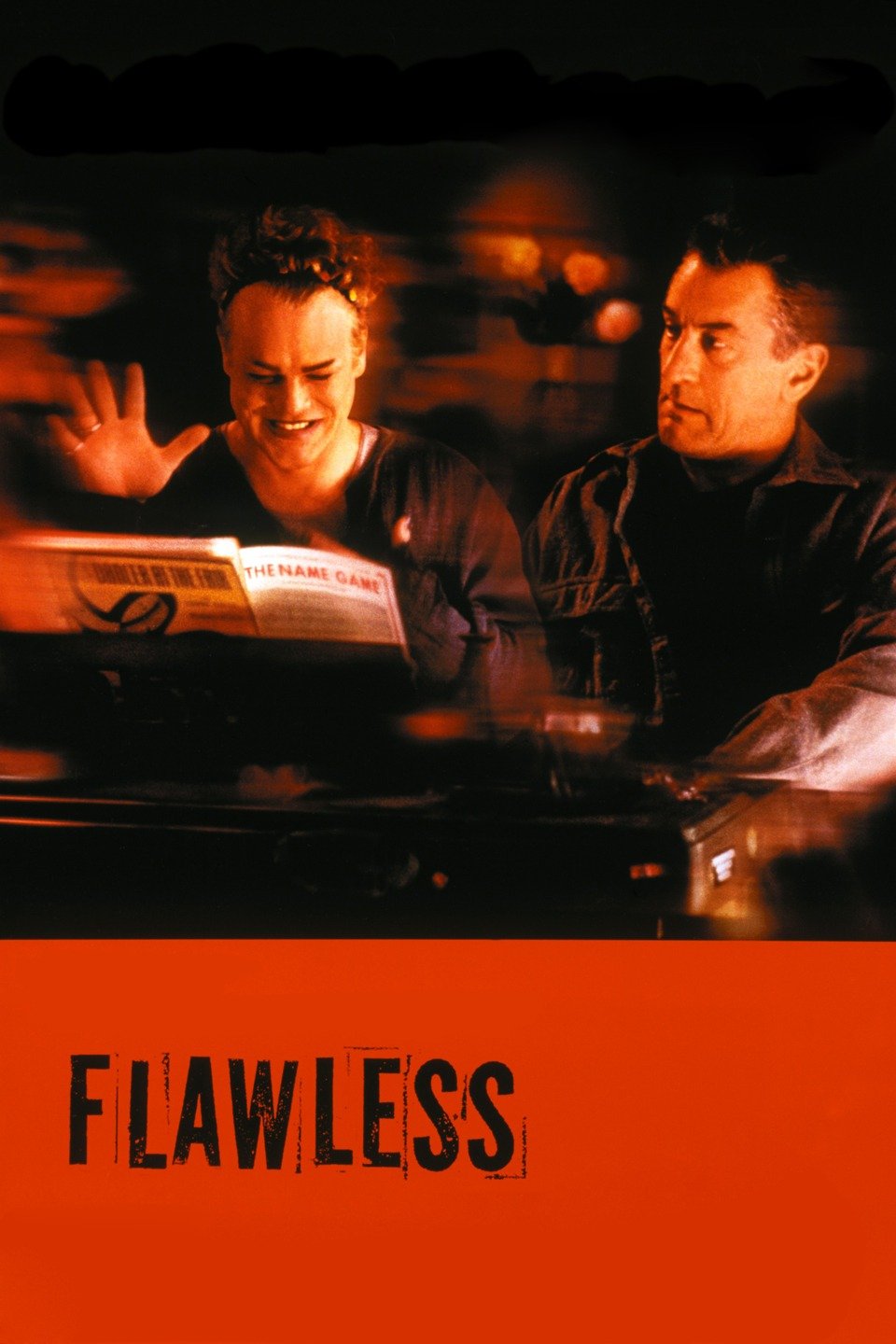
The one redeeming quality of this film comes on behalf of Philip Seymour Hoffman. Produced in 1999, Flawless was a film made right as Hoffman was ascending to fame, but still not quite there yet, having some well-received roles in Paul Thomas Anderson’s films, but still a relatively underpraised performer. This particular year was an enormous breakthrough for the actor, and while he may not have reached the heights here that he did with The Talented Mr Ripley and Magnolia that same year (both some of his best work), he is solid here. The key to his performance is the sensitive approach he took to the role. As one of the finest character actors to ever work in the medium, Hoffman could embody any individual, adopting a variety of characteristics without ever resorting to stereotype – and when you’re dealing with a drag queen that is a closeted transgender woman, one can easily worry about a cisgender, heterosexual actor taking on the part. Hoffman calms these nerves almost immediately, since despite playing Rusty as a flamboyant, eccentric individual, there is a depth to his performance that comes out more than any of the peculiar quirks that would bring a role like this down. He is genuinely moving in the part, and plays a difficult character with heart and precision. It’s not a performance free of minor issues, but it is surprisingly the least problematic part of the film, solely because of the actor’s outright dedication to making Rusty, more than anything else, an unabashedly human character, rather than just a bundle of tics and an exaggerated voice. The same can’t be said for Robert De Niro, who is conversely doing some of his worst work, playing a stroke victim. His entire performance essentially sees De Niro limping with a cane and mumbling out the side of his mouth – there is very little nuance or sensitivity, and considering so much of the film focuses on him regaining his voice, the vaguely parodic approach the actor was taking borders on offensive. It is troubling when the most problematic part of your film isn’t the straight actor playing a queer character, but the industry veteran phoning it in and delivering a ridiculously poor, misguided portrayal of a disabled character.
All the problems with Flawless can essentially be traced to one common issue that applies almost universally throughout – this is a film that quite simply doesn’t know what it wants to be. Schumacher was clearly aiming to work on a smaller scale, doing something more intimate and personal, rather than a big-budget blockbuster that lacked soul in favour of spectacle. Unfortunately, whether it’s a matter of the director not knowing how to construct such a story, or the studio pressuring him into making something that may be a deviation from what he traditionally did, but still at the very least bore his distinct traits as a filmmaker. The result is a film that is not nearly as funny as it believes it is (especially when the humour is incredibly dated, especially since the film was produced after many very tender and delicate glimpses into queer life), nor is it particularly thrilling. The crime storytelling is handled extremely poorly, both in terms of what it is saying, and how it executes some already bland ideas. Framing this entire film around missing money that belongs to a group of vicious criminals that are pursuing anyone who they believe has knowledge of its whereabouts, removes so much nuance from a film that was already struggling to establish a voice for itself. It’s convoluted and common, and doesn’t have much merit outside of a few cheap thrills. It also fails to find the humour in these situations – understandably, Flawless is about some serious issues, but the dour approach taken throughout the film does a great disservice to what is a very funny, touching narrative. It shifts between tones so much, the viewer begins to feel a sense of whiplash, which doesn’t serve the film well, and makes it something of a chore. The decision to have the resolution of the film be a jarring, action-packed sequence where all characterization is abandoned for the sake of some quick gratification is not nearly as satisfying as they seemed to believe it would be, and it comes very close to derailing so much of what makes Flawless such an interesting film by way of just disregarding everything that it worked so hard to establish in order to keep it within the confines of what those involved thought would make for an entertaining film.
Considering it came about during an era where issues relating to the LGBTQIA+ community were gradually becoming more prominent in mainstream media, and where representation of these marginalized groups was skyrocketing, it’s surprising that Flawless, a film with two prominent stars, an interesting story and popular director at the helm,isn’t better remembered and cherished alongside some other similarly-themed works from this period. This is until you see the film, after which it becomes exceptionally clear why this has faded away, having the status of a minor work. The film has many problems, but strangely, they’re not related to how the film looks into queer issues, with this side of the story remaining relatively strong and worthwhile, no doubt a result of the director actually caring about this side of the narrative. The critical reappraisal of Schumacher as some underpraised craftsman may be raging in some corners of the cinephile world, but almost unequivocally, Flawless is not an example in any significant way. It is often overly sentimental, struggles to grasp a particular set of ideas, and thematically falls apart the moment it steps away from the character-driven side of the story, which is where it thrives. So much could’ve been done to improve this film, and there is very little doubt that there is a great work somewhere in Flawless – it’s just obscured by layers of heavy-handed commentary and unconvincing attempts to be far too much that we bargained for entering into it. It isn’t a travesty, but it’s a film that needed more work to improve than it was willing to put in, so it’s hardly surprising that it turned out to be such a disappointment, when it could’ve easily been a much better film with some effort.
 The Postmodern Pelican