
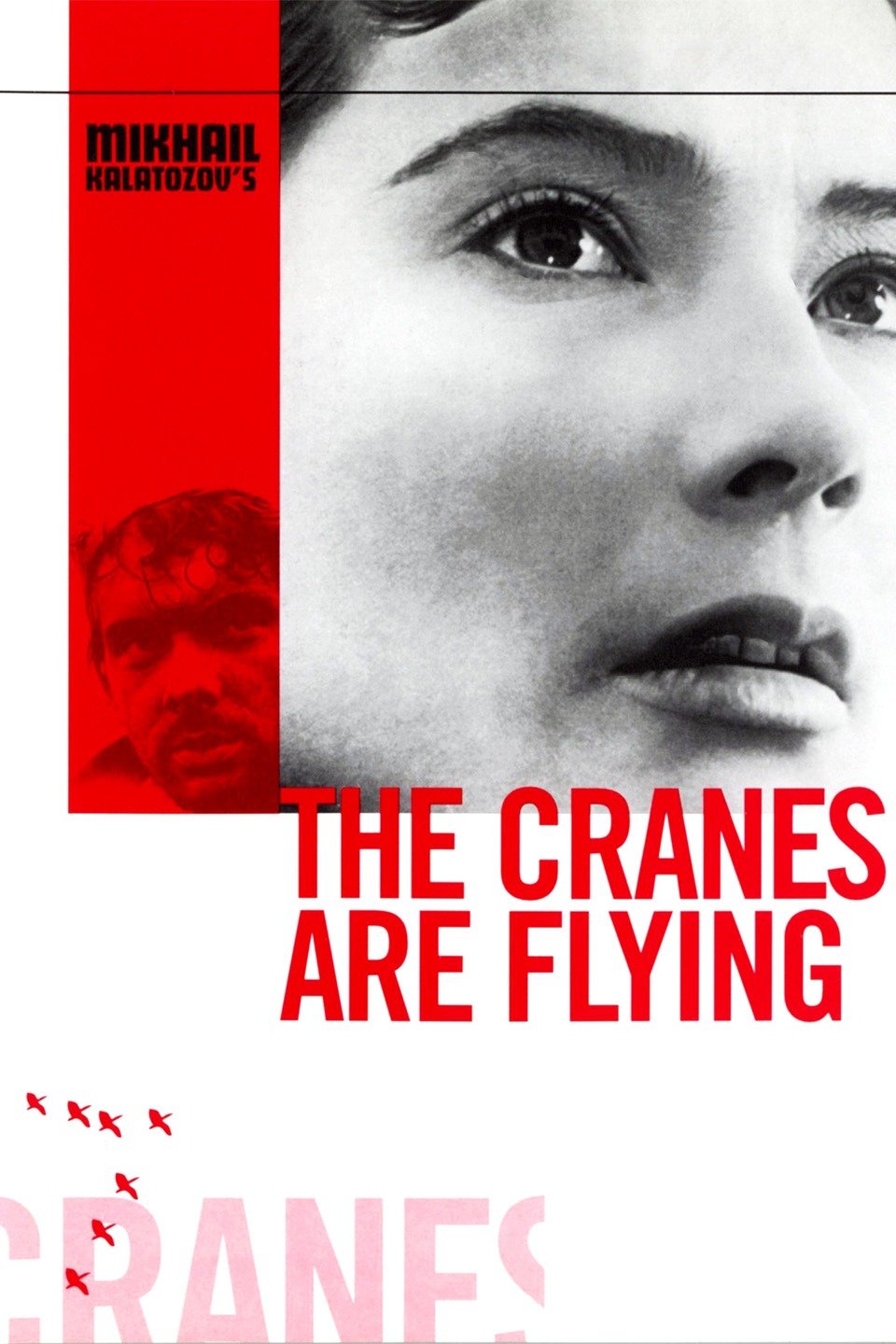
Russian cinema is severely underrated, especially when it comes to looking at how there are many filmmakers who traversed every conceivable genre, but often had their voice stifled by either the Soviet government, or by western audiences, who weren’t particularly enamoured with the idea of embracing films produced in a region that was essentially their political nemesis, even if most of the people making these films were just as against the regime as these audiences. When it comes to war films, some of the greatest have been produced in Russia – consider Elem Klimov’s incredible Come and See, or Larisa Shepitko’s astonishing achievement The Ascent, two of the greatest films ever produced on the subject of war, and often considered amongst the most brutal depictions of the psychology of warfare ever committed to film. However, predating both of them is The Cranes Are Flying (Russian: Летят журавли), the ambitious drama by Mikhail Kalatozov, who put together a war drama that was just as harrowing, haunting and deeply unsettling as those that would come later. One of the first truly successful and acclaimed films that critically deconstructed war from the Russian perspective, The Cranes Are Flying has stood up as a remarkable piece of filmmaking, composed with an intense honesty by a director whose interest in the material was far from superficial. Not an easy film at all, but rather one that takes us on a deeply disconcerting journey into different experiences of the Second World War, it gives us unfettered insights into the world from a distinct perspective that allows the film to overcome its meandering tone and slight narrative inconsistencies, to become an engrossing drama that says more about the war by opposing it than most films produced at the time would possibly dare.
As one of the more high-profile directors in the Soviet era, Mikhail Kalatozov helmed many memorable films, most of them being intricate character studies of the war and its impact on ordinary people. The Cranes Are Flying is his best-known work, and perhaps the most complete vision he ever had for a film, since the themes he touches on are both intricate (based on his own experiences as someone who worked for the Soviet government as a cultural attaché and artistic diplomat) and broadly resonant. The celebrated nature of this film comes from the director’s ability to pull the two disparate concepts together, transforming them into a coherent but undeniably poignant story of war, taken from two distinct perspectives. What is very notable about the vast majority of Russian films about war is how bleak they are – the concept of history being written by the victor isn’t necessarily a factor in these stories, since regardless of who triumphs, there was suffering that occurred as a result, death and torment that leaves a far more indelible impression than the victory parade these soldiers believe they are working towards. The Cranes Are Flying situates itself in the centre of a romance between two young people, one of them secretly enlisting to join the Red Army during the Second World War, and leaving behind his beloved, in the hopes that they will be reunited one day. This allows Kalatozov to present a bilateral story – on one side, this film is a harrowing, first-hand account of the horrors of war taken from the perspective of those fighting in it, and on the other, it’s a disquieting social drama about those who are left behind – the families and friends who watch these soldiers disappear into the ether of war, never knowing if they will ever see them again.
From this foundation, the director plumbs emotional depths that are revolutionary, since there isn’t any sense of victory that comes as a result – and the psychological impact is what Kalatozov is most intent on deconstructing. His interest doesn’t sit with the actual machinations of war – this subject matter has been covered in multitudes of work across every conceivable medium, and there doesn’t seem to be anything that he could add that would change one’s perspective (there is often nothing more redundant than a war film’s central theme coming down to the very obvious realization that war is bad). Instead, his focus is to get into the minds of two characters that experience the horrors of war, looking into their personal quandaries and trying to unpack all the emotions that undoubtedly come about as a result of living through such uncertain times. Those of us who are fortunate enough to have not experienced something like violent conflict are able to feel a great deal of empathy, since Kalatozov pays attention to presenting the brutalities of war in an authentic, non-saccharine way, and gives us a chance to see the realities many people throughout history had to live through (some of them not surviving these harsh conditions). It’s uncomfortable and disconcerting, but The Cranes Are Flying never promised to be anything other than exactly what it turned out to be – unsettling, deeply disturbing and always with a firm grasp on the cultural consciousness in such a way that future generations can garner an understanding of what their forefathers experienced at the hands of maniacal leaders and their insatiable quest for power and influence, where human life is not worth much more than statistical data.
Yet, despite the harrowing nature of the film, The Cranes Are Flying is presented with a kind of mystical poeticism that helps soften the harsh tone. Kalatozov finds the humanity in the situation by showing us the lives of people outside of just the war – these are not people who experience war through wallowing in their misery, but rather citizens who take an active part in their country’s affairs. One of the fatal mistakes many depictions of war tend to make is that they view soldiers in the battlefield as the only heroes in times of war. Throughout this film, Kalatozov focuses on a wider range of individuals, all of whom did their part in the war effort, playing a variety of roles. This makes The Cranes Are Flying a profoundly human film, one that is so engrossed in showing the inner turmoil of its characters, it sometimes feels like the war plot is sidetracked in favour of more intimate explorations of other aspects of social unease during such periods. It might even be intentional, since Kalatozov demonstrates a strong empathy for his stories that feels remarkably genuine, even if he himself wasn’t coming from a place of having first-hand knowledge, gleaning much of the material from Victor Rozov, who he collaborated with on the screenplay (based on the writer’s original play), who was a former soldier who did experience some of the horrors shown throughout this film. It’s a beautifully striking film that finds poetry in the deepest, most unnerving portrayal of war, and manages to do more to show us the truths about such experiences than many similarly themed films.
The Cranes Are Flying is an incredible achievement, and one that has thankfully been duly noted as a masterpiece, especially since Russian cinema is often dismissed (particularly those produced at this time, where there was always a sense of Soviet ideologies influencing every aspect of their production). As a work of anti-war fiction, the film is an intricate exploration of the lives of those who suffer the most – not only the soldier being attacked at close range in the battlefield, but his or her betrothed that waits at home for news that they have survived, always dreading that the worst will come to fruition, especially in a conflict as vicious as the Second World War. It’s not a particularly complex film, with Kalatozov keeping everything at the profoundly human level, which only bolsters the underlying themes, which come across as sincere and authentic, since they’re derived from a place of experience. Not an easy film, but certainly one that doesn’t waste any time putting us under its mystical spell, The Cranes Are Flying is an astonishing work, and a film that continues to be as impressive over half a century later, touching on resonant themes and going in search of something so much deeper and more profound than anything we could expect from less-effective glimpses into the realities of war.
 The Postmodern Pelican