
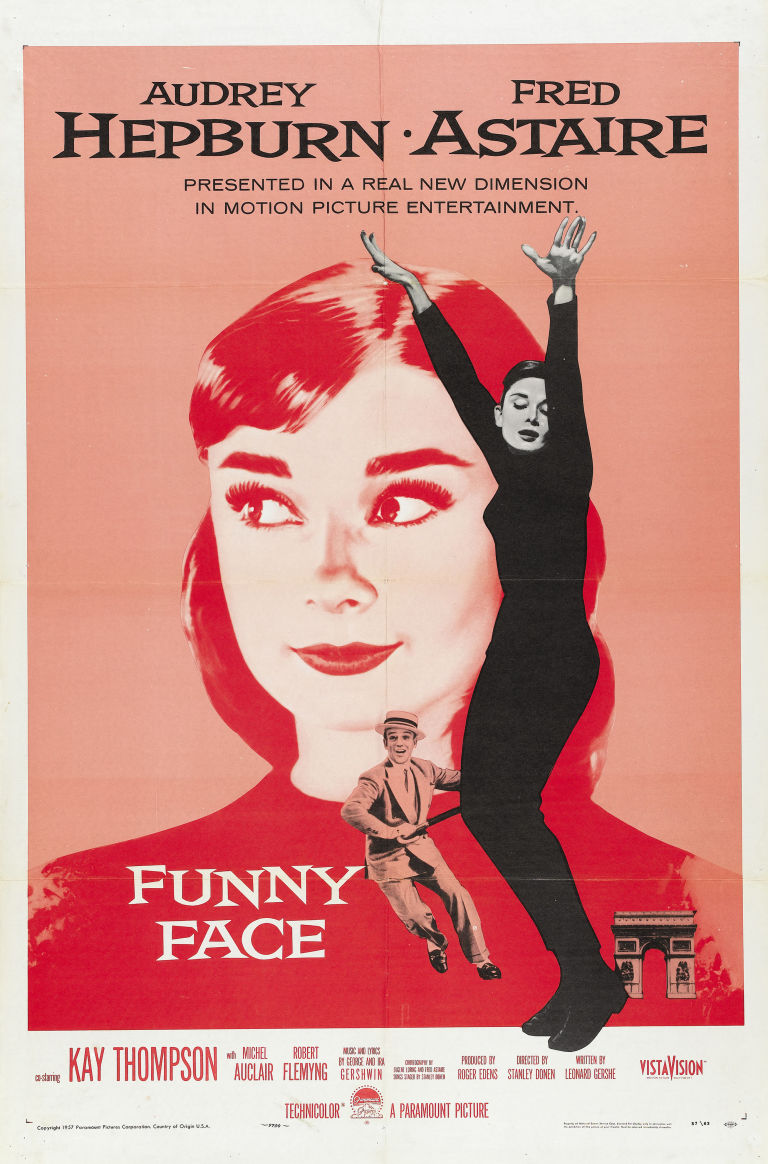
As much as they’d like to think they continue breaking boundaries with their constant pursuit of innovation, Hollywood quite simply doesn’t make films like Funny Face anymore. We certainly do see occasional pastiches of the Golden Era of filmmaking in movies like The Artist and La La Land, but these are only pale imitations of the mastery that existed decades ago – it’s not an indication that films used to be better in the past, rather that they were just so fundamentally different in a number of ways. Stanley Donen was a director who understood this concept, as well as knowing exactly how to direct a film that audiences will respond to, and with a career spanning from the peak of the classical era, all the way into the period of New Hollywood, he certainly had a firm grasp on how to pull together an entertaining film. Funny Face is a film that exists in a strange place in the director’s career – it’s not his most well-known film (especially since he helmed some canonical classics), nor it is necessarily his best work, but it’s still one that is incredibly strong, and shows a director with a keen understanding of putting on a show, which he does with remarkable ease, demonstrating an aptitude behind the camera that can match any of his contemporaries. Funny Face, which is very loosely adapted from the stage play of the same title by George and Ira Gershwin, is an utter delight – a charming and endearing romp through New York City and Paris, its a dazzling and exciting musical masterpiece, filled with heart and energy that can rival nearly any other musical from this era, if not on the sheer value of its production, but on the uniquely upbeat demeanour that defined this particular moment in film history.
If we were to consider stars who defined the Golden Age of Hollywood from beginning to end, we can certainly do much worse than to bring up Fred Astaire and Audrey Hepburn. While they were from slightly different eras (with the latter being towards the beginning of her stardom, while the former was gradually phasing into his semi-retirement), their partnership in Funny Face is just another opportunity for them to play unforgettable characters and turn in incredible performances, which is almost expected from these two masterful actors. This film came at a time when Astaire was banking less on his skills, and more on his image as one of the elder-statesmen of the industry, using his reputation and cherished status to great effect – but much like another actor who he has often been compared to, the incredible Gene Kelly, Astaire never really rests on his laurels, and even at a more mature age, he still managed to turn in a performance that has the same mastery as his earliest work. Quite simply, once Astaire starts to dance, we can’t help but just watch in awe-inspired bliss. Funny Face uses his legendary reputation perfectly – he is just as charming and personable, but takes a slightly more subdued role for the most part, which only makes the moments where we see him do what he does best even more captivating. Hepburn, however, was still building her reputation – already a fashion icon that proved she had serious talents, her career was still oddly in its infancy, despite having a few major awards behind it already. This was one of many breakthrough roles for the actress as she worked her way to the 1960s, the decade that would consolidate her as both a film and fashion icon – and even if what she is doing here is more focused on her gaminesque beauty, her striking talents as an actress come through regularly, and the film knows how to capture both sides of her personality perfectly.
Funny Face is a film that knows how to capitalize on the talents of its two stars, and despite Astaire and Hepburn being from different generations and having different sets of skills, their chemistry is irrepressible, and the film shows them doing what they are best at, and finding a common ground between them. It showcases Astaire’s incredible dancing ability, and demonstrates how Hepburn was the definition of beauty, a kind of pixie-like enchantment that hadn’t really been seen before, which is mainly why she caught the attention of a few playwrights and film directors early in her career. Even when their styles are in conflict, the film presents the two leads in such a way that seems so effortlessly in sync with one another. These are two full-bodied movie star performances by a pair of the finest to ever work in the medium – and in the great tradition that came about in the latter stages of this period, they were playfully deconstructing their own images in favour of doing something new, taking on roles that carefully challenge how we see them as actors – it gave Astaire the chance to try something slightly different while still keeping with his tradition of playing dashing heroes with furious feet, and Hepburn the chance to show that there was real depth behind her magnificent beauty, a sadly abstract concept that Hollywood is still having trouble accepting with its young ingenues today. Special mention must also go out to the wonderful Kay Thompson in one of her very few acting roles, where she steals nearly every scene she’s in, and helps bring out the best in her two co-stars, supplementing them while not distracting from their most important scenes. It’s a trio of impressive performances that the film builds itself on, and gradually becomes a deeply convincing musical comedy that is brimming with heart from beginning to end, all due to the wonderful characterization that went into its creation.
What makes Funny Face so endearing is that it doesn’t take itself too seriously, which can easily be attributed to Donen’s very precise approach to the musical process. One doesn’t co-direct a film like Singin’ in the Rain and not possess a very distinct playfulness and joie de vivre that exudes from every frame of the film. The combination of his unique understanding of what makes a musical compelling, and his bold visual style makes Donen the perfect candidate to helm a film such as this. His status as little more than a director-for-hire does a great disservice to his authorial vision, which was far more interesting than retrospective critics have claimed it to be. Funny Face has all of his most notable characteristics – musical numbers executed at breakneck speed, a deft blend of beautiful locations and constructed sets (with the difference between them being far too minimal to even notice), and a rabid sense of humour that keeps the viewer invested from beginning to end, never losing our attention for a moment, even when the third act may become too meandering with an additional sub-plot that felt out of place, and a conflict resolution that came about far too suddenly and without much reason. There is only so much content someone can fit into a globe-trotting adventure that spans only 100 short minutes – but if there was ever going to be a director who could effortlessly combine soaring romance, outrageous comedy and a sense of intrigue that keeps us on the edge of our sets, Donen is certainly a prime contender. This film came about when Donen was in the peak of his career, so its hardly surprising that he managed to pull together something quite compelling – and looking back at his impressive body of work, now is a better time than ever to celebrate the distinct and vivid imagination that the director demonstrated throughout his career, which is nearly unmatched in terms of bringing joy while still inciting some meaningful discussions along the way.
Funny Face is such a delight, and a film that reminds of how valuable something as simple as a love story and an upbeat song can be when positioned in the right way. The 1950s had several iconic musicals, so it’s not surprising that this one has been slightly neglected (not necessarily forgotten, as there are still many supporters who are endlessly devoted to this film) – but revisiting it is never anything short of an enthralling experience, since the film is so layered with meaning that we don’t initially find at first. Each subsequent viewing is filled with so much joy, which comes from a place of genuine depth and heartfulness, which only makes the experience of seeing Donen’s madcap version of the world presented on screen seem all the more enticing. Featuring some memorable work by two of the finest performers to ever make an imprint on the medium, exuberant in the way that only a classic Hollywood musical can be, filmed beautifully (the cinematography, art direction and costume design in this film are some of the best of the era), and sewn together with a masterful dedication possessed by a director who had an enormously satisfying vision that he was never afraid to showcase in a series of unforgettable musicals and comedies, Funny Face is just such a joyful piece of filmmaking, and a poignant reminder of the extent to which we can take the craft, not only artistically, but also in how these stories can resonate with different generations, all of whom will likely have the same awe-struck reaction at seeing the beautiful work done in films that set out to simply celebrate the smallest pleasures of life, which is easily accomplished in this delightfully unique but incredibly influential film.
 The Postmodern Pelican
Ugh! Movies about senior citizens on the cusp of 60 romantically pursuing women a quarter of a century younger are creepy. Yes, it happens but wise Maude acknowledged the absence of a happily ever after in such a scenario.
Funny Face ! Great style of sophisticated Paris in the 50s. Hepburn ballerina style !