
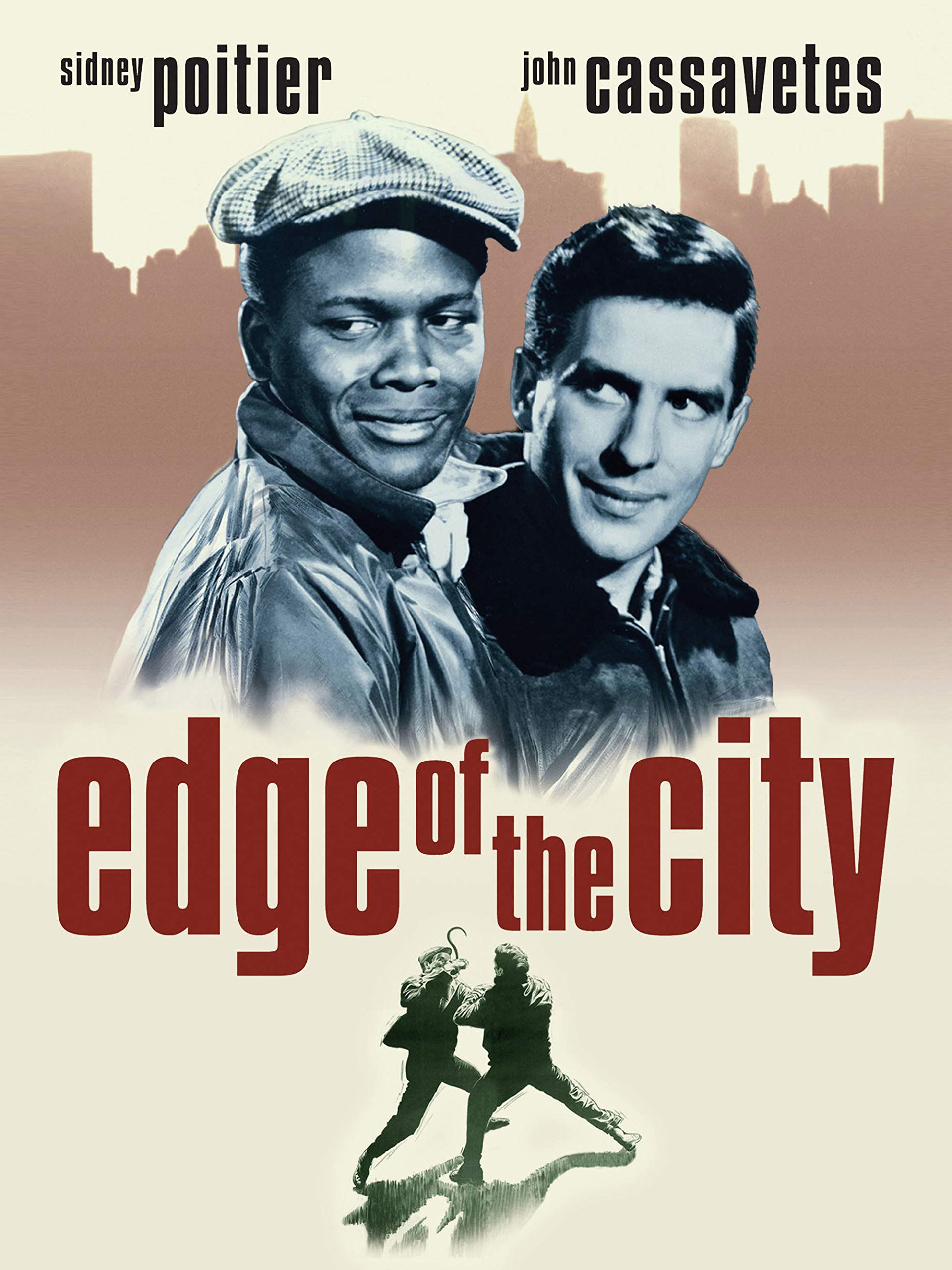
There was a crossover period somewhere in the mid-1950s, where the Golden Age of Hollywood came into collision with the earliest pioneers of New Hollywood – we weren’t quite at the point where it made sense to consider these young, burgeoning revolutionaries as being the next shining stars of the industry, but there was some sense that they were on the verge of redefining what filmmaking meant. Two figures that serve as representatives of this pivotal moment are Sidney Poitier and John Cassavetes, two wildly different artists who share only a few essential qualities – they both got their start at the tail-end of the Golden Age, but would find their work stretching across different eras. They were also incredibly gifted in a multitude of ways, and were able to bring out the nuance in any project, elevating the work they were given without much difficulty. Needless to say, both Poitier and Cassavetes are absolute icons – so the film that threw them together is immediately going to hold some value, if only in terms of being a chance to see earlier work from two incredible artists, who demonstrated their remarkable skills from the beginning. Both had already been acting for a few years, so weren’t entirely new to the industry – but Edge of the City (which also served as the directorial debut for Martin Ritt, a terrific filmmaker who is barely given his due) is a chance for the two actors to develop their skills on a platform that only served to bolster their profile and consolidate them as indelible components of an industry that was radically changing, particularly through the effort being put in by films such as these, which took on a new set of challenges that revolutionized how stories were told, even on a much smaller scale, as we see throughout this intimate, character-driven drama.
Edge of the City is a film primarily about friendship, and the extent to which having a genuine companion can help one through some of life’s more disconcerting challenges. Considering this film was made in the 1950s, and centres on a companionship between an African-American and Jewish-American (at the height of both being considerably marginalized), with the possibility that one of them may be homosexual, makes the social message underpinning this film all the more impressive. Taken from the television play A Man Is Ten Feet Tall by Robert Alan Aurthur (who adapted his own teleplay, making considerable changes but keeping the spirit of his original social commentary), Edge of the City is a bold exploration of two men using their friendship to overcome some obstacles set down by them by the institution they are fighting against. Using their relationship as the starting point, Ritt constructs a truly compelling portrait of two men finding common ground, especially against the social hierarchy of which they appear to be at the very bottom, but are gradually trying to inch their way up further, through the sheer virtue of resilience. The original title of the story centres on the two protagonists aiming to become “ten feet tall” through fighting against the system and taking on every challenge that comes their way, with the strength garnered during these hostile encounters only helping them grow mentally and emotionally. The film is a difficult piece, and the sense of unity that exists between the two characters is truly heartwarming and helps Edge of the City compensate for its slightly weaker approach to a variety of smaller themes that would have derailed the rest of the film had there not been an active sense of socially-charged authenticity that drove most of the story and gave it the necessary nuance.
In careers as storied as theirs, calling any film the definitive work of either Cassavetes or Poitier seems hasty. In terms of the former, while he may be better known as a director (and revolutionary in the world of independent cinema), Cassavetes was certainly very gifted – and watching Edge of the City is even more enthralling when we realize that this is one of the many acting jobs that he took on as a means to finance his directorial career, which would result in him undergoing the process of shooting the film that would become Shadows less than a year later. Cassavetes is the de facto lead of the film, playing Axel Nordmann as a shy but hardworking young man who is trying to run away from his past, but doesn’t know what to do when it catches up to him. It’s a masterful performance that shows Cassavetes’ commitment to character, and his ability to develop a role beyond mere archetype. However, the film is truly at its peak when Poitier is on screen, since he is undeniably the heart and soul of the film. His warm smile, upbeat demeanour and towering frame makes him the centre of attention in every scene, even those when our attention should be directed to another character. Poitier just exudes effortless charm, and manages to pull together the paltry strands of an underwritten character into one of his finest performances, even if he may be treading through familiar territory in terms of the character and his quirks. It helps that both leads have an incredible chemistry, since so much of the film is built on their relationship, and how they find themselves in a spiritual symbiosis throughout. Edge of the City has a pair of masterful performances that feel so much more genuine considering the effort that went into their creation.
However, a cursory glance at the premise of Edge of the City would lead viewers to imagine that it may be far more innocuous than we’d expect. This isn’t simply the story of two men from different backgrounds finding a kindred spirit in one another, and developing a strong friendship – it certainly starts that way, be rapidly becomes a vicious social drama that takes ferocious aim at racism, showing the depths to which many ignorant individuals would go to degrade those that they genuinely believed were inferior. It may not be the most lucid narrative, nor the platform that these themes could best flourish on, but the film is undeniably powerful, particularly in how Ritt shifts the tone from good-natured buddy comedy to a haunting drama that isn’t afraid to show the darker side of humanity. The antagonists in this film only grow in villainy, becoming even worse than just being close-minded, hubristic fools – they’re fully-fledged bigots that thrive on their ability to hurt those who they think deserve to be put in their place. Some of the commentary can be quite stilted, and many have argued that Edge of the City takes a very binary approach to racial issues, showing it as being a cut-and-dry case of good triumphing over evil – and these criticisms are absolutely valid, since there are some aspects of how the story addresses these issues. Yet, the fact that it was starting these conversations, and presenting such a story in a way that is both striking and elegant, only bolsters the overall message, and allows us to overlook the slightly shortcomings. Edge of the City isn’t regressive so much as it is more apprehensive to be too detailed, or perhaps not daring enough to explore the institutionalized problems that are far more troubling – but it’s still remarkable that it had the good sense to at least ignite the discourse to begin with, which means more than most critics have given it credit for doing.
Edge of the City is a tremendously effective film, and one of the many instances of forward-thinking cinema, whereby some trickier issues were used as the foundation for powerful, socially charged storytelling. It may not always be flawless, and there are indeed numerous instances of the film feeling stilted and awkward, especially when it comes to exploring the nuances of race. However, starting the conversation is already half the achievement, and Martin Ritt does so splendidly, especially through working with two fascinating actors who are delivering staggering work, performances so good, they often feel as if they’re being stifled by a film that may not have the space to develop them as much as a more intricate film would. Regardless of its minor issues, Edge of the City is a decent effort that has a great deal of heart, and a soulfulness that feels real and genuine, even if there were more areas in which it could’ve been more effective. Some of the discussions in this film are notably more cutting-edge than many other race-based films produced at the time, so the combination of progressive thinking and a traditionally structured narrative of two friends overcoming adversity, are more than enough to qualify this film as one that is absolutely worth the time, especially when looking at the growing presence of race-based films that were starting to appear around this film, taking matters into their own hands and proving that these stories are worth telling just as much as anything else being produced by the industry.
 The Postmodern Pelican