
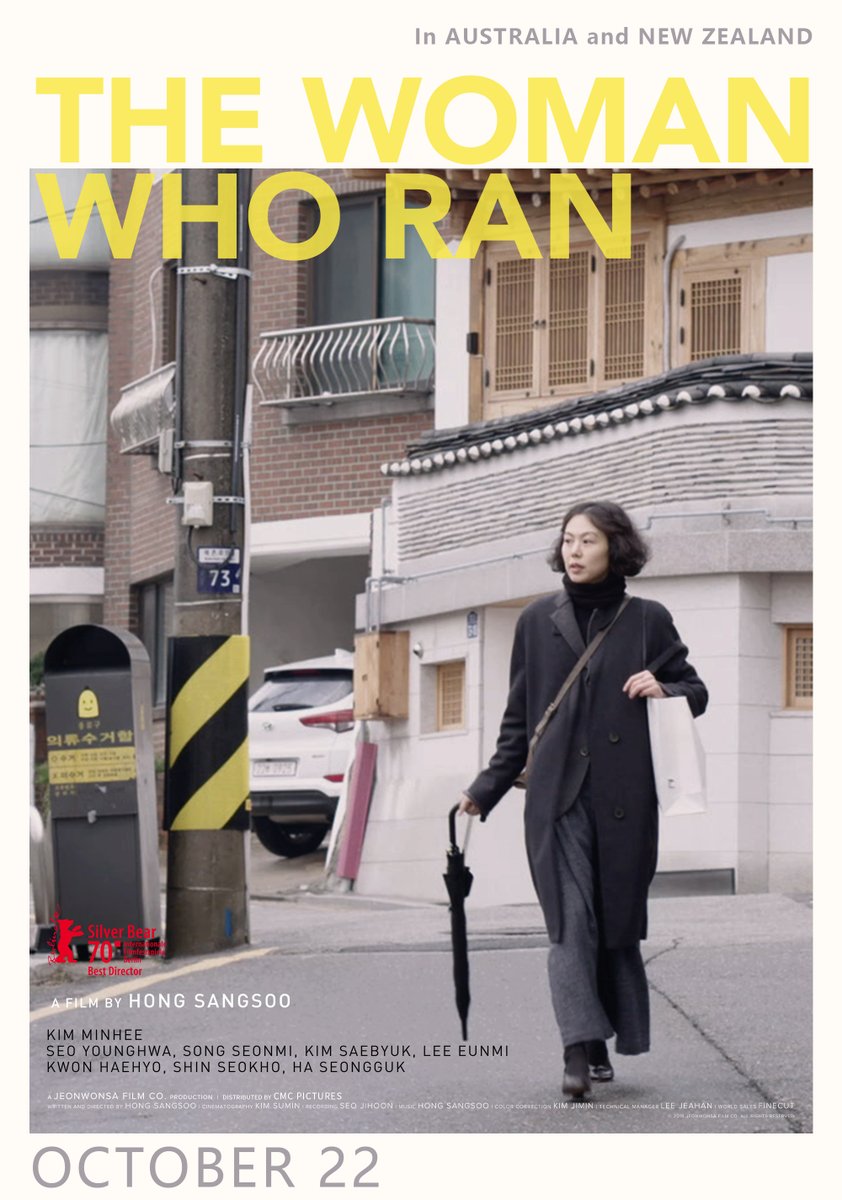
There’s a certain faction of the filmgoing community that absolutely idolizes Hong Sang-soo, whose work has reflected a keen sense of understanding the human condition, so much that it has come to singularly define him, all the while some of his contemporaries have risen to more worldwide acclaim, outside of the niche arthouse of which Hong is an absolute mainstay. Known for a highly prolific career of subdued, simple stories that are more focused on intimate encounters and the resulting dialogue, his films are fascinating glimpses into contemporary South Korea (as well as a few other locations that the director has explored through his various films on sporadic occasions), driven by compelling characters and meaningful discussions that seek to unearth some unimpeachable truths about our species. His most recent effort is The Woman Who Ran (Korean: 도망친 여자), a straightforward drama very much aligned with the director’s style, and told with an authentic, direct manner, which allows the director to articulate many of his most sincere and strikingly profound observations on modern society. Armed with a terrific script, a small ensemble of tremendous actors (including his most regular collaborator, the beguiling Kim Min-hee, who works with the director for a seventh time, making it one of the finest partnerships between auteur and performer of recent years), Hong is firing on all cylinders with The Woman Who Ran, a film with some bold ideas, and the good sense of unveiling them gradually and with the exact poise we’d expect from inarguably one of the most elegant filmmakers working today.
As tends to be the case with international films, the meaning of the title of The Woman Who Ran got slightly lost in translation, since the original Korean would more accurately be translated as “the woman who ran away”, which adds an added level of nuance to the film, as there is a sense of escape. The film focuses on a young woman visiting a few of her friends around modern-day Seoul over the course of a few days. The visits are lengthy and meaningful, with the friends spending time uncovering the past few years in their individual lives, unpacking their various traumas while enjoying the company of people they truly appreciate. Hong’s films are always driven by dialogue, with the majority of them taking the form of long conversations between individuals, whether old friends becoming reacquainted, or strangers entering into the lives of another through random encounters that are so impactful in what they convey, you’d imagine Hong held some firm belief in celestial guidance. The Woman Who Ran does occupy the more optimistic side of the Hong spectrum of themes, since many of the ideas the director is exploring here are more common than those which populated most of his other films – whether it be something as intimidating as a divorce, or simply a conversation with a hostile neighbour about the feeding of feral “robber” cats, the film is filled with discussions, each one revealing invaluable insights into both the characters occurring in that scene, and life in contemporary Seoul, which is a concept that Hong has succeeded in implementing into the majority of his films, making them both resonant with locals who understand the references being made, and outsiders, who are afforded valuable insights into life in the city.
As tends to be very common when discussing his work, The Woman Who Ran is a difficult one to pinpoint, since so much of what makes it worthwhile panders more to our subconscious, playing on our more visceral emotional reactions, rather than inspiring a wealth of discussion, which has always been one of the director’s most fundamental strengths, albeit becoming a quality that dissenters use to disparage what the director is doing. The film situates itself as a series of conversations centred on the innumerable banalities of life, which occur concurrently to more haunting subject matter, with the director oscillating effortlessly between vaguely lighthearted musings on the relationship between a few hens and a particularly mischievous rooster, and existential issues that occupy the minds of the protagonists, causing them to question reality as it stands, provoking some deep, unsettling questions that absolutely terrify them, and thus cause them to seek out meaningless conversations as a means to fill the void and find solace in the silence that afflicts all of them. None of the characters in The Woman Who Ran are necessarily suffering – they’ve all experienced hardships, but they don’t quite have the plight of some of Hong’s previous characters, who had a legitimate reason to seek out some meaning. These are ordinary people working their way through the intimidating modern world, and their conviction is matched only by how conventional they are – each viewer can find something of value in these characters, a recognizable quirk or emotional quandary that Hong so perfectly conveys through their bittersweet dullness that is somehow effortlessly captivating to behold.
Much of what makes this film so compelling is the precise nature of how Hong constructs these individuals, particularly the protagonist. The character of Gam-hee is an aimless young woman – we never see her personal life, and everything we learn about her is contained in her discussions with the various friends she visits. She doesn’t remove her coat, nor does she seem to be rooted anywhere in particular – and it’s clear that Hong and actress Kim are relishing in creating a character who is seeming without a past, instead being a spectral figure weaving herself through the lives of these characters she visits over the course of the film. Hong is one of the rare types of filmmakers who has built his career on simple stories and even more straightforward executions (it’s difficult to find films that are as compulsively against excess than those produced by the director), but there is always something deeper to be found once we provoke the surface and find something of value in the story being told. Whatever the impetus behind the creation of The Woman Who Ran may be, it’s undeniable that Hong wasn’t just interested in an hour of in-depth conversation between old friends – and while it does take this form, it’s more a result of the director, in conjunction with his ensemble of performers, taking on very disparate ideas for the sake of evoking discourse that may take some time to unpack, but is entirely worthwhile once we’ve found ourselves on the wavelength of a film entirely committed to its unique approach to exploring the human condition.
Powerful films come in many different forms, and while something like The Woman Who Ran may not be to the taste of some viewers, who prefer more eventful, traditionally-structured narratives, with a clear storytelling framework, those who find the subdued cinema of Hong Sang-soo compelling will surely be captivated by this one. At only 76-minutes in length, it is an absolute breeze to get through, and the powerful performances by the actors, particularly the always exceptional Kim Min-hee, only make it more of a delight. It’s an easygoing, simple film that takes the form of an extensive series of discussions, evoking the feeling of sitting across a table from an old friend, reminiscing on the past while uncovering some facts that are perhaps not quite as comforting. This film delivers exactly what it promises, and actually may be one of the few Hong films that condense many of his notable qualities, such as his level-headed approach to storytelling, intricate exploration of life’s smallest idiosyncrasies, and a beautifully poetic sense of understanding that underpins all of his work. It’s undeniably a film that may polarize viewers, but it is almost certain that what Hong is doing here may be low-key and subtle, but it’s rarely ever boring, and manages to be quite hypnotic at times, which is an incredible achievement, and all the more reason to celebrate this film and seek it out immediately.
 The Postmodern Pelican