
One of the great joys about exploring film, and subsequently writing about it, is that not only do you get to experience unimpeachable masterpieces and contribute to the discourse, you also have the opportunity to rediscover films that were previously undervalued, or not given the love they deserved on their initial release. We’ve seen proverbially “bad” films receive a critical re-evaluation, normally when they’re discovered by a younger generation that attempts to rectify the misguided criticisms of previous critics and audiences. This has happened almost consistently as long as film has been a medium that has been consumed en masse, but that doesn’t mean that every hidden gem has been found yet, and we’re still anxiously awaiting the breakthrough for certain films that are supposed to be considered classics, but still reside in relative obscurity as underrated masterpieces. Josie and the Pussycats, the adaptation of the wildly popular characters plucked from Archie comics, is one such film. It has a fair share of devotees, but a range of other factors, such as the period in which it was made and the films that surrounded it, meant that it was both critically reviled at the time, and still struggling to break through as a work of note. By no means a film that carries much meaning, or does anything particularly revolutionary, it is instead a daring and outrageously funny piece of scathing satire, disguised as an upbeat, family-oriented comedy, which is essentially why it hasn’t gotten the attention it deserves, since a cursory glance simply can’t do this incredibly entertaining film justice. Instead, one needs to take a leap into the centre of the story, and see exactly why Harry Elfont and Deborah Kaplan brought these characters to life, and wove together a mesmerizing comedy that warrants another look – it may not be a masterpiece in the traditional sense, but in terms of pure, unbridled entertainment, one can do a lot worse than this film.
To be perfectly clear, there is absolutely nothing in Josie and the Pussycats we haven’t seen before – but instead of this being a criticism, its the aspect that perhaps makes the film so engaging, keeping it thoroughly captivating without it needing to grasp at complexities that would be hopelessly out of its reach. Essentially, the film is just a Nickeloden-inspired version of the Faust story, and if that isn’t enough to compel any viewer with a sense of humour and an interest in seeing how Hollywood can make sure of such abstract ideas, then absolutely nothing else about this film will be convincing. We’ve seen a ridiculous amount of stories that focus on a small-town artist being given the opportunity to achieve immediate success, at the cost of something very personal to them (mostly their soul, but that would be slightly too sinister for a film that genuinely tries to appeal to all ages), by shadowy, mysterious figures that use their charms to hypnotize them into thinking that fame comes easily if someone is in the right place at the right time (back in 2001, this was a more absurd statement than it would be today, where we see many people achieve fame for the most inane reasons imaginable). It doesn’t do anything particularly revolutionary with this premise, but rather keeps it simple and endearing, knowing exactly when to hit all the right notes and play to the rafters when it is necessary, and when to show some careful restraint in the more quiet, meditative moments that may not ring particularly genuine, but still have a peculiar gravitas to them, the kind we find embedded in these superficial comedies about young people navigating the perils of the real world, sustained by their own pluckiness and dependent on lifelong friendships that they believe can carry them forward.
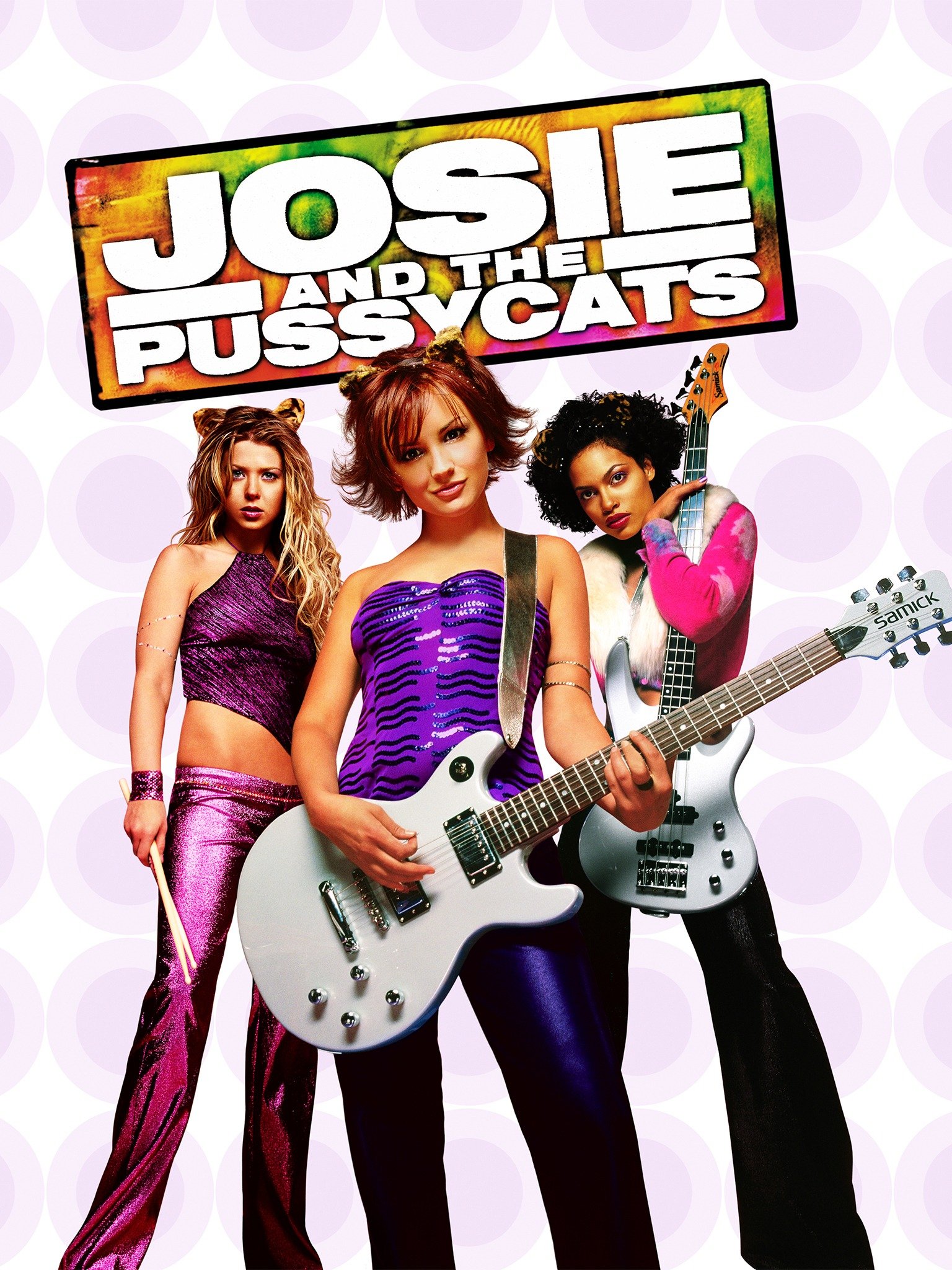
The premise may be predictable, and it certainly doesn’t deny its tendency to hit very familiar beats, but there are some components to Josie and the Pussycats that make it worthwhile. The characterization is absolutely key to a film like this, since this is essentially a work that is built on the charms of its leads, as well as the scene-stealing work done by the supporting cast, both sides needing to be in perfect synchronicity in order to succeed and convincingly keep us enthralled. In this regard, the film is a marvel – the titular trio are played with masterful sincerity by Rachael Leigh Cook, Rosario Dawson and Tara Reid, who were still relatively young performers at this time, and thus didn’t have much cultural cache, other than being borderline teen idols, with Josie and the Pussycats clearly being an attempt to establish the trio as the next superstars that would take over the industry. It didn’t quite work out as well as it was intended to, since none of them soared to astronomical heights in terms of fame, but they certainly did get a considerable boost, enough to put them as an indelible part of the culture in their own way. Their performances here are terrific – Cook holds the film together as the good-natured Josie, who is caught between fame and her friends, while Dawson is a feisty, principle young woman willing to fight for what is right. Reid is wonderful as the airheaded drummer, having some of the best moments in the film (it’s always a tremendous surprise when someone is able to take lines that are not at all funny, but still manage to elicit laughter through the delivery alone). Added to these three lovely performances are the villainous turns by Alan Cumming, who is at his most slimy and abhorrent, and Parker Posey, one of the finest comedic actresses of the past few decades. Both are formidable antagonists, and find the right balance between irreverent and maniacal, in a way that only someone with their impeccable comedic timing could harness.
The other triumphant aspect of the film, and perhaps the one that is most notable in terms of looking at Josie and the Pussycats as a much better work than it is given credit for, is found in the very specific humour the film employs. This isn’t just a mindless musical comedy that strings together a weak narrative around someone memorable songs – it’s a delightfully twisted satire that launches itself directly into providing some of the most subversive commentaries on the entertainment industry produced in the last two decades. There is always something admirable about a work of art that is unabashedly meta – the risk is always there of becoming too self-aware and removing the mystique that film tries exceptionally hard to contain in many instances. Josie and the Pussycats is not afraid to take a few risks, commenting on itself very creatively, albeit only in a few instances, making this approach more of a clever wink to the origins of the story more than it is one that depends on this metafictional commentary. The film is far more intelligent than we’d imagine at first, with most of the jokes, even those that are the most abstract, landing perfectly, executed with a precision that many of even the most well-formed comedies may struggle with. The difference is that Josie and the Pussycats doesn’t aim for wall-to-wall laughs, but rather choosing specific moments with which to hit the viewer with an unexpected twist, which gives the film a sense of unpredictability, and goes towards counteracting the slightly hackneyed story – if you can’t have an original plot, at least have some unique jokes, which is an area in which Josie and the Pussycats is simply unimpeachable, and where it derives the vast majority of its brilliance.
Josie and the Pussycats is certainly derivative, but inoffensively so, and it works well in the context of the story in general, which feels authentic to its intentions. This is supposed to be a fun, breezy comedy with upbeat performances and unforgettable music, and it certainly achieves exactly that, if not even more, since it has some unexpected surprises awaiting any viewer willing to surrender themselves to this delightfully deranged satire. Far more intelligent than we’d imagine based on the premise and the form it takes, one wouldn’t be blamed for thinking Josie and the Pussycats is just a slight, unremarkable entry into an oversaturated canon of musical comedies (and considering this came out only a year after Spice World, which has always had a firm grasp on early 2000s musical comedies about girl groups – and Cumming seems to be doing a pale imitation of Richard E. Grant’s iconic villainous manager, you’d not be amiss in thinking this was just an attempt to capitalize on that). However, when the specifics of the story fade, and we’re left with just the final product, we see just how special Josie and the Pussycats actually is – its heart is enormous, its sense of humour pointed and enduring, and everything about it hints towards a critical reappraisal being on the horizon. It may not be the most original, or be the most well-made film, but it’s beyond entertaining, and gives the audience a good time – and sometimes, when it comes to films like this, that’s more than enough.
 The Postmodern Pelican