
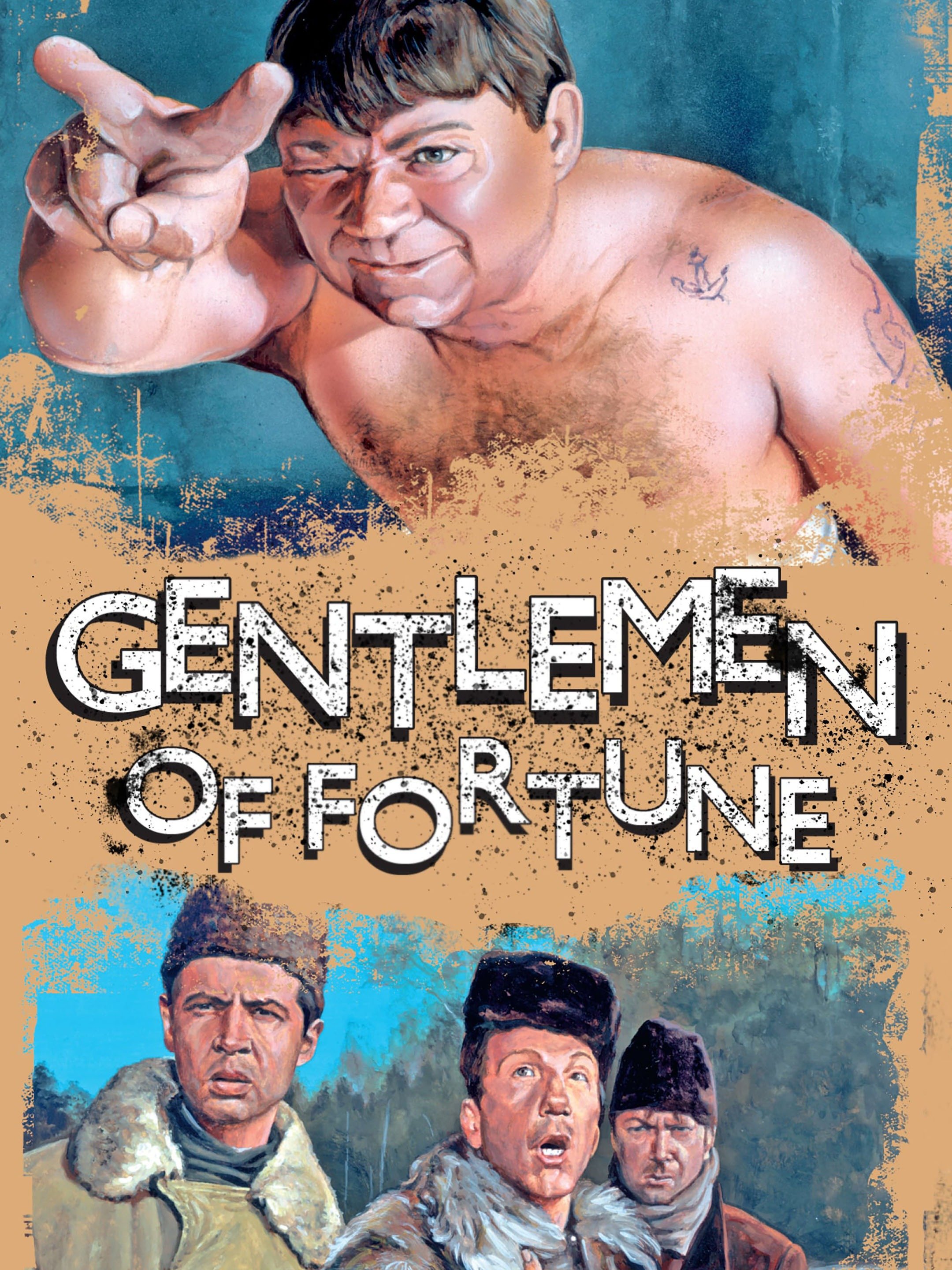
A group of archaeologists are hammering away somewhere in Europe when they quite literally come across a treasure trove, which included a solid-gold helmet that they estimate belonged to Alexander the Great when he was on his campaign to conquer the entire world. Their history-making discovery is soon interrupted by the arrival of three criminals, the notorious Dotsent (Yevgeny Leonov) and his two goons, Cross-Eyes (Savely Kramarov) and Sad Sack (Georgy Vitsin), who steal the artefact and ride away with as much speed as they did when they first appeared out of nowhere. Knowing that they see it as only a chunk of gold that could be easily melted down and sold to any ignorant buyer, the authorities seek out this gang, and are eventually successful, since they’re not the smartest group of criminals. However, they fail to find the helmet, which means they have to make another plan to find out its whereabouts. Salvation comes in the form of Yevgeny Ivanovich Troshkin (also played by Yevgeny Leonov), a mild-mannered schoolteacher who bears a striking resemblance to Dotsent. The plan is to send the gang-leader off to a prison out of the country, while Troshkin disguises himself as the tough-as-nails gangster, and is subsequently imprisoned in the local Moscow jail, with the two men who believe him to be their former boss. His assignment is simple – fool the two goons into revealing the whereabouts of the helmet, and then he’ll be able to return to his everyday life. However, this proves to be far more difficult than any of them bargained for, since no one seems to remember exactly where the helmet was stashed. The only option is to escape – but even with the secret support of the prison, there are many complications that result in weeks of meandering through the country, trying to solve the mystery without getting into even more trouble, which proves to be almost impossible for this motley crew of deliriously useless criminals.
By this point, we’ve discussed Russian comedy enough to move beyond the point of being surprised that a nation perceived as being far more dour and authoritarian than many others actually produced work that stands as amongst the funniest ever made. On a personal level, I’ve found more joy in the works of Leonid Gaidai and Eldar Ryazanov than many western directors. However, there are some instances where their comedy just doesn’t work, which often can be attributed to the plot just not holding up and failing to really get off the ground. More interestingly, there are certain situations where the premise is incredibly strong, but the film instead falls victim to structural problems, which cause it to falter, if not outright fail in some regards. Gentlemen of Fortune is one such film, and while it may not be a failure in the traditional sense (it is an absolute riot, and should absolutely be seen by anyone with an interest in Soviet-era comedy), it falls just short of being an astounding success based on how director Aleksandr Sery and screenwriters Viktoriya Tokareva and Georgiy Daneliya (whose Splendid Days a decade earlier stands as one of the finest Russian productions ever made) handles what is an incredibly promising story, struggling to reach the depths that the premise hinted were well within its capabilities. However, this is not a disparagement of what is essentially yet another outrageously hilarious film, but rather an observation of the areas in which it fell behind, which could’ve easily have been rectified with a little work, since the foundation of absolute genius was already very much present throughout this otherwise entertaining but slightly unremarkable film.
Like many comedies of its time (not only restricted to its native land), Gentlemen of Fortune is a film that draws from a limited set of ideas, and uses paltry yarn to spin something very close to comedic gold. In this case, we have the classic instance of mistaken identity being used for comedic purposes – a middle-aged schoolteacher is initially thought to be a notorious criminal, before being recruited to find information. It’s a promising idea that sets off two acts of absolute brilliance – there aren’t many instances of a story like this not being extremely successful, since it has a certain quality about it that immediately makes it memorable, and allows the director to extract from a ready-made set of conventions that are tried-and-tested, with audiences responding to them with at least decently-sized enthusiasm throughout the years. Russian comedy often works well because it is so primordial – while they may be very much about life in Russian during any particular era, they have a universal quality, with their comedy touching on some universal concepts that should be recognizable to all of us. Oscillating between supremely intellectual and outrageously infantile, there’s a degree of needing to expect the unexpected when it comes to films like Gentlemen of Fortune, since it is clearly willing to go in any direction to elicit a few laughs – but it’s very possible that this same devil-may-care approach to its comedy may have been the root cause of its ultimate downfall, since it gradually loses its subversive edge, and becomes somewhat tedious. Never dull, but rather lacking in some of its raw, unhinged comedy towards the end, Sery’s work could’ve been improved by either a tighter handle of the material once the plot was fully in motion, or an entirely different direction. Either way, it doesn’t cause the irresistible charms of the film to erode in any way, instead proving to be just as enthralling as some similar films, just not as consistent in how it uses its material.
Structurally, Gentlemen of Fortune struggles to maintain the goodwill it amasses at the start, which is an unfortunate situation, since so much of what makes this such an entertaining film comes in the first half. We can attribute this to the central plot coming too soon – it takes less than 10 minutes for the film to be entirely focused on the main crux of the story, which may be appealing to those who enjoy the tendency for Russian films to cut to the chase almost immediately, but it comes at the expense of some necessary exposition, since there are some aspects of the story that could’ve benefitted from a preamble, allowing us to come to know these characters, as well as the significance of the item they’re seeking out. Less than an hour into the film, we can see how the story is stretching for content – there are moments that clearly exist to fill up space, rather than contributing to the storyline, which has essentially been resolved around the midway point. Gentlemen of Fortune reaches its peak here, and the gradually loses momentum, coming across as if it is trying too hard to be funny, not realizing the qualities that made it work the most are those that were introduced too early, leaving very little space for the viewer to be surprised. The film is too long to justify the extended coda, but too short to warrant the introduction of several new ideas, so the director was in a precarious position. It’s difficult to blame him for the shortcomings in the story, since there is clear evidence that a great deal of work was done in bringing this premise to life. It only falls apart when it tries to do too much, rather than keeping it straightforward – and one of the most endearing qualities about a strong Russian comedy is its adherence to simplicity. It doesn’t derail the film, but it does unfortunately prevent it from reaching its full potential.
While it may falter in some ways, Gentlemen of Fortune is generally a delight, a film that overcomes some of its shortcomings through the same scrappy dedication to its premise, as well as the national pride it felt (one of the more forgivable aspects of pro-Soviet comedies was their genuine fondness for their traditions, which stands separate to any particular opinion one has on the ideologies of the country, which don’t often factor into these stories all that much, outside of a wayward reference on occasion – there’s a joy in seeing anyone show pride towards their culture), which makes for a very enjoyable film that seeks to be more entertaining than it does original. Ultimately, it has many of the same ideas and narrative beats as any of the other Russian comedies produced during its time, so if one has seen any of them, you’ve essentially seen them all. Yet, it doesn’t matter all that much here, since so much of what makes Gentlemen of Fortune so special comes in how it carefully evokes gentle laughter that doesn’t restrict itself to a particular time and place, but rather appeals to a much wider audience, making these impeccably resonant films that still extract hearty laughter from contemporary audiences. Traditional but still strangely refreshing in both form and content, Gentlemen of Fortune has its moments of weakness, but still manages to salvage enough goodwill from its general premise to justify being a worthwhile experience for anyone with even just a passing interest in the period and the comedies produced during that time.
 The Postmodern Pelican