
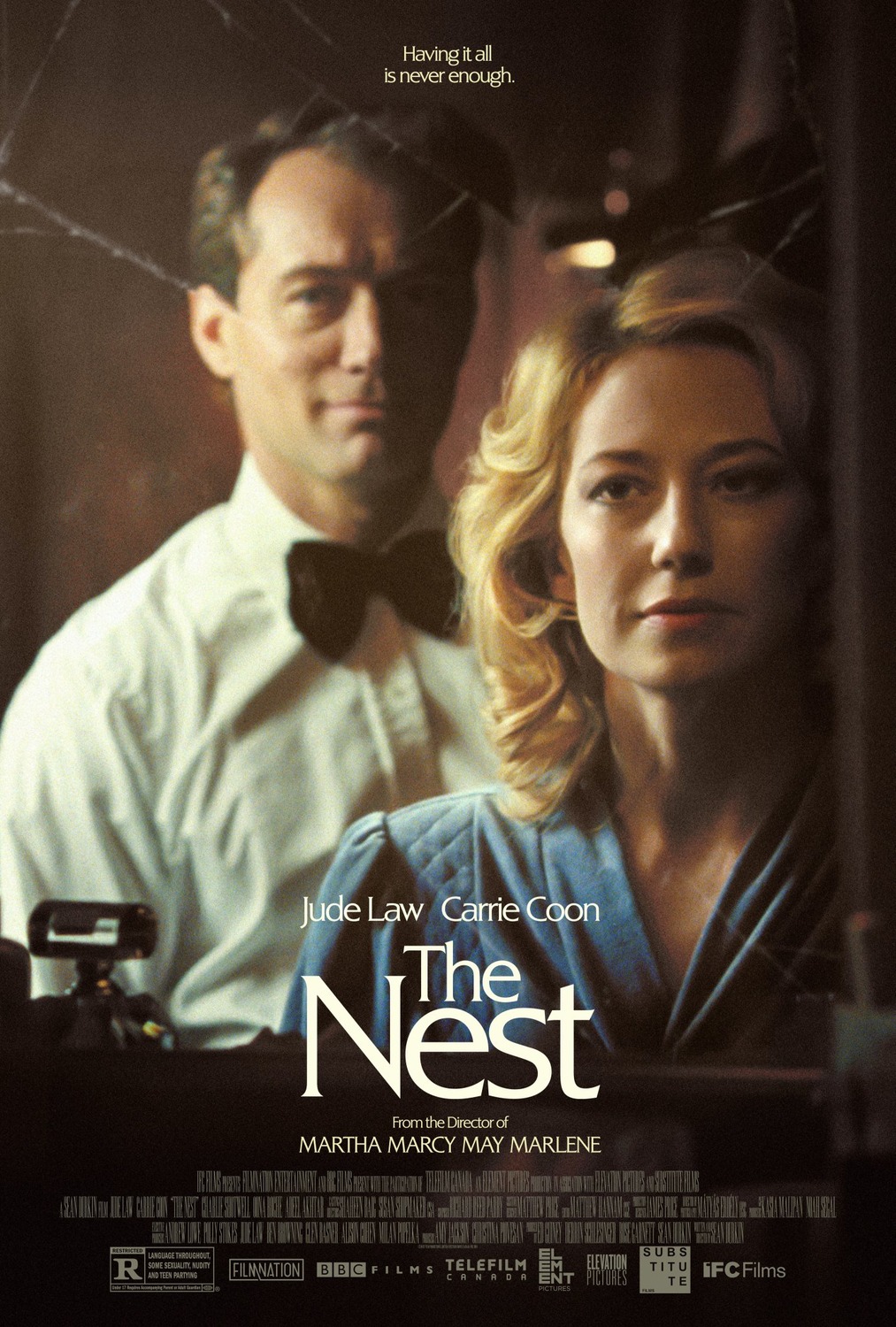
Sometime in the mid-1980s, a marriage is gradually falling apart. Rory (Jude Law) is a mildly successful businessman who begins to realize that his recent streak of good luck is coming to an end, and that there isn’t much hope for him in New York. He consults with his wife, Allison (Carrie Coon), who works as a horse trainer, and proposes that they move back to his hometown of London, where he believes there is a golden opportunity. Allison is understandably hesitant – she has been through the process with her husband many times before, with his ambition far outweighing any potential success, and the idea of uprooting their lives and moving to an uncertain future naturally causes her immense anxiety. However, Rory is insatiable, and she finally relents – after all, he assures her that failure is impossible, and that he has a good life awaiting them on the other side of the pond. However, their arrival isn’t easy, nor are the weeks that follow – their children (Charlie Shotwell and Oona Roche) struggle to adjust to this new way of life, being outcasts by virtue of being foreigners, as well as through their parents’ putting them in situations where they are bound to be judged. It doesn’t help that Rory begins to realize that his plans were not as rock-solid as he believed they were, which he only notices when the money depletes, and he’s left with no other option than swallowing his pride and asking his wife to help support the family with her own hidden funds, which is the final nail in the coffin of their declining marriage, with Allison being on the verge of a complete breakdown, isolated in a decrepit mansion in the middle of the English countryside, surrounded by nothing other than her miserable children, deadbeat husband and acres of dying land that mocks her weakness in relenting to give up a relatively decent life to end up on the precipice of poverty.
The world is a hostile place – and no one knows this better than the protagonists of The Nest, the harrowing social drama directed by Sean Durkin, who is finally gracing us with his sophomore effort, nearly a decade after he burst into the world of independent filmmaking with the incredible Martha Marcy May Marlene. Clearly not one to rest on his laurels, but also a filmmaker who understood where his strengths were the most effective, The Nest demonstrates a fascinating step forward for Durkin, with the director going in some unexpected directions with this darkly poetic story of a marriage falling apart, and the aftermath of the psychological torment that comes with being in a loveless relationship. The themes at the basis of The Nest are too complex to simply reduce to a brief logline, and even calling it a portrait of a deteriorating marriage seems somewhat misguided, since there is so much more lurking beneath this film, which is woven together with a slender thread of vague misanthropy and societal despair. It makes for a haunting, unsettling experience that captures our attention and forces us to stop and reconsider the limits of our own selfishness, and how we function in a world that is far less welcoming to those in need than the more idealistic of us would like to believe. Produced with precision and constructed in a way that it never gives too much of itself to the audience until the very end, The Nest is a powerful film that takes the viewer on a disconcerting journey into the depths of life at a particular moment in time, but which will undoubtedly resonate with any viewer that felt the same resignation and hopelessness as those who this film focuses the bulk of its attention on.
First and foremost, The Nest is anchored by two incredible leading performances by two actors who are doing some of their best work. Jude Law’s evolution from dashing heartthrob to reliable character actor has been fascinating – not necessarily a demotion, since he continues to do some incredible work, he has pursued a range of roles that often play on his earlier reputation for being the handsome leading man that broke as many hearts as he captured during his peak. Playing the vaguely sinister Rory, a man whose only villainy is that he is too audacious for his skills, Law is magnetic – he draws our attention with his cockeyed gaze and crooked grins that hide some sense of malice and manipulation. It is some of his best work in over a decade, and he continues to be immensely impressive as a man who is slowly starting to realize that he may not be as brilliant as he has led himself to believe, but his hubris keeps him from ever fully-admitting to these clear shortcomings. Law is matched perfectly by Carrie Coon, who is steadily rising to be one of the best actresses of her generation, treading the boards on film, television and stage, creating a reputation for being able to take on any role and infuse it with life and complexity, regardless of how thinly-written the parts may be. Much like Law, Coon is playing a role that is very internal – the contrastive voice of reason to Law’s volatile and impulsive character, she captures the spirit of a wife yearning for a better life perfectly. However, she constantly refuses to reduce Allison to a meek, weak-willed woman who is disappointed with her spouse, but not intrepid enough to confront the problems. In fact, part of what makes her performance so compelling is the fiery passion that burns beneath it, and how she works with Durkin to construct a character that is far more than just a thin archetype, but rather the beating heart of the entire film.
The relationship between the two main characters is pivotal to the film, since it forms the foundation on which a number of other discussions could be conducted. The Nest is a film primarily focused on a long-term relationship in decline – but unlike other works that have used this as a framework for some very compelling glimpses into the sacred institution of marriage, The Nest isn’t interested in the intricate machinations of what drives spouses apart from one another. There’s a complete lack of exposition in terms of how Durkin puts these characters together – we’re never impelled to feel even an iota of sympathy or pity for them, since both Rory and Allison are abhorrent individuals who conduct themselves in manners most unbecoming, which is what drives them apart. Their marriage itself is relatively solid – there’s a lack of infidelity, and they’re both equally committed to raising their family to the best of their abilities. It’s their hubris and inability to look beyond their own understandings of what a family should be that drives them apart. The Nest does very well to strip itself of unnecessary empathy, and the audience can’t be blamed for peering into this marriage with a sense of bemusement, because what is portrayed on screen is unfortunately a very clear and honest representation of what any long-term relationship can easily become without psychological curation, namely two people who have allowed their own insecurities, anxieties and refusal to move beyond their own delusional beliefs that they are the ultimate authority on domestic matters, not realizing that they are as incompetent in making such decision as they are in maintaining a level of respect for one another. It’s a harrowing film, because it doesn’t let either character off the hook – and even at their most tender, we can’t help but look at Rory and Allison with more scrutiny, since they’ve proven to not deserve the benefit of the doubt. They might not be equally at fault for the decline of the marriage, but they’re certainly complicit in refusing to work on their own issues and resolve the underlying tensions for the sake of the family and their lives as a whole.
Yet, beneath the very challenging exterior resides a beautifully human story about resilience in a world that seems to grow increasingly hostile to everyone, especially those who find themselves on the downswing. The Nest is set in the 1980s, when the United Kingdom was at a very difficult point in its existence, as the peak of Margaret Thatcher’s time in office caused some economic strife for those that weren’t part of the fraction that her ideologies favoured. Durkin isn’t interested in relitigating the political turmoil of the period, and is more focused on the social aspect of the story, which he explores through this touching tale of a family trying to make it work, despite lacking the fundamental resources needed to succeed. Using the period and location as a backdrop for this story of working through the challenges of trying to succeed when the social and cultural forces surrounding these characters are actively working against them, the film manages to capture the spiralling madness that comes when we’re in situations that appear inescapable. It gives The Nest a sense of humanity, and lends it a depth that may not be expected, considering how bleak the main thrust of the story is. There are brief notes of hope that underpin the film, especially towards the end, when we realize that none of these characters are going to have a revelatory moment that changes their behaviour or gives them stunning new insights into life, and causes them to reevaluate their choices. They’re likely going to continue on this same path, albeit only with minor changes, all of them coming from the necessary action of moving beyond one’s pride, and simply just doing what is right, rather than what is easy. It’s a humane portrayal of some unsettling issues, but Durkin executes it with such precision, balancing the cold-hearted commentary of the story with a slight sense of optimism.
The Nest is a fascinating film, and one that isn’t easily categorized, since it may be quite simple, but it has a complexity to it that doesn’t lend itself to a straightforward analysis. Many have classified it as a psychological thriller, which isn’t inaccurate, but serves to be more of a starting point than an all-encapsulating description of the film. Like his debut feature, Durkin is searching for something deeper beneath the surface of a relatively direct drama about domestic issues, which have been layered with a sense of existential despair, particularly in how the story explores the inner-depths of something as common as a longtime marriage. He carefully extracts an endless amount of emotion by looking beneath the surface of an idyllic relationship, and exposing the underlying tensions that persist throughout it. Not necessarily a film told in broad strokes, but rather through intimate details, The Nest is a poignant elegy to those who are working through challenging times, whether professionally or in their domestic lives. It’s bleak and tends towards being more unsettling than it is heartwarming, but there is a sense of hope that gradually comes through, particularly in how Durkin clearly understands these characters and fashions them as meaningful representations of individuals, rather than archetypes used to tell a story. Convincing in its intentions, and beautifully direct in how it confronts certain issues, this film is a powerful look into a marriage, delivered with poignancy and honesty, and a sincerity that tends to be most prominent in this exact brand of intimate, quiet independent dramas that say more through implication than it does through explicitly discussing a range of issues.
 The Postmodern Pelican