
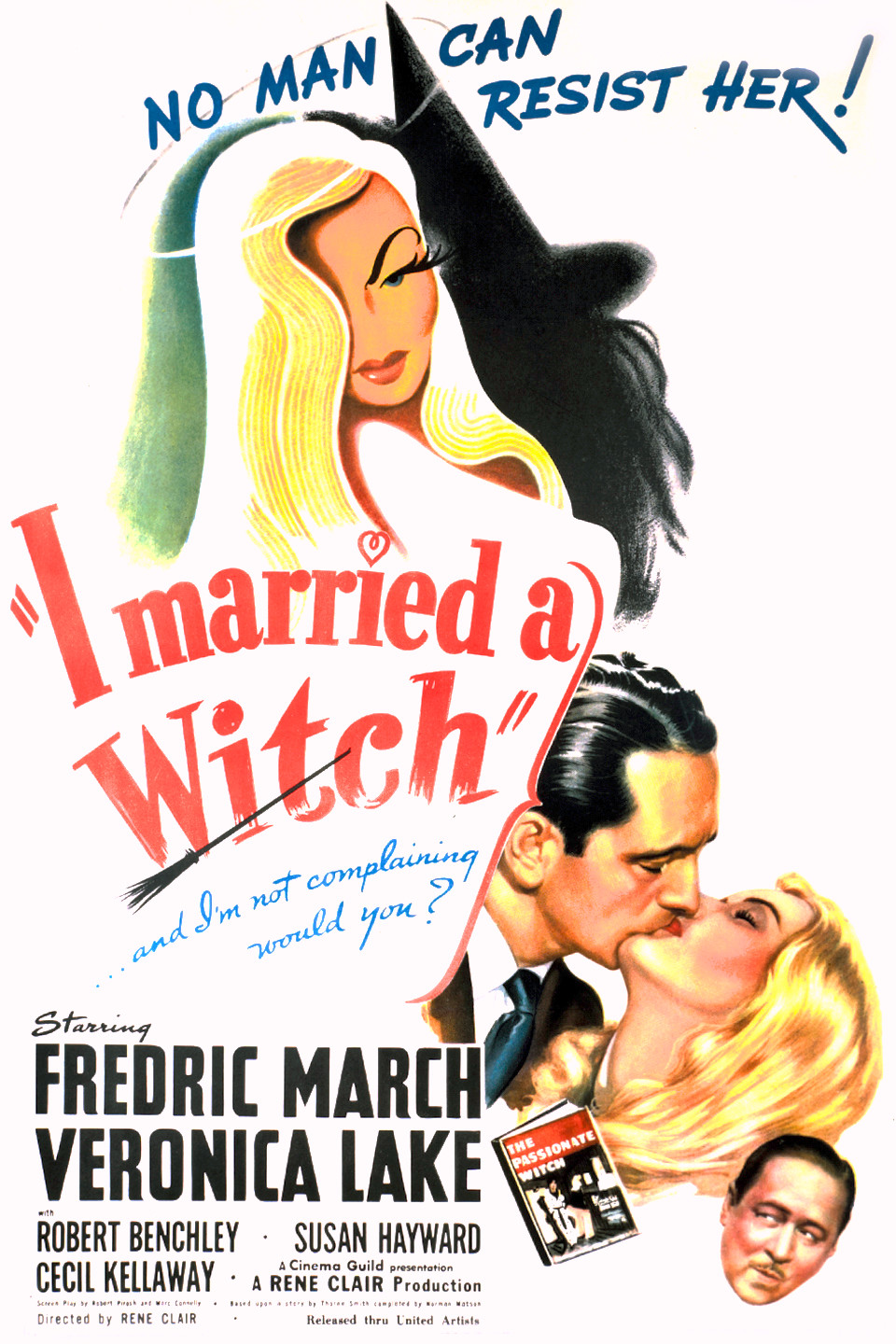
In the late 16th century, a witch (Veronica Lake), and her sorcerer father (Cecil Kellaway) are caught in the middle of the infamous witch-hunts that many puritanical individuals occupied their time with. Three hundred years later, they manage to emerge as smoky entities, now in search of bodies to allow them to enter into the 20th century. It so happens that they come across Wallace Wooley (Frederic March), a young politician who is running for Governor, and is most likely on his way to victory, since he is well-liked and passionate about his line of work. It also helps that he is engaged to be married to Estelle Masterson (Susan Hayward), a pernickety young woman. Their marriage isn’t one built on love or admiration, but rather strategy, since her father (Robert Warwick) is a well-known public figure who runs the local press, and has made a concerted effort to show his future son-in-law as being the perfect candidate for political office. Unfortunately, these plans are derailed by the arrival of these visitors, with the witch taking on the name and body of someone named “Jennifer”, who is sent to fall madly in love with Wallace, and cause him to do the same. This is an unexpected turn of events, since he was not anticipating this mysterious woman entering his life – so his discovery that she is not some arbitrary figure, but rather a powerful, ancient witch, only further proves to complicate his affairs and causes him to second-guess absolutely everything he held to be true in the first place.
In his second English-language directorial outing, masterful French filmmaker René Clair made something quite special with I Married a Witch, an adaptation of the novel The Passionate Witch by Thorne Smith, turning it into a lovable little romantic comedy that has that delightful sheen that many films produced in the Golden Age of Hollywood tended to feature quite prominently. The kind of film that one doesn’t look towards for mental stimulation or revolutionary filmmaking tactics, but rather for a much-needed dose of high-energy catharsis after a long day, I Married a Witch is an absolute joy to watch, and running at a paltry 77-minutes, it’s a breeze to get through, with Clair’s filmmaking keeping everything moving along steadily, extracting the most meaningful comedy from an otherwise outrageous premise. All of it converges into one of the more unforgettable films produced at the time, an era in which the form was starting to become much more experimental in the stories it told and the form they took, which can be found condensed in every frame of this film, which doesn’t take itself too seriously, and knows how to give the audience the experience of a good time, which means more than the self-serving films that existed at this time, in which romances were viewed as something much bigger than it actually is. Intricate, compelling and never anything other than hilarious in how it delivers some unforgettable emotional punches in between the broad comedic jabs, I Married a Witch is a total triumph, and a film that is only more rewarding on further viewings.
You can’t really talk about this era of Hollywood history without coming into contact with Frederic March, one of the greatest actors to work in the medium, albeit one whose legacy is sadly confined mainly to cinephiles and connoisseurs of this era of filmmaking. An effortlessly talented actor who could do comedy and drama in equal measure, his skills are put to the test in I Married a Witch, placing him at the centre of an irreverent romance that pays tribute to both his impeccable skills as an actor, and his ability to play the straight-man in such a way that he isn’t entirely humourless or submissive to the quirkier charms of the story. March had an effortless charisma that Clair was able to effectively play with in this film, placing his character in bewildering situations and watching him scramble to get out of them – and it all makes for unhinged comedic brilliance, since March is nothing but willing to do all of it. He is complemented wonderfully by the iconic screen siren Veronica Lake, whose combination of a fragile, rose-like physicality and an unexpectedly deep sense of comedic timing, make her performance as Jennifer instantly iconic – hilarious, but in a measured, structured way, Lake brings out the inner complexities of a character that could’ve so easily been a mere stereotype, a thinly-veiled stock character that doesn’t add much to the story. In looking at the reasons why I Married a Witch is still so acclaimed today, one of the key components are the two central performances, with their individual work being strong, and their chemistry being palpable – it’s difficult to imagine anyone doing what March and Lake did any better than what we see in screen, which is a strong indication of an indelible set of performances.
Looking at I Married a Witch and its central premise from a contemporary perspective may give off the sensation that it’s a very simple story without much depth. However, considering this was a film made in 1942, a time in which a story centring on positive representations of witchcraft and other supposedly “dark” arts, there is a level of audacity that went into the creation of this story. Hollywood grew to be quite liberal quite early on (obviously within reason – looking back at old films through a contemporary lens is bound to find problems that don’t lead to much effective discussion in many instances), but even for that time, a story such as this may have been considered quite scandalous, if not vaguely vulgar. There isn’t much effort to hide the fiery sexuality of these characters, the moralistic cores of mid-century American society dismissed in favour of an intrepid exploration of lust and desire, with a healthy dose of literal magic thrown in to complicate it even more. Obviously, a film made at this time couldn’t be so frank about these issues, instead portraying them through allusion and innuendo – and what often happens with attends to conceal the real message is that the attempts to hide it only make it even more fervently scandalous, which only adds to the humourous depths of this story. Clair brought a distinctly European flavour to the production – this comes after a few years working in his native France, where comedies were much more acidic, and executed with a kind of laissez-faire approach to the stories, letting them flourish into their own distinct works without the confines of a stringent studio system – working across the pond meant that Clair may have had to reign his style in somewhat, but his style still persists throughout, making I Married a Witch one of the first studio films helmed by someone with as distinct an authorial voice as his at the time.
I Married a Witch is a fascinating film, and one that feels so incredibly simple. It isn’t surprising that it has come to be one of the most cherished comedies of its era – if we look back to this time period, the ones that stand out the most and resonate with audiences more than others are those which present us with a simple but effective premise that offers an original concept, but never goes about complicating the matters too much, letting it all flourish organically. It makes for a rather thrilling series of events, with everything contained within this delightfully quaint comedy feeling impactful and entertaining, which is a sign of a work that continues to leave an impression, decades after its original release. Hilarious, irreverent and, more than anything else, built on a foundation of pure, unadulterated fun, I Married a Witch is such a cheerful, captivating comedy, grounded by two solid performances, and a screenplay that keeps everything simmering with the same kind of lovable charm that kicks it off and makes it so unforgettable from the very first moment. Ultimately, Clair knew how to make something special, and quite literally enchants us and puts us under a spell from which there is little hope of escape – not that we want to leave this world anyway, since it’s so much fun to be a part of it.
 The Postmodern Pelican