
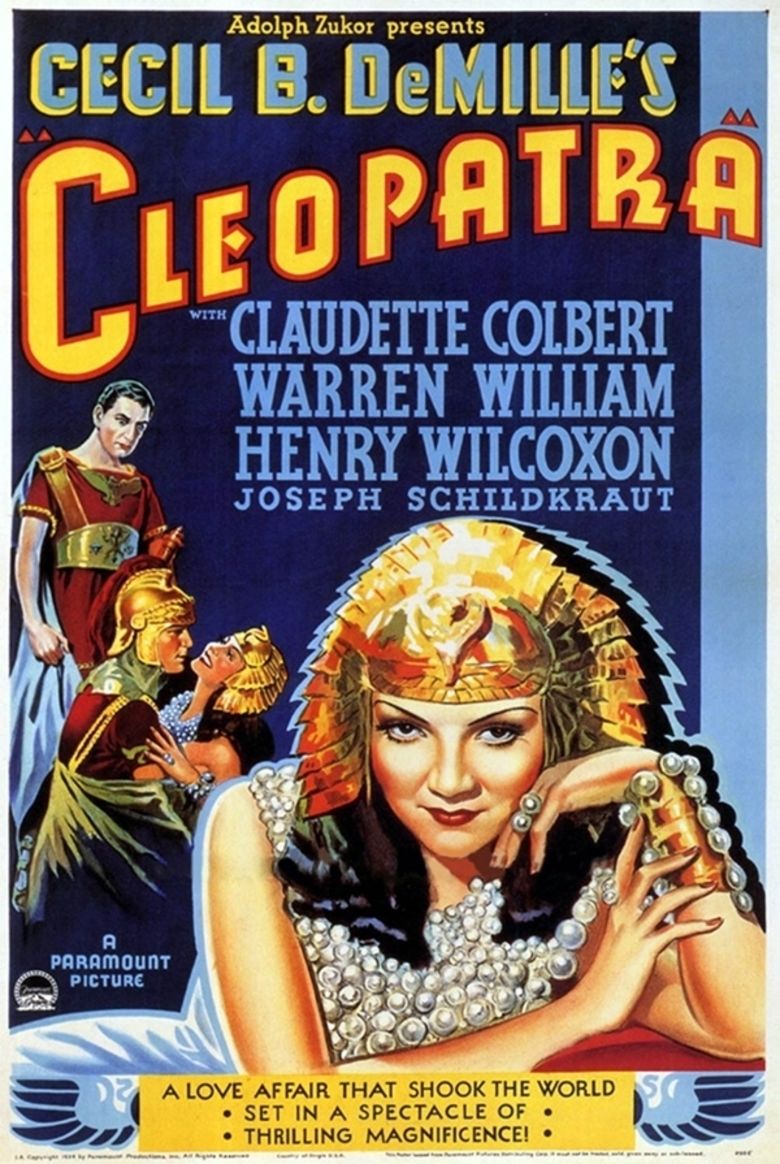
Let’s talk about Cleopatra, Cecil B. DeMille’s ambitious attempt to capture the life and times of one of history’s most enigmatic figures on screen. This is a film brimming with historical inaccuracies (with screenwriters Waldemar Young and Vincent Lawrence, and the film’s resident researcher and compiler of information, Bartlett Cormack, choosing to forego correct chronology for the sake of a streamlined flow), filled with some racial and gender choices that would certainly not be acceptable today, and tries to condense an entire life into a neat, 100-minute long package. Yet, despite all of this, Cleopatra somehow manages to be a masterpiece. A visually striking, fascinating foray into the life of the titular Egyptian queens, whose experiences DeMille is dedicated to capturing on-screen in a way that both pays tribute to the historical figure it represents, and gives the audience something unforgettable. Not necessarily the definitive account of Cleopatra’s life, but rather a thrilling attempt to bring it to life during an era where cinema was becoming more ambitious, DeMille’s work here proves why he stands as the most commercially successful filmmaker to ever work in the medium, with his eye for detail and ability to evoke only the most genuine reactions from viewers making his work incredibly resonant, even over a century since his directorial debut. Not his most well-known work, but certainly one of his most fascinating experiments (especially in his slightly earlier days, where he wasn’t reliant on exorbitant lengths and all the funding Hollywood could muster up for his next projects), Cleopatra is an enthralling and captivating biographical drama that pays appropriate homage to its main character, and gives us something memorable to take with us afterwards.
Cleopatra was made at a fascinating time for Claudette Colbert – 1934 was a banner year for the actress, with a number of projects featuring her immense talents being released that year (including her star-making performance in It Happened One Night), proving that she was an actress who would leave an indelible mark on the industry. The role of Cleopatra is certainly one that any performer would be thrilled to put her interpretation on, since there is so much to work with. The famed Egyptian queen was a truly charismatic individual, and the amount of character work that could go into her is staggering. Colbert occupies the role brilliantly, especially since it is slightly against-type – she was known for playing feisty characters on occasion, but she didn’t have the distinctive mysticism that many other portrayals of Cleopatra have depended on. This is used to incredible effect, since so much of the role requires Colbert to tap into her inherent waif-life charms, which stand in stark contrast to the fierce conviction with which the character is constructed. It’s a collision of different personality types that works well, especially since Colbert is willing to take on a very nuanced portrayal of one of history’s most fascinating individuals. Cleopatra is filled with many characters, each one with memorable moments – but they all essentially exist in service of the compelling leading performance, and function as supportive of her, rather than stealing the spotlight away from what is a very strong, but easily neglected, performance by one of the Golden Age of Hollywood’s most fascinating actresses.
As strong as Colbert is, she herself is only in service of DeMille, whose vision is what drives Cleopatra forward. This is a visual spectacle that can rival any of the other interpretations of the Egyptian icon’s life – and in many ways, it manages to be even more impressive, since the director found ways to tell this story without the endless resources that later versions would take for granted. Produced in the notoriously ambigious space known as the Pre-Code era, where directors could get away with more than they would in a few years, Cleopatra sees DeMille taking some interesting risks, and while it is entrenched in the antiquity, there is an atmosphere of modernity – the outfits are far from conservative (and there are even moments when prominent female characters are shown to be wearing trousers, which may be historically inaccurate, but provides a sense of originality to this film), and the general mood of the film seemed refreshingly unique, especially for a historical epic. Certain moments in Cleopatra are filmed so stunningly, they stand as some of the most innovative of the era – the assassination of Julius Caesar, the arrival of Cleopatra in Rome, and the final moments where she sits on her throne after committing suicide, are striking and unforgettable, woven into a film that doesn’t have a shortage of memorable sequences. DeMille is often equated with excess, but it’s always important to remember that he garnered such a reputation not because he was wasteful, but due to his tendency to extract every bit of potential from a moment, which is evident through every frame of this film, which goes from a simple biographical drama to a full-blown historical spectacle that leaves an incredible impression on the viewer, even if the story itself may suffer as a result.
One of the more distinct complaints that have been thrust on Cleopatra is an element that I find quite remarkable is its ability to dismiss the concept of accuracy in favour of a stronger story. In the modern cinematic landscape, such artistic liberties are almost taboo unless it serves a very clear purpose – and simply doing it for the sake of making your story more palatable doesn’t immediately strike one as being a good enough reason. Yet, considering the wealth of information that we know about Cleopatra’s life, which could’ve easily filled up several hours worth of filmmaking (as we saw in the ill-fated 1963 film version of her rise and fall, which often bit off far more than it could chew), it’s admirable that DeMille took an approach to only touch on the major events, and let everything else fall into place wherever felt most appropriate. At times, this version of Cleopatra can feel like a greatest-hits compilation – we have the arrival in a carpet, the death by the bite of a snake and everything else in between – but it works in the context of this film, which was never trying to be the comprehensive account of her life, but rather a charming, vaguely-comedic look into history that sells itself as a crowd-pleasing piece of entertainment, rather than an exhaustive, stuffy period drama that takes itself too seriously. Cleopatra is a film that feels like it is trying to actively entertain audiences – and its beautifully poetic visual splendour only helps contribute to the experience of seeing her story told by someone who excelled in taking the antiquity and presenting it to audiences in new and exciting ways, even if it meant sacrificing some accuracy along the way.
As one of the true embodiments of the gold-standard of film directing, Cecil B. DeMille has always stood out as someone who took his craft seriously, and reaped the rewards throughout his career, becoming a filmmaker who defined a generation of grand-scale storytelling. Cleopatra may not be as well-known as some of his other films, but it doesn’t mean that it’s any less enthralling, particularly in how it tinkers with the conventions of the historical epic, a genre that was still relatively in its infancy, especially in the sound era, where suddenly focus shifted away from only presenting a visual spectacle, but also have a strong story and memorable dialogue to exist alongside it. This film is a hypnotic experience, using the legendary life of Cleopatra as a starting point for a fascinating character-study that attempts to uncover her life and understand her, beyond the guise of simply an iconic historical figure. There’s an honesty to this film that feels very refreshing, especially in the moments where it touches on the human side of the titular queen. We’re given something compelling in Cleopatra, which is certainly one of the most interesting epics from this era, and the rare kind that can balance splendour with earnest, character-driven details in equal measure, which all eventually add up to a truly endearing look into the trials and tribulations of a true historical icon.
 The Postmodern Pelican