
James Hart (Timothy Bottoms) has steady plans for the future, and the conviction to work towards it, choosing to pursue a career in law, which means that he has a long road towards becoming an expert in the field ahead of him. He manages to get into a law programme at Harvard, which he soon learns is a fact that one can gloat on for only a short amount of time before they truly need to start working to actually graduate, which is a much bigger challenge than getting into the famed institution. It doesn’t help that Hart is a more hands-on learner, with his approach to studying being one that works for him, but doesn’t situate him immediately as someone who will be successful by the end of it. His biggest challenge comes in the form of Professor Charles Kingsfield (John Houseman), a pedantic, elderly academic who is well-regarded at the university with an almost folkloric reverence, but who proves to be a fierce adversary for the more rebellious Hart, who decides that he isn’t going to let a dissenting, bitter old law professor like Kingsfield destroy his ambitions. It soon becomes clear that Hart has found his match in his lecturer, who proves to be able to roll with the punches and take everything presented to him in stride, which is worrying to Hart and his fellow students, who do their best to assert their own authority and make their voices heard, even when they have someone before them who is well-versed in controlling renegade students, being almost proud of his tendency towards ruining just as many dreams as he helps realize.
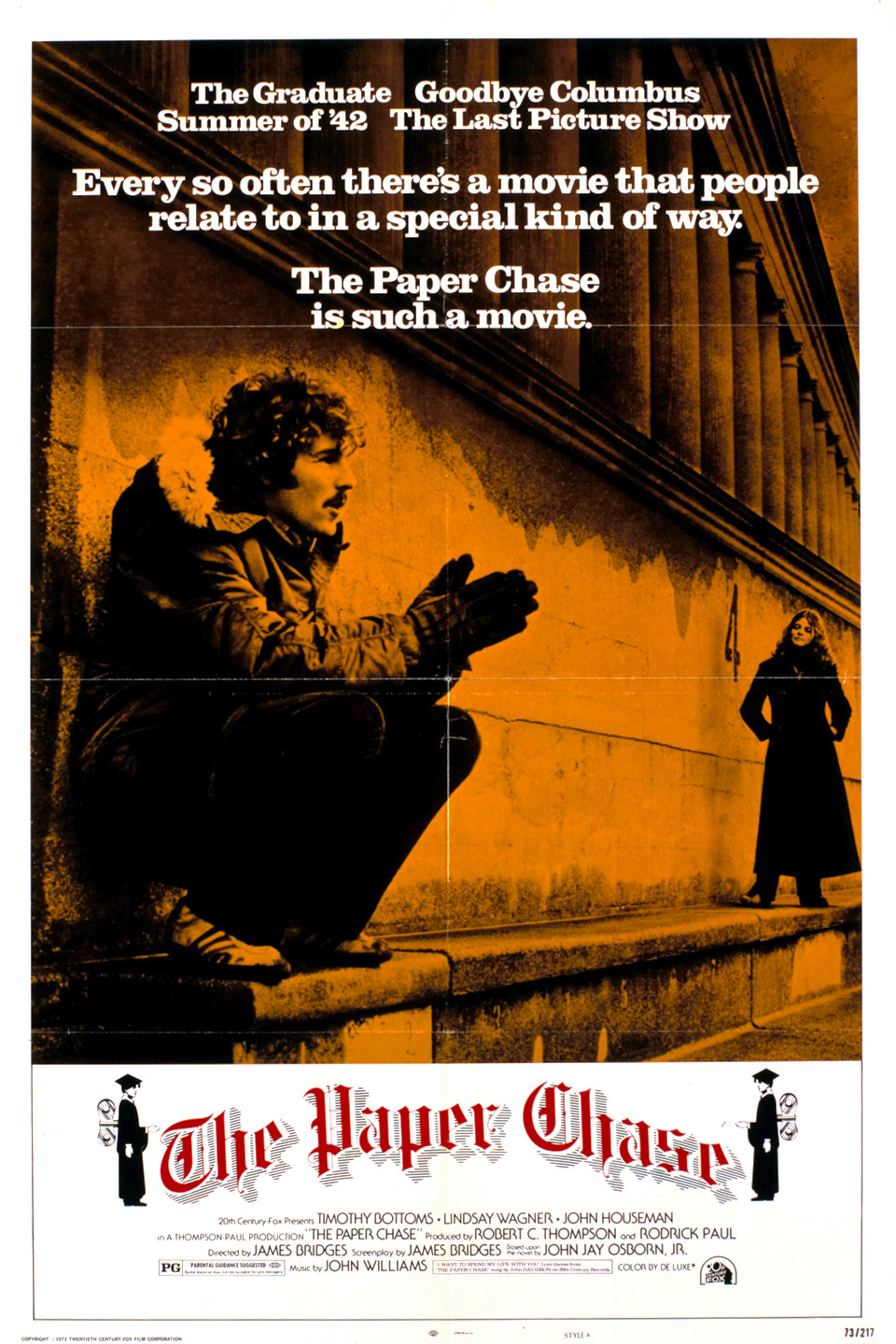
The trouble with iconic films from a few decades ago is that not everything can be remembered, which means there are a great deal of other films that fade into obscurity, while others are mostly memorable because of a specific aspect that keeps them in the conversation, even if only as a novelty. One such film is James Bridges’ wonderfully wry The Paper Chase, a decent little comedy that is mostly remembered as the first major role of John Houseman, better known as a writer and friend to wunderkind Orson Welles from the famed auteur’s earliest days as an upstart troublemaker in the 1930s. Bridges, who is also a filmmaker who hasn’t become part of any real discussion of notable figures from this period, made a tremendously fascinating film that may not always have the longevity of some other films from this period, but is still worth taking a look at, especially considering how timely some of this subject matter tends to be, and how there are certain resonant themes embedded deep within this film that keep it quite refreshing, even if it was produced nearly half a century ago, and where many of its ideas can be considered outdated if we look at it from the wrong angle. Understandably, a film like The Paper Chase doesn’t have much cultural cache, which makes it the perfect candidate for a late-breaking re-analysis from a contemporary perspective, where the novel by John Jay Osborn Jr. can be given another look, and its fascinating approach to the world of academic once again the subject of considerable conversation, and an equal number of delighted cheers (and perhaps a few well-placed jeers) at the very peculiar sense of humour employed throughout the film.
The Paper Chase is a film that depends almost entirely on its actors, with every member of the ensemble playing a part in bringing this story to the screen successfully. The film is led by the wonderful Timothy Bottoms, whose charisma and rugged, modern masculinity combined with a deep intelligence made him a very unconventional leading man, but one that functioned perfectly in the film, even if he wasn’t the most memorable part of it. This honour instead goes to John Houseman, who is perhaps the most compelling reason to watch this film, since his performance isn’t only exceptionally good, but the circumstances surrounding his casting is just as endearing as the actor himself. By his own accounts, prior to his casting, Houseman was “an ageing schoolmaster” selected to play the role by the director himself, drawing on a previous professional relationship between the director and the jack-of-all-trades who had to wait until he was well into his seventh decade before finally getting the chance to prove himself as a screen star. Houseman is captivating – dry but filled with a peculiar warmth, his performance as Professor Kingsfield is a revelation if there ever was one. Clearly inspired by his own time behind a lectern, Houseman commands every frame of the screen when he appears, and leaves a profound sense of absence when he steps away from it. His chemistry with Bottoms in particular is worth noting, since this entire film is built mostly on the dynamic between a young, rebellious student and his brilliant but prickly professor, showing the gradual disintegration of the student-teacher relationship, turning this into a very unconventional cat-and-mouse game that would be almost a psychological thriller had it not shown the necessary restraint that allowed it to remain so entertaining and buoyant.
Anyone who has ever had experience in the world of academia will undoubtedly find something in The Paper Chase to latch onto, whether it be the feeling of those early-morning lecturers, conducted by people who were so knowledgable on their area of expertise, they are bored by their own brilliance, which filters towards the despondent students, or the sensation of being young and lost in a world that we have barely been given the chance to try and understand before being vicious thrust into it, in the hopes that we can find a way to survive. This is a film made for a generation of viewers who can recall the various degrees of despair and triumph that come with a tertiary education (and considering recent events, it may be considered a relic much sooner than we’d think), which is both responsible for the strong reaction many have had towards it since its original release, as well as the disparaging remarks from viewers who find its overly-academic approach stifling and inappropriate, since it certainly does convey a sense of superiority, situating itself as a commentary on the machinations of a college education, and making it known that it believes higher education is the one and only means towards success (which is subsequently dismantled in the unforgettable final moments, where this entire message is literally lost at sea). It’s certainly a film that has a bookish sense of humour and a constant need to get into some profoundly serious discussions on the role of education in forming one into a functional member of society – and while some more care could’ve been taken to open up this world to other viewers, so one doesn’t need to have had their own first-hand experience with the concepts being explored here, The Paper Chase does relatively well in making a riveting film from material that could’ve so easily been the folly of something more dull and lifeless.
The Paper Chase is a niche film – it is undeniably overly-academic in its approach, and there can be a perceived lack of any tension beyond this particular set of quirks. Unlike many other films that take place within a college, this film doesn’t have anything necessarily external to serve as an entry-point for those who may not be as familiar with the ins-and-outs of being a university student, which is perhaps the film’s most unforgivable aspect, since it would’ve been so much easier to open this world up to a wider viewership, rather than alienating them, which seems to be one of the fundamental reasons why the film isn’t as well-remembered today as some of its contemporaries. However, putting this aside, it’s clear that Bridges made a very effective film, an effortlessly traditional glimpse into the trials and tribulations of students, especially those fighting to find a place in a world they’re still struggling to make sense of, which is only made worse by the endless confusion that comes when interacting with those on the other side of the career spectrum, but who inspires nothing but despair in those hoping to pursue such a line of work. It’s upbeat, heartfelt and often very funny, and even at its most prosaic, the film has a lovely sense of humour that shows a distinct admiration for the human condition, which is a wonderful and very worthwhile reason to seek out this otherwise delightful comedy.
 The Postmodern Pelican
Houseman is brilliant as Kingfield. It would be a different film if the original casting of James Mason had not gone awry.
As someone who finds Mason a bit too excessive when he plays these overly-pernickety, intellectual roles, I can’t be more glad that Houseman got the role and delivered such an outstanding, complex performance.