
Through her capacity as one of the film industry’s preeminent artistic revolutionaries, Agnès Varda introduced many distinct ideas into the global film culture, among them was the concept of cinécriture (“film writing”), perhaps her most important idea, since it is the one factor that not only bound her films together under a single artistic theory, but served as a manifesto for half a century of filmmaking, with many contemporary artists still employing her ideas, sometimes without even realizing it. It’s important to bring up cinécriture here, since this essentially seems to be the foundation of Heroes Don’t Die (French: Les héros ne meurent jamais), the ambitious social drama by Aude Léa Rapin, who is making her feature directorial debut with this astonishing testament to identity and the ways in which our perception of the world changes, depending on how we react to a particular situation and our place within it. An electrifying drama that takes the form of a documentary, interweaving many different ideas under one artistic umbrella, the film aims to find the nuance in a story that has been explored many times before (most notably in another recent film, Quo Vadis, Aida?, which serves to be a wonderful companion piece to this film, with one looking at the fateful day of the Srebrenica Massacre, in which over 8000 civilians were brutally executed by the Army of Republika Srpska, and the other focusing on the aftermath, a quarter of a century since it happened), bringing a sense of unimpeachable humanity to a premise that may have fallen apart without as assured a hand and steady a mind as that demonstrated by Rapin, who is already proving herself to be an essential voice in contemporary cinema, if Heroes Don’t Die is anything to go by.
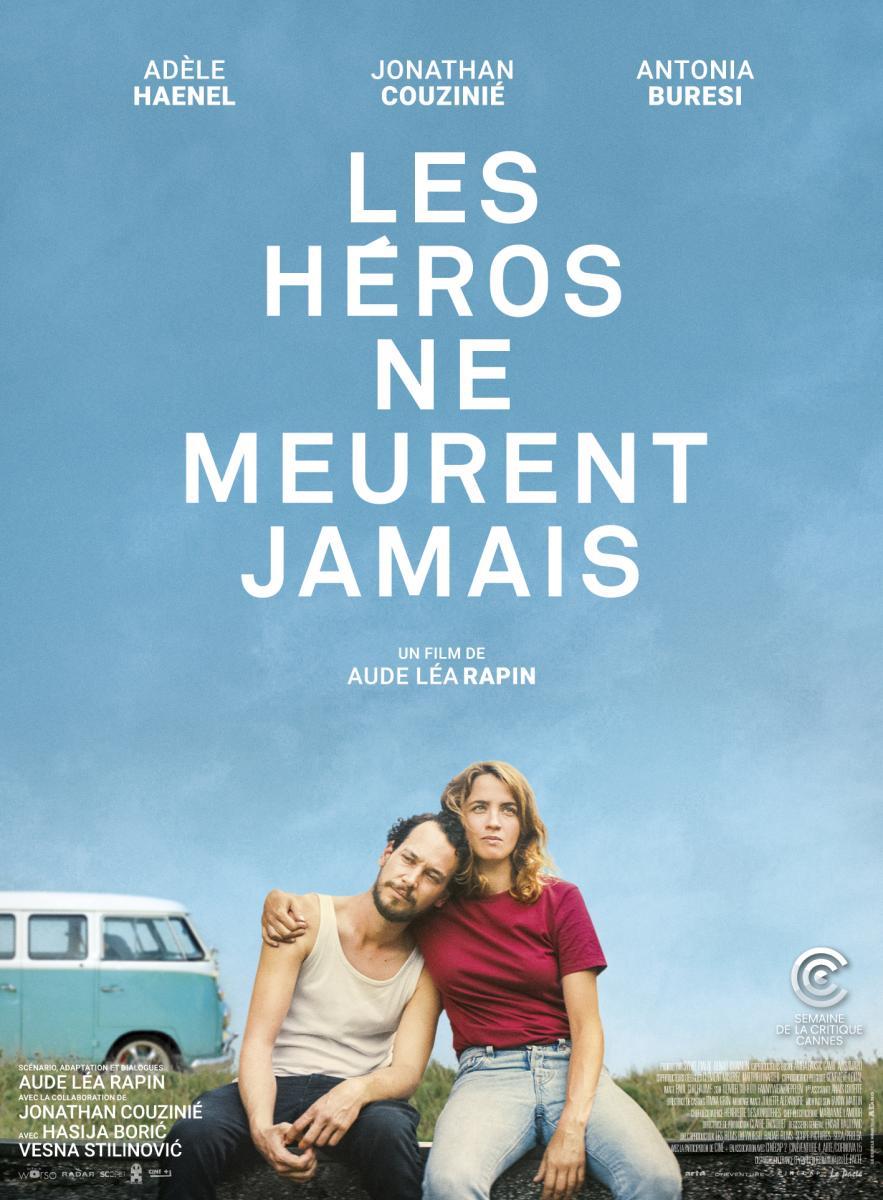
At the start of the film, we’re introduced to two character – the first is Joachim (Jonathan Couzinié), a young man living in Paris. The other is Alice (Adèle Haenel), a freelance journalist and filmmaker, with whom he has a peculiar relationship. One afternoon, he mentions how he was accosted on a crowded street, and called by the name “Zoran” by a complete stranger, who claimed he had been responsible for the deaths of countless people. Realizing that the date that this mysterious “Zoran” died was the same day he was born, Joachim begins to believe that he is the reincarnation of this man, and with the assistance of Alice and her film crew, they travel to Bosnia and Herzegovina, to a village that Joachim vaguely remembers as being associated with his past, even though he has never even stepped foot in the country. Over the next few days, the crew travel throughout the country, looking for clues to the identity of this mysterious man – armed with only his first name (which they soon learn is by far the most common name amongst the Serb population, making the process of narrowing it down nearly impossible), and the date of his death, they frantically look for some evidence to his existence, whether it be a gravestone that confirms that he was indeed a real person, or a first-hand testimonial from any of the occupants of the village that he supposedly came from. However, this proves to be almost impossible, especially when doubt starts to enter into the mind of Alice, who begins to wonder where this bizarre quest is actually worth it, and if there is any reason to believe someone whose mental fragility indicates that this may all be some absurd fantasy he is reenacting as part of some traumatic, suppressed past that he never fully reveals to anyone.
To draw back to the Varda theory spoken about at the outset, Heroes Don’t Die is a film that focuses on the power of the camera as a discursive tool, rather than just a means of recording. There is a tendency to view the camera as essentially just a method of capturing everything that occurs in front of its lens, making it a neutral device of investigation, and the person behind it nothing but a passive observer to what is before them, using it as a medium to examine without commenting, which is all done independently of the camera. Cinécriture focuses on rebelling against the idea of simply capturing reality, and that the filmmaker is just as capable of using the camera as a tool to “write” stories, in the same way that one would use a pen to do the same. It’s a vaguely ethnographic approach to the filmmaking process, and one that is certainly not lost on Rapin, who does exceptionally well in bringing these ideas to the present film, sometimes in very direct and explicit ways. The camera doesn’t only reflect stories, but can also actively shape them (we’ve seen this most prominently in non-fiction films), and in creating a vivid story that is presented as if it were a documentary, Rapin is making some profound statements on the nature of the human mind, and how we tend to construct narratives that we believe are ideal, and change the world around us in ways that help consolidate these ideas and make them fit into our particular chosen stories. Reality is impossible to fully comprehend, and an objective perspective on life is just as implausible as the most fantastical flights of fancy – but when we’re dealing with a story that focuses almost entirely on the boundaries between fact and fiction, it all becomes somewhat more ambigious and takes on an entirely new meaning, which the director beautifully conveys throughout this magnificent, heart-wrenchingly striking testament to the human condition.
Throughout the duration of Heroes Don’t Die, the mystery surrounding these characters and their particular perspective begins to unravel, and we start to understand the lengths to which the film goes to explore certain ideas. Blurring the concept of fact and fiction is pivotal to the film, but Rapin is not the first director to take on the idea, since there are many instances of such stories being told in new and exciting ways. It’s not the concept that keeps us engaged, its how the film makes use of it – and as we learn more about these characters (particularly Joachim), the more we understand the rationale behind some of the absurd lengths his friends go to in order to support him – we learn late in the film that he is terminally ill with a heart condition that could cause him to die at absolutely any moment, with everyone around him knowing that he is essentially living on borrowed time, and that he could meet his fate at the drop of a hat. As the film progresses, we come to realize that this film isn’t about a group of renegade filmmakers venturing into unchartered territory in order to solve a mystery – it’s a loving final act done by a trio of friends for someone they care about, who is choosing to live his final days walking through some delusional fantasy, as a means for him to come to terms with his impending death. The moment we realize where this film is heading – essentially making it less of a faux-documentary about the aftermath of the 1995 massacre, and more a touching elegy to the human spirit in a time when one’s future seems entirely unclear – is a powerful scene, and it recalibrates this film on an entirely different path, making it something that functions as a beautifully-poetic love letter to generations of lost souls. The gravity of its themes are not lost on anyone involved here – each person in the cast and crew understand the importance of the story being told, both the personal human story, and the overriding socio-political context that serves as its backdrop – and it allows this film to evolve organically and with a poise that is absolutely remarkable.
In the midst of all this complex commentary, Heroes Don’t Die holds its story together through some very impressive filmmaking. As a debut director, Rapin demonstrates exceptional skills. This could’ve so easily have succeeded as a more simple, low-key drama, but she decided to venture beyond the confines of the story and deliver a vivid portrait of a time and place. A film that revisits the past has an inherent responsibility to represent it in a way that both honours history, as well as gives insights into why it is important to remember this particular period. The cinematography is stunning, and even if we detach the beautiful story from the form it takes, Rapin’s camera catches the villages of rural Bosnia with such tenderness, it becomes incredibly poetic and truly something to behold. Her camera also manages to record two wonderful performances on the part of Adèle Haenel, who once again continues to prove herself as perhaps the brightest young French actress of her generation (considering this film was made almost at the same time as her two wildly different performances in Portrait of a Lady on Fire and Deerskin, her range is nothing something to be ignored), and Jonathan Couzinié, who not only played the part of the terminally-ill Joachim with grace and complexity, but aided in the writing of the film, ensuring that every moment of it came across as genuinely moving and undeniably authentic. The filmmaking in Heroes Don’t Die rivals the story it tells, creating a symbiotic relationship between the two elements that is far more effective than we’d imagine from such an intimate drama.
Heroes Don’t Die treads through some very difficult narrative territory, and touches on many complex issues that are far from seamless to employ in even the most insightful dramas. However, its gracefulness and undying devotion to a particular series of ideas is nothing if not utterly admirable, and considering this hails from a relative newcomer, it’s difficult to imagine this being anything other than a wonderfully audacious debut for someone who is set to become quite an important voice in the industry. Rapin, working alongside co-stars Haenel and Couzinié, handcrafts a delicate and poignant story of life and death, celebrating the former while directly addressing the latter as something that shouldn’t be feared, but rather accepted as inevitable. Of its many themes, one in particular stands out as the most important – reincarnation is a fascinating subject, but its one that film often struggles to explore with the respect and complexity it deserves – its either the subject of flippant humour or overwrought hysterics, so it stands to reason there would be some risk in telling this story. However, the nuance Rapin brings to the project, and her ability to convince us to both the sincerity felt by the character of Joachim in his steadfast belief that he is the reincarnated spirit of a deceased soldier, and the good-natured humouring of his quest by his friends, makes for a truly compelling film that never abates in its unflinching humanity, and allows this film to quietly evolve into an absolutely unforgettable work of unquestionably powerful storytelling that blurs fact and fiction in the pursuit of something far more profound and ambigious – and like life, this film never gives us all the answers, which only makes it even more of a triumph.
 The Postmodern Pelican