
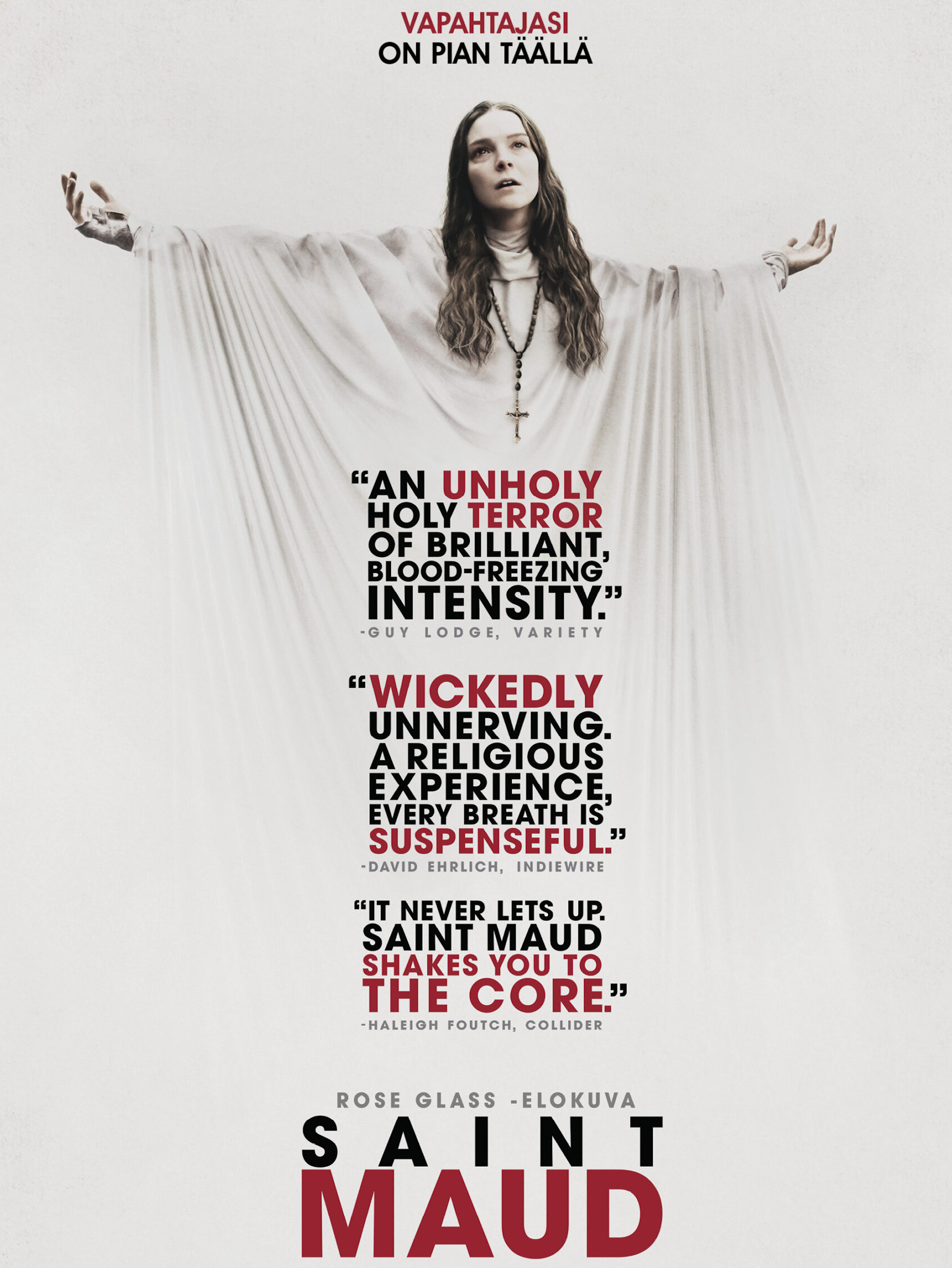
One of the more unfortunate cases of marketing getting a film entirely wrong comes in the form of the promotion for Saint Maud, the long-anticipated directorial debut from Rose Glass, which has been gestating in various forms since late 2019, and constantly delayed from being released due to unforeseen worldwide circumstances that kept it from being seen by audiences for over a year. This only helped the film, as there was a sense of mystery surrounding it, each new piece of information adding to the enigmatic nature of the film. What was promoted as the next supernatural horror that would terrify even the most desensitized viewer (being programmed alongside films such as The Exorcist) actually turned out to be something far more complex, a film that doesn’t quite fit into any preconceived genre. Our tendency to only consider something legitimate if it is able to be put into a preconceived category ultimately causes films like Saint Maud to be at an inherent disadvantage, since there isn’t much about this film that can be considered similar to anything we’ve seen before. Not merely a terrifying horror, but a daring, provocative glimpse into the darker side of humanity, Glass’ film is an absolutely stunning achievement, an intricate and meaningful psychological drama that manages to allure us in with its peculiar understanding of the human condition, and repulse us with the unhinged despair that informed it. In short, Saint Maud is a worthy entry into the canon of revolutionary horror films, where jump-scares and suspense are dismissed in favour of a foreboding sense of danger, and a kind of terror that plays on something far deeper in our psyches than most horrors. An incredibly strange film, but one that never quite manages to leave one’s mind, it leads us down a path that may not be particularly pleasant to experience, but nonetheless leaves an indelible impression.
Putting the essence of Saint Maud into words is a difficult task, since this is such a visceral film, one that depends less on the narrative, and more on the atmosphere it evokes. Glass is clearly a very gifted filmmaker, since not only did she make what is very close to a modern horror masterpiece on her first attempt, she did so in a way that is so profoundly different from anything else being done in horror today. This is certainly far from the first horror film that uses the darker side of Catholicism as a foundation, nor is it necessarily the best in this sub-genre. Instead, it takes on all aspects of the genre it has inherited, and subverts many expectations, creating a film that doesn’t quite fit in anywhere, but still has the appearance and sensation of being along the same lines of the masterpieces that inspired it. This is a film fundamentally built on evoking a certain mood, and Glass uses every resource she can to create a film that feels very much aligned with a particular atmosphere, one that is difficult to describe beyond using hackneyed terms such as “demented” and “absolutely horrifying”. There is a lingering malice to this film that doesn’t abate, even after it has ended – a kind of sinister, foreboding sense of dread that envelopes the viewer far more than any of the horrifying material we see on screen. Deviating from mainstream horror, which utilizes the same tricks to give viewers a quick fright before moving onto the next cliched trope, Saint Maud feels remarkably different, carrying a feeling of despair that continues to grow as the film goes on – and by the end, we’ve been through 80 minutes of absolute unhinged terror, despite only a few brief moments of actual palpable horror having been shown on screen.
Through her directorial prowess, Glass is capable of extracting some genuinely terrifying situations from the material she’s working from. Saint Maud is a film that depends on two factors – how willing the director is to let go of preconceived notions of what makes a horror film effective, and the extent to which the audience will place their trust in a newcomer to deliver something that will not only scare us, but also give us new insights into modern horror, which is constantly pushing the boundaries of what can be placed in a film to frighten us. At the most rudimentary level, everything about Saint Maud can be attributed to the metaphysical sensations that Glass evokes – driven mostly by the inner thoughts of the titular character, who narrates the film through prayer, there is a very peculiar tone introduced throughout the film, one that comes across as amiss from the first frame. There is always something deeper to every scene, each one playing a part in piecing together this very ambigious puzzle of a film, the meaning of which is still something I am trying to work out. Bewildering, but in a way that only heightens our fascination, rather than leaving us confused, Saint Maud has a very distinct tone that is far more terrifying than anything visual. There are only two or three moments of traditional horror in the film (with the most effective lasting less than a second, right at the end of the film), with everything else being derived from the malice lurking throughout the film, the horror manifesting as an exploration of the unknown, which is perhaps the scariest concept imaginable, and which this film exploits perfectly, showing the right amount of restraint so as not to be too excessive in how it handles the tone, but rather striking the precise balance between terror and psychological torment.
The title character in Saint Maud is played by Morfydd Clark, one of the most promising young actresses working today, and who has already established herself as someone with a very distinct control of genre, with an array of performances across many different types of films populating her small but impressive list of credits. This film is her first leading role, and it’s not difficult to see why she is being positioned as someone on the verge of major stardom. She’s a profoundly intelligent actress, as evident through the choices she makes in bringing this character to life – Maud/Katie isn’t an easy individual to play, and it could’ve just as easily have lent itself to a hysterical performance, rather than one that captures the intricate nuances of the character. Clark embodies the role with conviction, playing every note with precision and an earnestness that would have been lost on an actress who didn’t have the self-assured innocence that she brings to the part. So much of the character is built on a combination of her naivete and refusal to believe that evil is embedded in the world around her – and her decision to try and save the soul of her employer, genuinely believing she could accomplish something nearly impossible, only contributes to the masterful detail behind Clark’s performance. Jennifer Ehle matches her beat-for-beat as the former dancer who is currently dying of cancer, with her performance being filled with striking moments that hint at something much deeper below the surface, which leads up to one of the most unsettling revelations in modern horror history, where something so brief manages to terrify us more than anything being produced by major studios. Saint Maud is a two-hander of a film, and both Clark and Ehle bring such a vivacity to roles that could’ve simply been archetypes, developing their characters into individuals that simultaneously fascinate and repulse us.
Saint Maud is quite a film – somehow managing to be a deeply compelling and incredibly effective horror film, but without laying any of its intentions bare, nor being particularly clear with what it was attempting to convey. Instead, it gradually develops into a cold, clinical psychological thriller that is layered with allegorical meaning on everything from discussions on the role of religion in contemporary society, to how volatile fame tend to be, especially when someone suffers from obstacles outside of their control. This is a beautifully evocative film, which isn’t very common for a horror – shot beautifully, and composed in such a way that we’re not used to when it comes to this kind of story. There are various elements that prevent Saint Maud from being considered entirely a horror, since it is so intent on breaking the rules of the genre – there are moments of bleak social drama, sardonic dark comedy and a large amount of religious commentary that is handled in a way that is distinctly unique, never venturing towards becoming overwrought in the slightest. This is a film that burrows into the psyche of the viewer, taking us on a journey into the complex mind of its protagonist, without ever really revealing her to us in any significant way, leaving it up to the viewer to piece together fragments of her past as a means to understand who she is, and what her purpose is supposed to be (which is the first question the character asks when she is praying at the outset of the film). One of the more intelligent horrors to come about in recent years, where explicit demonstrations of fear-inducing subject matter is instead replaced with something simpler, and yet even more terrifying. Glass is a promising director, and someone who has already consolidated herself into the industry in such a way that she will have to work doubly as hard to make sure whatever she makes next meets the high-standard she set with this film – however, if she keeps the same artistic integrity and continues to provoke some harrowing ideas with unconventional poise and elegance, there’s very little doubt that she is going to carry on making some tremendously effective films, of which Saint Maud is certainly an undeniably ambitious and thoroughly successful debut feature.
 The Postmodern Pelican