
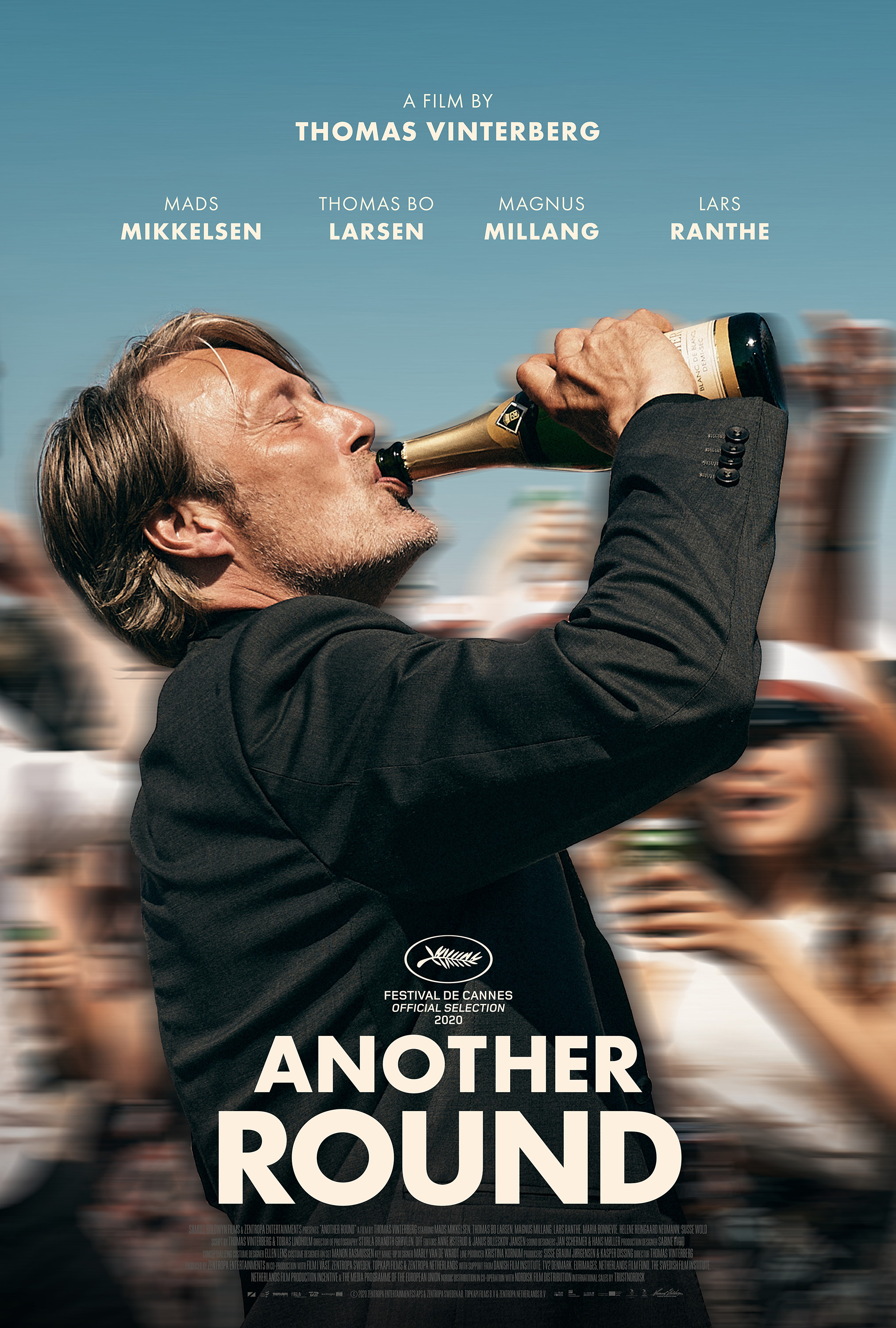
As one of the formative voices of the Dogme 95 movement that redefined how filmmakers produce art, Thomas Vinterberg is an established director who has dabbled in a variety of genres, from intimate comedies to the most sumptuous historical epic. However, where he tends to succeed the most is in his smaller films, the ones that hearken back to the earlier days of his career, when he was just a young, ambitious filmmaker with the audacity to construct a series of guidelines vital to the purest form of artistic expression one could hope to produce. Not every artist should be judged based on their previous work (since even the most stubborn tend to evolve in some way), but context is important in this instance, since looking at Vinterberg’s earlier films helps set the stage for Another Round (Danish: Druk), a film that has a strong premise, and some right ideas on how to execute them – but somewhere in the middle, there is an enormous disconnect between the two, a void of nihilistic meandering that just simply doesn’t serve the film well, and almost goes so far as to betray the fascinating origins of his career, where he and collaborator (and occasional friend) Lars Von Trier concocted a manifesto that may have been overly strict and convoluted in how it approached art, but gave structure and meaning, which came into contact with very strong stories of behaviour in the contemporary world, leading to pure, unadulterated explorations of the human condition. The same can’t be said for Another Round, a film that elicits a strong reaction on both sides of the spectrum – which makes my total apathy for it (other than a few inspired sequences) all the more bewildering, since if there is one aspect of this movement of European auteurs that has remained true, they rarely ever bore the viewer – but with a lack of cohesion, and a genuinely curmudgeonly view of the world, Vinterberg managed to prove this preconceived notion entirely wrong.
There are many different words that can be used to describe Another Round (to the point where one needs to wonder if the script was composed almost entirely of adjectives strung together by a loose premise centring around alcoholism), but perhaps the most accurate is “misanthropic”. It’s rare to find a film that has as much hatred for the entire human race as this, but through the sheer willpower of never managing to find a single likeable character, regardless of how deep he plumbs into the emotional depths of these four individuals and their personal lives, Vinterberg does the impossible and creates arguably the most despicable representation of human behaviour seen outside of extreme arthouse cinema. Context is important, and Vinterberg himself did suffer an enormous loss just prior to the film going into production, so the vaguely grim tone can easily be attributed to the fact that, by virtue of his origins as a filmmaker, he has always prioritized his own personal quandaries, exploring them through his work. This isn’t an excuse, but rather an astute observation, since the genuine umbrage he seems to hold for the characters at the centre of the film hints at someone who seemed unable to fashion anything close to a likeable figure, despite the fact that he had an abundance of opportunity to do so, which would’ve massively elevated this film. As much as one wants this film to succeed (especially for those who were excited at the prospect of Vinterberg returning to the more intimate, character-driven drama that made him such a fascinating figure in the first place, which he was going for the first time in nearly a decade), there isn’t much to grasp onto you, and by the end of the film, we feel somewhat cheated, since there was a genuine wealth of potential lurking just beneath the surface, ready to be used to explore the endless depths of the human mind, and how we perceive the world around us.
Entering into Another Year, we expect a darkly satirical character study about fragile masculinity in the modern world – by the end of it, what we’ve been given is almost entirely that, but rather one that seems to celebrate the vile shortcomings of these characters, rather than reviling them. The central theme of the film is as ambitious as it is intimidating – life, and the celebration of it. There are numerous refrains of the song “What a Life” used as the framing device for the film, showing that this is a story that had more to do with the inner turmoil of its characters navigating a hostile world, while addressing their own personal quandaries through a pseudo-psychological experiment in which they’re perpetually intoxicated. Considering this (which is quite an interesting approach), we have to question why the film devolved into an inconsistent, jarring comedy about a quartet of middle-aged men getting drunk, acting like fools and not facing the consequences until much later – and their response is to only heighten that inappropriate conduct, implying the poor behaviour can simply be cancelled out by acting out even more. There have been some superficial comparisons to The Hunt, the previous collaboration between Vinterberg and his star, Mads Mikkelsen, of which Another Round is the deranged alter ego. The former was an intricate character-study focused on hysteria, and which questioned whether one can ever truly have purely good motives. This film tries to capture that same cerebral attitude, but instead comes across as a flimsy, poorly-constructed elegy to a form of toxic masculinity that many artists have toiled endlessly to eradicate, only for Vinterberg and his cohorts to burst through and eviscerate a great deal of the hard work done in the past, including by the director himself. This is a truly demented film, which makes the fact that there was a genuinely convincing story at the core all the more disappointing, since it’s not difficult to see precisely where the film could’ve rectified some of its more notable shortcomings.
The problem with Another Round is that it has the premise, it just fails to have the conviction to do anything with it. This had the potential to be a masterpiece, and there are slight glimmers of where it could’ve easily have succeeded had more work been done to emphasize these brighter aspects. Mads Mikkelsen is an endlessly gifted actor, and whether working in his native Denmark, or lending his immense talents to a bevvy of other filmmakers, he’s rarely not the highlight of anything he’s involved in. Another Round had potential to be yet another reminder of his talents – after all, he’s the rare character actor who has established himself as an unimpeachable star, to the point where he’s the epitome of the breed of enigmatic leading performers that the arthouse tends to produce when they realize their talents. This film unfortunately fails the actor, and he constantly seems lost throughout – he fights his way through the inconsistent storytelling, as well as dismal character motivations, but it means very little, considering how there isn’t much he could do to fix what was already hopelessly underwhelming. There are a few moments in which Mikkelsen is touching on something quite profound – the first history lesson after he begins the experiment, and the final scene of the film, are very strong moments that showcase his skills. Unfortunately, it doesn’t do much in that regard, since there is a genuine lack of interest in developing the character of Martin, or any of his friends (who are all given even less to do, and come across just as thinly-written), creating a situation where there is nowhere for this film to go other than steadily downwards. Based on a cursory glance of both Vinterberg’s previous work, and the general synopsis of the film, we’d easily be forgiven for thinking that there was something special somewhere in the film – and there may be, only that it’s compacted under layers of egomaniacal rambling, making all attempts to justify it’s existence a fool’s errand.
When a film like Another Round cares as little for its characters as it does, it’s akin to making a war film without even a passing mention of the military or conflict – the basis is just not there, and the result is something that lacks the fundamental qualities that are supposed to make it stand out, even if it is attempting to subvert common tropes. It would be unforgivable had this film not already bored us with its long-stretches of self-serving arrogance, since we can’t even find the space to become furious at how inconsequential this film’s message actually is. Every intention of this film comes across as hopelessly muddled – we never know what it’s trying to convey, whether it wants to highlight the dangers of addiction, or if it simply wants to be an experimental character-study that pushes the audience towards the edge through provoking dormant ideas of human behaviour. Whichever way the film is heading, it’s quite obviously not successful. This is an endlessly bewildering film, because it’s one of the rare instances of a terrific work of art squandering every bit of potential it had, until it is teetering dangerously close on becoming a bad film. Ultimately, there is something to be said about Another Round that prevents it from being entirely meaningless – as I mentioned before, this inspires more apathy than it does rage, especially because there are some brief glimpses of brilliance, where the dry, sardonic wit does appear for a fleeting moment, or when we see an iota of humanity underlying these despicable characters. More than anything else, this film is an enormous disappointment – it comes across as insincere at best, thoroughly pretentious at worst. It’s the self-absorbed, garrulous minutiae that are perceived as being deep, that perhaps inspires the least confidence, since it feels as if the film is implying that it is smarter than the viewer, and that it has every right to put us through a truly miserable experience, since its very existence apparently warrants the deployment of some truly questionable morals, none of which seems to be nearly as insightful as it claims to be. The end of the film is quite sadly the one moment in which these sketchy intentions are used well, being a moment of catharsis that demonstrated some direction. It’s a shame the rest of the film preceding it didn’t have the good sense to apply the same approach throughout, resulting in a vapid, unconvincing and thoroughly disappointing film that had all the tools necessary for success, but lacked the dedication to use any of them.
 The Postmodern Pelican