
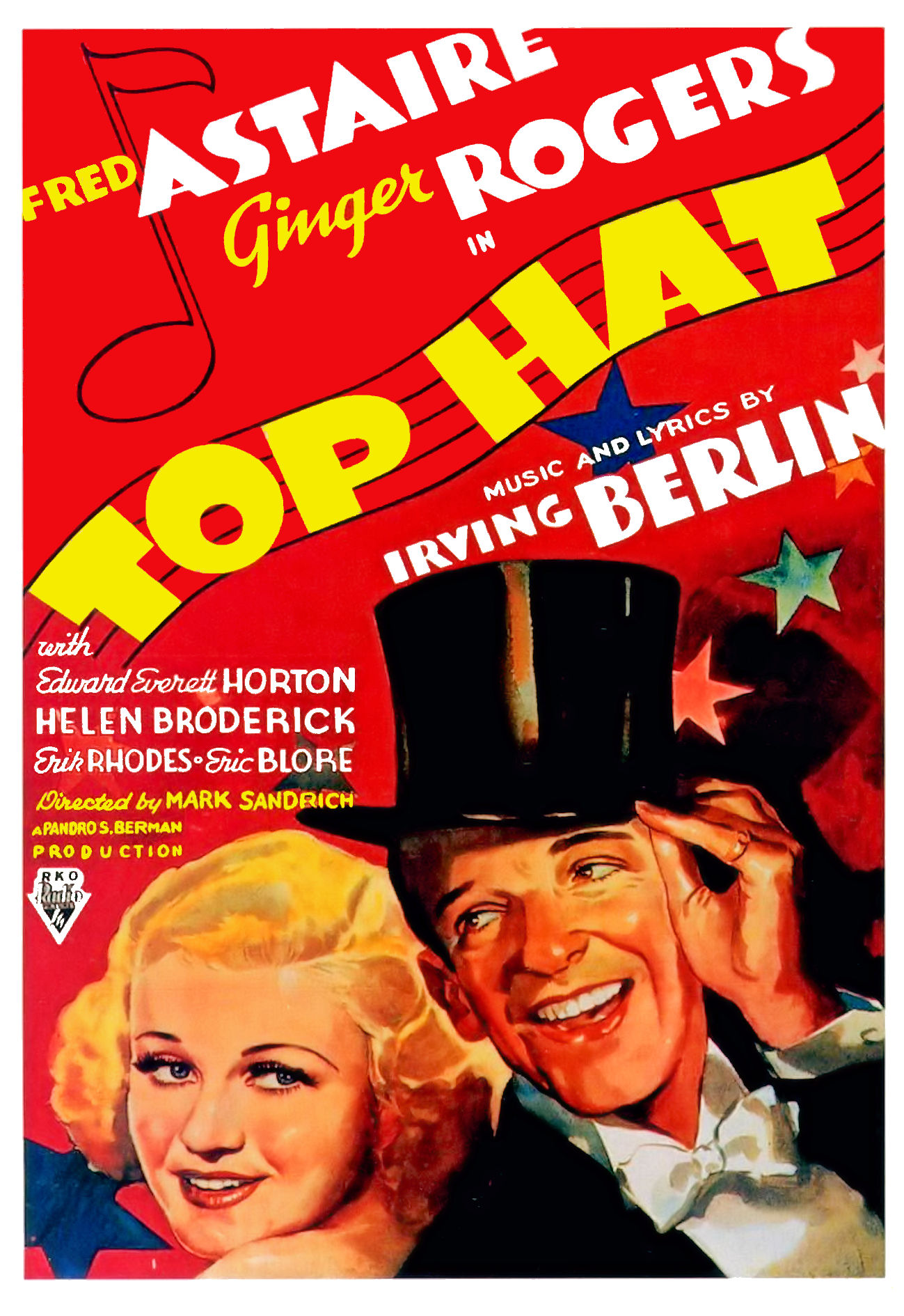
Jerry Travers (Fred Astaire) is a world-renowned dancer and performer who has quietly made his way to London, where he has been hired to be the star of a new revue by theatre impresario, Horace Hardwick (Edward Everett Horton), who is very excited to have a major American performer as the lead in his show, as he believes this will bring audiences to the theatre en masse. However, the moment he arrives, Jerry proves to be a bit of a troublemaker, someone who is more intent on having a good time rather than working hard, being safe in the knowledge that when it comes to the matters of the stage, there isn’t any need for rehearsal. This gives him time to pursue Dale Tremont (Ginger Rogers), a beautiful young woman he encounters one evening when she emerges from the hotel room directly below his, after a particularly passionate tap-dancing session disturbed her. The duo immediately are at odds, especially since she believes Jerry is actually Horace, since she had yet to meet him – and considering Horace is married to Dale’s best friend, Madge (Helen Broderick), this case of mistaken identity is even more inconvenient. When she is swept off to Venice to spend the weekend with her intended, acclaimed fashion designer Alberto Beddini (Erik Rhodes), Dale is pursued by Jerry, who believes that he can easily win her heart in one of the most romantic cities in Europe. However, without realizing the hilarious mistake both are making in terms of identity, only hilarity can ensue, culminating in an elaborate wedding – but the question is, who is it that’s going to be at the altar at the end of it?
There are good films, and there are great films. Then there are films that are just a privilege to watch, works that are so incredibly well-made, their very existence is stunning. As a global audience, we’ve been so fortunate to have the work of Fred Astaire and Ginger Rogers preserved on film for us, since what they did during their peaks as performers is truly unprecedented. Every word of acclaim that they have received over the course of what is rapidly approaching a century is far from hyperbolic, since they thoroughly earned their reputations, perhaps even failing to be appreciated as much as they should be by contemporary audiences. Top Hat is widely considered their finest work, a collaboration that launched them into worldwide stardom and made them indelible in the film culture. Watching this film from a contemporary perspective is quite an experience – despite having been made several decades ago, and having some sensibilities in both style and narrative that could not be further from how cinema operates today, Top Hat has aged remarkably well – it is just as refreshing, entertaining and bold as it was when Astaire and Rogers tapped through Europe in 1935, and whether through the production value, the unforgettable music (composed by one of cinema’s preeminent maestros), or the sheer ambition that went into the creation of this delightful musical comedy, there isn’t much possibility of denying the utter brilliance that pervades every frame of when Top Hat is trotting across our screens. Not many classical-era comedies manage to be as timeless as this one, and perhaps its just nostalgia for the joyful, upbeat musical masterpieces that defined my childhood, but every moment of this film is brimming with an unforgettable exuberance that simply fails to abate until every viewer is suitably captivated, taken on a journey into another world, one where music and dance reign supreme.
Praising the work of Fred Astaire and Gingers Rogers is a fool’s errand, since there is very little that can be said about either of these magnetic, dynamic performers (as well as their partnership) that hasn’t been said a myriad of times before. There’s a depth to their work that stands out from the moment they first appear on screen, making them far more than just dancers, but rather athletes (it’s hardly surprising that martial arts icon Bruce Lee was heavily inspired by Astaire, and his tendency to ensure that his movies featured dance-scenes filmed in wide-shots, so as not to cast even a shadow of doubt in the viewer’s mind that it was Astaire doing the footwork, a quality that Lee himself employed in many of his most notable works), manoeuvring their bodies in unpredictable, but truly mesmerizing ways. The movement that this duo was capable of, whether individually or together, is beyond spellbinding, and simply just watching them move across the screen, dancing as if they were weightless and occupants of some ethereal space, is as mesmerizing an experience as any other, but unlike works of fantasy, everything Astaire and Rogers did was authentic and extracted from an endless amount of hard work over the years. Their partnership is undeniably one of the best of the period, as evident by Rogers’ famous quip that she “did everything he did, but backwards and in high heels” – and if that doesn’t speak to two artists who were so profoundly dedicated to their craft to the point where they managed to define film history, then absolutely nothing else can come close. Natural born performers in every sense, Fred and Ginger manage to keep us entertained and enthralled for the entire duration of the film through their charisma and comedic timing in the narrative segments, and the explosive power of their dancing in the musical sequences, creating two fully-formed, well-rounded portrayals that keep us engaged for the entirety of this incredible film.
The reasons why Top Hat is such a captivating film aren’t all that easy to determine, since so much of what makes this so special is how it touches on a very visceral set of emotions. Seeing two performers traversing the screen and using their bodies as instruments is not something that can normally be put into words, and much like many abstract art-forms, the more you try and dissect it and find the meaning behind it, the least effective it is. However, this isn’t a film that is just composed of wall-to-wall dancing – in fact, there are only about half a dozen musical sequences in the whole film (rather than being filled with them, as is the case with many inferior musicals), with a great deal of emphasis being placed on those moments outside dancing segments. Everyone involved in the creation of Top Hat knew that audiences would essentially only be paying to see Astaire and Rogers honing their craft, but what tends to keep us there (and perhaps even returning to such films) is how there is a clear balance between the dancing scenes and the narrative. The film has a very entertaining story that is an early entry into the canon of screwball comedy, centred on mistaken identity and the kind of lovable romance that really only exists in films from this era, where absolutely anything can happen and it appears entirely convincing. The balance struck between the two is incredible, and Mark Sandrich deserves a great deal of credit for not only his brilliance at capturing the marvellous dancing, but also the moments in between, showing that it is just as important to have a strong narrative, rather than stringing together a few musical sequences with a limp, lifeless story. There is a technical mastery to this film that does extend beyond the two iconic stars, with the amount of effort that went into every frame of this film being quite astonishing, and almost entirely unforgettable.
Top Hat is an undisputed classic, not only of its genre (being one of the definitive musicals of its era), but also of the Golden Age of Hollywood in general. There is ultimately not very much to this film in terms of precise concepts – it’s an entertaining musical that sees two of the masters of their craft doing some of their best work, set to the backdrop of some gorgeous scenery and under the careful direction of a filmmaker who knew how to weave together the dance sequences with a story that is just as enjoyable, keeping us enthralled and under a very precise spell. Yet, there is still something so enigmatic about this film, a lustre that gradually unveils itself as the film progresses, and a sophistication that only grows as we realize how deep the film is willing to go. It has spawned many iconic moments (“Cheek to Cheek” remains one of the finest standards in the Great American Songbook, and its manifestation on screen here is truly heavenly), as well as being an inspiration to roughly eight decades of musical theatre and film – and when something as effervescent and simple as this manages to have such an influence, it’s impossible to deny that its something special. Yet, through the ambition of a group of very creative artists, and the willingness to give audiences a spectacle, Top Hat becomes a very special film, and an iconic work of classical cinema that is just as exciting today as it was at the time of its original release.
 The Postmodern Pelican