
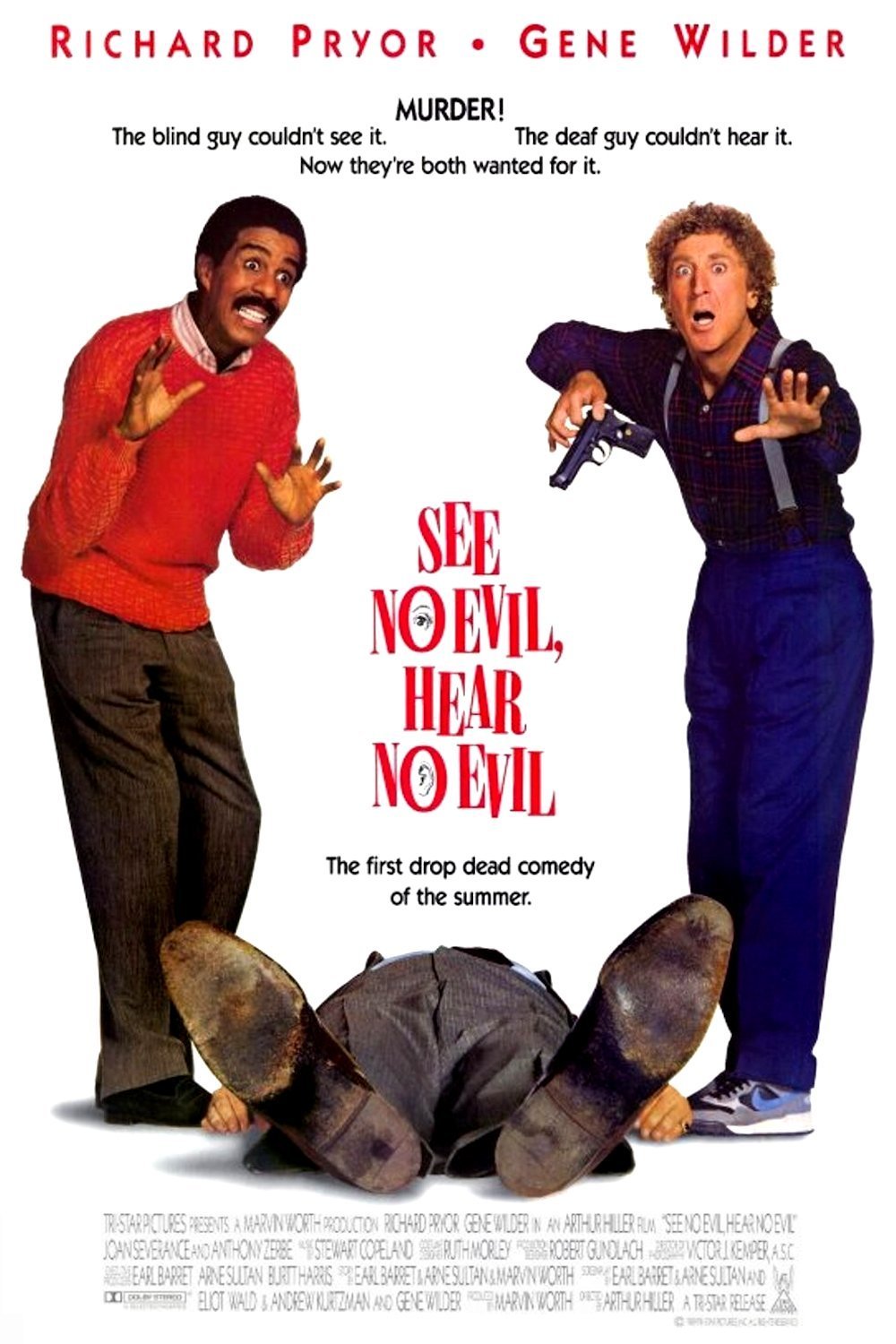
Wally Karew (Richard Pryor) and Dave Lyons (Gene Wilder) are two ordinary, middle-aged New Yorkers – they go about their day in their usual way, trying to pick as few fights as they can, all the while trying to stay ahead of those around them, since they’re both not in the most comfortable position in life, emotionally or financially. It doesn’t help that the two men are both affected with conditions that have rendered them differently-abled – Ben was left blind after an automobile accident, while Dave suffered from long-term effects of scarlet fever that caused him to lose all of his hearing a few years before. However, neither of them lets their disability stop them from living their lives as the epitome of the cranky New Yorkers they have grown to resemble to all those around them. It’s this exact misanthropic behaviour that brings them together when Wally applies to work at Dave’s newspaper stand in the lobby of an affluent building – and it’s there, on a particularly fateful day, that the duo are witness to a cold-blooded murder, when a destructive femme fatale (Joan Severance) murders someone in front of them. Both men were there when the murder happened, but the problem is that they weren’t in the right position – Wally heard the gunshot but couldn’t identify the assailant, while Dave saw some potential suspects, but not in time to positively identify any of them as the murderer. Naturally, in the absence of other witnesses and their position in the crime scene, the two men are the prime suspects, and it is only exacerbated when it becomes clear that the deceased was a loan-shark for the gambling-addicted Wally, meaning that the police now have a motive that these two bumbling fools were actually the murders. Not only do Wally and Dave have to prove their innocence to the police, they also have to evade the real killers, who are in rapid pursuit after they realize that they have the valuable artefact that caused the entire crime to occur in the first place.
One of the comedic pairings that barely comes up in conversation anymore is that composed of Richard Pryor and Gene Wilder, two comedy icons that had very different styles and personalities, but which worked so incredibly well together when put alongside each other. A particularly popular film that the two starred in is Arthur Hiller’s See No Evil, Hear No Evil, a comedy with a hilarious premise, and a solid execution. Not necessarily a film that is all that well-regarded outside of being a crowd-pleasing comedy with a lot of heart and humour, but rather one that takes a strong story and turns it into a hilarious romp that is built almost entirely on the charms of the two leads. By no means the best work done by either Pryor or Wilder (both of whom are more known for their high-concept comedy, whether on stage or in film), but one that functions as a fascinating combination of their talents – and in their third collaboration, they are so clearly as ease with one another as screen-partners, it’s bewildering to consider that they only worked together four times, since their chemistry indicates an intricate understanding of one another as both professional performers and colleagues working towards a very simple but admirable set of principles. See No Evil, Hear No Evil may not be inventive or entirely groundbreaking, nor is it a film that functions as anything more than a delightful comedy – but there’s very little doubt that it’s thoroughly entertaining, and when you have something that doesn’t demand attention, but is rather content with just existing on its own terms, it’s difficult to argue against it as a bit of enjoyable escapism.
Speaking about a film like See No Evil, Hear No Evil is quite a challenge, since there isn’t much to say about it in regards to its originality, but yet it still manages to be quite an enthralling experience based on how it takes a fun premise and turns it into something memorable, albeit only to those who find this brand of irreverent, off-the-wall comedy amusing. There are certain comedies that one can easily attribute to having been conceived as a one-liner joke that flourished into an entire film – and the concept of a film that focuses on a cold-blooded murder, where the only witnesses are a deaf man who saw the act being committed, and a blind man who heard it, is one that may not be particularly notable for revolutionizing the genre, but rather a hilarious way to capitalize on the unique talents of its two stars, who were as involved in the creation of this film as they were complicit in bringing it to the screen. It’s a film made to entertain the crowds, rather than be a galvanizing work that sells us on the brilliance of a narrative – and anyone expecting to see something that takes on the institution and shows us something we haven’t seen a myriad of times before, both in theory and form, will be severely disappointed by See No Evil, Hear No Evil, which is incredibly derivative and conventional, and hits all the beats we’d expect it to him – but for those who are already sold on seeing Wilder and Pryor in tandem once again, this film may be exactly the kind of diversion from reality that one needs, and a firm reminder of a time when comedies could just be incredibly dumb without it being a shortcoming.
See No Evil, Hear No Evil is barely a work that stands out without its two stars at the forefront – and as a result, the amount of enjoyment that the viewer will derive from this film comes directly from how they feel about essentially ninety minutes of shenanigans between Wilder and Pryor, who are at the top of their craft here (albeit a few years removed from their peak, but far from unpopular or lacking in passion), since everything else about the film depends on the performances given by these two comedic icons. However, this doesn’t suggest that they’re not giving spirited portrayals – after all, there is some degree of effort needed in playing these characters, and while there is certainly some controversy around the fact that the film is lead by actors who are both sighted and hearing, playing individuals with disabilities. Relitigating the merits and shortcomings of this approach is certainly relevant, but at the very least, Wilder and Pryor seem to have some degree of respect for individuals afflicted with these conditions (even if the first few scenes of the film, where the protagonists repeatedly insist they don’t have these disabilities is unfortunate, since it is implying that it is something to be ashamed of), and go about portraying their respective characters with an enormous amount of dignity, which is not always to be expected from a film as broad as this. They’re both hilarious, and even when they’re not relying on the disabilities of their characters (which can sometimes be seen as a crutch for their performances), they’re as charming and endearing as they normally were. It’s a pairing that works on the virtue that they both bring out the best in one another, and work seamlessly together, finding common ground that not only accentuates their different sensibilities, but often even celebrates it as something worth watching, which is credit to anyone who can put a saddle on these two comedians and derive something of value from their often irrepressible mayhem.
While it may not be anything we haven’t seen before, See No Evil, Hear No Evil is a lot of fun. It hits every familiar beat, goes in the expected direction throughout, and quite often refuses to be anything other than a slight, enjoyable comedy that may lack depth, but makes up for it in personality and the willingness to provide consistent laughs, even when the subject matter is far from ideal. Directed by the jack-of-all-trades Arthur Hiller, who may not have expressed any real directorial prowess with this film (which is more driven by the plot, with the screenplay being attributed to half a dozen names, which may explain the scattershot narrative), and carried almost entirely on the pairing of its two heroes, See No Evil, Hear No Evil isn’t a major work in any way, whether as a satire or broad comedy (or even, as some have suggested, as a piece of disability representation), instead playing it safe throughout and functioning as an entertaining work that doesn’t need to prove its merits, instead relying on its very simple premise and the hopes that the viewer will be able to be sold on its very peculiar charms. The final product is a solid but unremarkable film that exists solely for the purpose of having some fun, and very little else. In a lesser film, this would be a terrible shortcoming – but when you have one that intends to be exactly what it promises, then there’s no reason to dismiss See No Evil, Hear No Evil as anything but some mindless escapism that has a hearty sense of humour and the good-natured sincerity to make it a worthwhile time for anyone seeking a quick distraction from reality.
 The Postmodern Pelican