
“I can’t tell the difference between our act and us anymore”
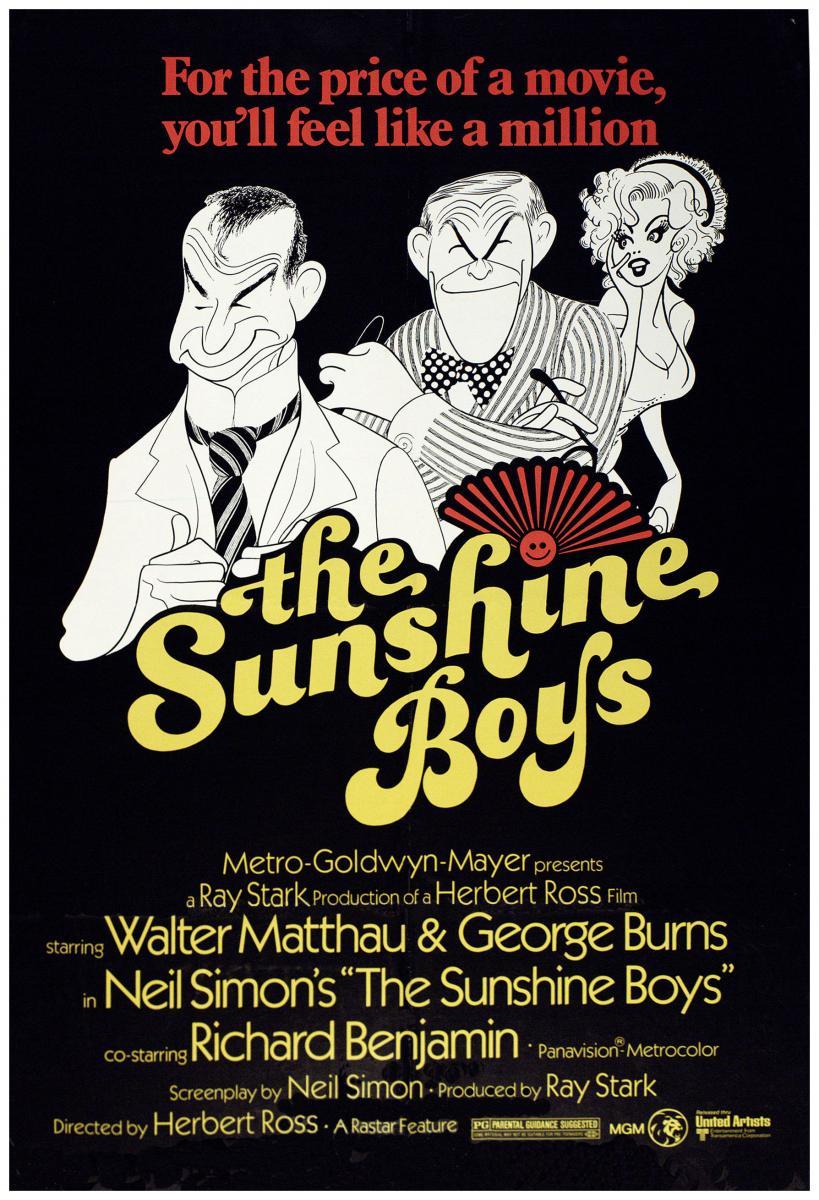
The Sunshine Boys is one of those films that has always been omnipotent in my life – from the earliest days, I recall it being shown on television, and over the years, it captivated me in ways I could never quite describe. It’s a film that I attribute to my lifelong adoration of comedy, and it has become a regular occurrence to revisit it, whether in its entirety, or in any of the hilarious segments that make up the film, which are just as tremendous in isolation as they are as part of a single work. Neil Simon was one of the finest playwrights to work in the medium, someone who could weave gold out of the most paltry concepts, and turn even the most banal stories into irreverent, upbeat works that transcend all sense of time to be universally resonant, decades after their original release. These are enduring works – and one of Simon’s most beloved is The Sunshine Boys, which seems to be riffing off his incredibly popular The Odd Couple, in focusing on two bickering individuals who are on opposite ends of the personality spectrum, but find common ground after all the hostility has subsided. The play was turned into an incredibly successful film by Herbert Ross (who was a master at bringing Simon’s work to the screen, as evidenced by their numerous collaborations over the years), and through capturing some of the finest work done by a pair of comedy’s greatest stars, and an execution that feels refreshingly authentic, while still being exceptionally traditional in its style and sentiments, The Sunshine Boys is an enormous success, and a film that stands up perhaps better than most comedies from this era, for a number of reasons.
One such factor behind the timeless quality of The Sunshine Boys comes on behalf of the themes it looks at. The film situates itself in a post-vaudeville world, which may be an abstract concept to contemporary audiences, but in 1975, the shadow of the old music-hall comedy routines was still lingering, giving this film a very peculiar sense of being situated within a particular time in history, while still being very modern in its sensibilities. The concepts embedded in this film may be foreign to modern viewers, who may ironically feel about network television (which is shown here as a cutting-edge medium) the same way the characters in this film felt about the heyday of vaudeville, which was well into the antiquity by this point. However, Simon’s work consistently has a quality that keeps it from ageing – the writing is direct and honest, while the humour is razor-sharp, each quip being as meaningful as it is hilarious, giving insights into the particular matter being explored here, which essentially has allowed the writer’s work to remain so incredibly resonant, as well as increasingly malleable, with many artists over the years using his plays and screenwriting credits as the blueprint for their own work, whether directly adapting them in their own way (The Odd Couple has seen as many reinterprative variations as it is has direct adaptations), or simply through using the tropes and conventions that he made his own over the years. It gives the film a timelessness that is difficult to match, and it’s difficult to envision many other playwrights of his generation that have had such a substantial role in the way comedy has evolved over the years, with his work stretching across decades and generations, and shaping much of what we consider to be modern humour.
At the centre of The Sunshine Boys are two incredibly convincing portrayals by actors who epitomize the concept of legendary performers, which fits in exceptionally well with the general theme of the film. Much like most of what Simon writes, this film depended on the performances given by its leads, both individually and together, with a specific level of chemistry required to make sense of what we’re seeing. When it comes to the history of comedy, you don’t quite any anyone more iconic that Walter Matthau and George Burns, who still endure as incredibly important performers today, despite having been at their peak quite a while ago. Matthau is the lead, playing the prickly and standoffish Willy Clark with a conviction that was integral to his success as an actor – he was playing slightly older than he was in real life, but unlike other instances of actors playing outside their age group, Matthau is thoroughly convincing, playing through the old-age makeup in a way that not many manage to do. It’s one of his finest performances, and one of the many that allow him to demonstrate his seamless ability to toggle between hilarious comedy and heartfelt drama, both of which are woven intricately into his performance. The Sunshine Boys also reignited the career of George Burns as an actor, being his first appearance in a film since the 1930s, and a return for an industry veteran who quite simply defined comedy across the twentieth-century. Hidden behind his signature thick glasses, and speaking in the iconic raspy, cigar-aged voice that made him so distinctive, Burns embodies the spirit of an ageing comic, drawing from his own experiences, but showing a spunk and dedication that far exceeds his nearly-eighty years. It’s a remarkably complex portrayal from someone who managed to show that he wasn’t just restricted to his particular brand of comedy, but could also deliver a knockout performance when it came to character work – and his chemistry with Matthau was absolutely impeccable, and is worth seeing this film for all on its own.
Showbusiness is certainly a brutal world, and no one seemed to understand this better than those involved in the creation of The Sunshine Boys, which has a lot to say about the cutthroat nature of the industry, to the point where it can something border on being too ambitious. This is one of a rare kind of film which takes place between two different kinds of entertainment medium – situated between the peak of vaudeville, and the peak of television, the film has a peculiar tone that finds the value in both worlds, refusing to revile one over the other, but also not presenting any of them as superior. It’s hardly surprising that so much of the thematic content of this film centres on the history of entertainment, since a great many of the components of the film focus on the gradual disintegration of one form of entertainment, which occurs concurrently to the rise of another. The industry is anything but consistent, and the volatility of fame is called into question many times in this film. Simon doesn’t only write irreverent stories about quirky individuals – his words have weight that make them so utterly enthralling, and the message embedded in this film is absolutely remarkable, especially in how the writer (with assistance from his two stars and a director who implicitly understands how to interpret his work) manages to infuse every moment with a melancholy that is almost unprecedented for a film like this, where good-natured humour is complemented by a deeply compelling story of holding onto one’s identity, even after the jeers of the formerly cheering crowds try and dissuade you from doing so. We love Willy Clark and Al Lewis not only because they’re funny, but also because they’re filled with conviction and an earnest dedication to their craft – and that means a lot when it’s coming from a group of industry veterans such as those involved in the creation of The Sunshine Boys.
The Sunshine Boys certainly earns its reputation as a classic of the world of comedy, which is perhaps the best way to describe it, since very few films are as ingrained in exploring the history of the genre more than this one. Neil Simon was a master of his craft, and while this particular work may not have the cultural cache as some of his other works, it is still an absolutely staggering work that has proven to only get better with time. Whether it be through the impeccable performances being given by the two leads, with both Walter Matthau and George Burns firing on all cylinders (not to mention the criminally underrated Richard Benjamin, who is rarely ever given his due, despite being the beating heart of this film), and providing all that Simon’s wonderful script required, even if it was something as simple as a small expression or well-placed piece of dialogue. This is a wonderfully timeless work that may be set within a particular temporal moment in the culture, but still resounds with a sincerity that can only come from someone who implicitly understands the industry that he is lampooning – and while it may have its moments of outdated humour, this is still an absolutely solid piece of entertainment that is still incredibly enduring and fully worth every bit of acclaim and effusive praise that it has received over the past five decades since its release.
 The Postmodern Pelican