
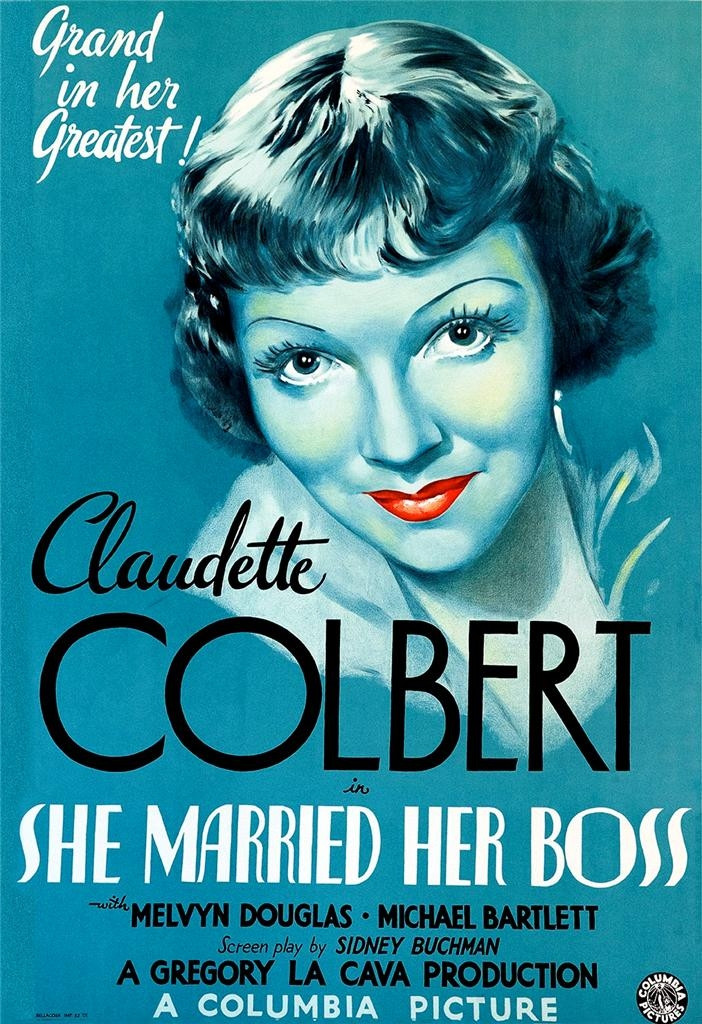
Julia Scott (Claudette Colbert) lives a pleasant life – she works for a reputable clothing company, being an administrative assistant that has her sights firmly set on a leadership position, which is almost entirely guaranteed, considering she has a reputation amongst her co-workers and those they report into for being a hard-working young woman who is capable of running the business better than any of the executives. The trouble comes in the fact that despite being exceptionally gifted when behind that desk, Julia yearns for something (or rather, someone) else – her boss, Richard Barclay (Melvyn Douglas), who is an enigmatic young entrepreneur who is currently unmarried for some reason, and lives a life of luxury, despite not having anyone to share it with, other than his meddling sister, Gertrude (Katharine Alexander) and hopelessly spoiled daughter, Annabel (Edith Fellows), who begin to fear that he’s plotting something that will get in the way of their comfortable lives. Julia decides that she is going to throw caution to the wind, and pursue the man she truly loves – and the result is an almost immediate marriage, with Barclay being bewitched by Julia’s effortless charms, and ability to run their home with the same spirited conviction as she controlled his business. However, over time, the couple begins to find the boundaries between their personal and private lives are blurring, which results in their marriage taking strain, since despite becoming a wife who takes care of their home, Julia struggles to leave behind the attitude she employed towards her corporate life, which only causes Barclay to realize that he may have lost control of his wife, who is beginning to take over his home in the same way she was planning to take over his business. Yet, even in the midst of their struggle, there’s a spark that keeps the duo together, and confirms that they are nothing if not perfectly matched for one another, disproving the adage that one should never take their work home with them – after all, how can one possibly hope to lead a pleasant, idyllic domestic life when that too becomes yet another business to run?
One of cinema’s great mercies occurs when a film proves to be a lot better than its title would have you suggest – and when it comes to She Married Her Boss, there are few examples of a film’s premise betraying its own name, at least not in terms of veering more towards the positive. Gregory La Cava was a maestro of the screwball comedy, specializing in hilarious irreverent tales that combine gut-busting humour with broad overtures of romance. One of his more forgotten works is this very film, which serves to be a terrific comedy with fun performances from a duo of the finest stars plucked from the Golden Age of Hollywood, thrown on a blank canvas, which could’ve easily have resulted in an overwrought, unconvincing attempt at humour (especially considering the subject matter, which flirts dangerously close with misogyny at some points), but rather comes across as deeply authentic and thoroughly meaningful, even when it’s at its most effervescent. The result instead is actually a far more interesting achievement – one of the more notable examples of a classical-era comedy positioning a woman at the forefront where she isn’t made to be the seductress or mindless object of desire for a philandering male co-star, but instead placed at the centre as a feisty, defiant and (most importantly) utterly independent modern woman who acts on her own volition, and relishes in her ability to work hard enough to make it in a world that at this point was still adjusting to the idea of feminity less as a theoretical concept, and more of a practical issue that was simply yearning to be explored with as delicate and meaningful a touch as it was here.
There are a number of ways that She Married Her Boss shifts the conversation away from the more common tropes dominant at the time of its release. Primarily, this is a film that looks at a woman who has actually achieved something out of her own hard work, rather than being born into an affluent family, or marrying someone with influence and wealth, sharing their spoils with her. Instead, the film focuses on the concept of the working woman, someone who defies the conventions of domesticity and seeks out a life in the corporate world. It isn’t the first time this story has been told, but where it departs from convention comes in the fact that, rather than spending a portion of time focusing on a scrappy, ambitious young lady seeking out a career in the perilous city, the film begins in media res, where the protagonist has already arrived in terms of achieving a degree of respect in her chosen career, with all signs pointing towards her position coming from nothing but her own inherent intelligence, and the good sense to work hard, and reap the benefits of her efforts. From a modern standpoint, it may seem almost condescending for a film to be so self-congratulatory of how it treats its protagonist, to the point where simply having her succeed in a relatively simple corporate job takes up space in a discussion – but considering how this was a notable leap forward for representation, to the point where the entire film centres on someone abandoning their reputable job in favour of living a domestic life (rather than the inverse, which has been the subject of many films), it becomes clear that there was some degree of work done into challenging conventions of the period, even if it seems like this film was doing the bare minimum from a contemporary perspective.
A large portion of She Married Her Boss depends on the charismatic performance given by Claudette Colbert, who was at this point one of Hollywood’s most cherished stars. Occurring only a year since she captivated audiences everywhere with her delightfully delicate performance as Ellie Andrews in the iconic It Happened One Night, her portrayal of Julia in this film is both a slight departure from the role that consolidated her as a bankable young actress, but also one that makes great use of her unique talents, with the balance between the two being an absolute highlight of the film, and proof that there were many occasions during the Golden Age of Hollywood where a star was able to play a different kind of character, rather than ones that hinge on a very particular reputation – and while she may not be undergoing a character transformation akin to Bette Davis in Of Human Bondage, there is a complexity to this character that we don’t often witness when it comes to romantic leads. Her performance as the feisty, strong-willed Julia is something of a revelation, perhaps not in terms of what Colbert could do (since this is very much a character within her wheelhouse), but in how it embodies the aforementioned concept of the working woman, focusing on her fierce independence without making her too focused on settling into domestic life at one extreme, or callous in how it treats her as a character on the other. There’s a beautiful balance struck between the character’s many vivid traits, and Colbert does exceptionally well in realizing them, to the point where her co-lead, Melvyn Douglas (who is immensely gifted in his own right, and was very good here) almost entirely disappears, since Colbert simply commands the screen with a ferocity rarely seen with these kinds of films.
She Married Her Boss may be a relatively minor work, but it’s certainly just as entertaining as any of the more prominent screwball comedies from this era. An undeniably simple film in both theory and execution, the film focuses on an entertaining concept that may not have much originality based on a cursory glance, but manages to be quite potent when exploring some themes that were somewhat revolutionary for the time in which it was made. Anchored by one of Claudette Colbert’s most charismatic performances (as well as one that allowed her to playfully subvert the more innocent, waifish image she had amassed in previous years), and with terrific chemistry with Melvyn Douglas and the surprisingly excellent Edith Fellows, the film is a tremendously entertaining work of socially-charged comedy that may hit familiar beats, but emerges a fascinating comic odyssey that keeps everything at the fundamentally human level, even when it’s clear that there is something far more complex inspiring this film. Not the definitive word on any of these issues, but rather a wonderfully exuberant expression of social ideals, She Married Her Boss gives the viewer something memorable, taking us on a hilarious journey into the heart of society, and working through a number of compelling narrative threads in order to be as resonant as it is thoroughly entertaining.
 The Postmodern Pelican