
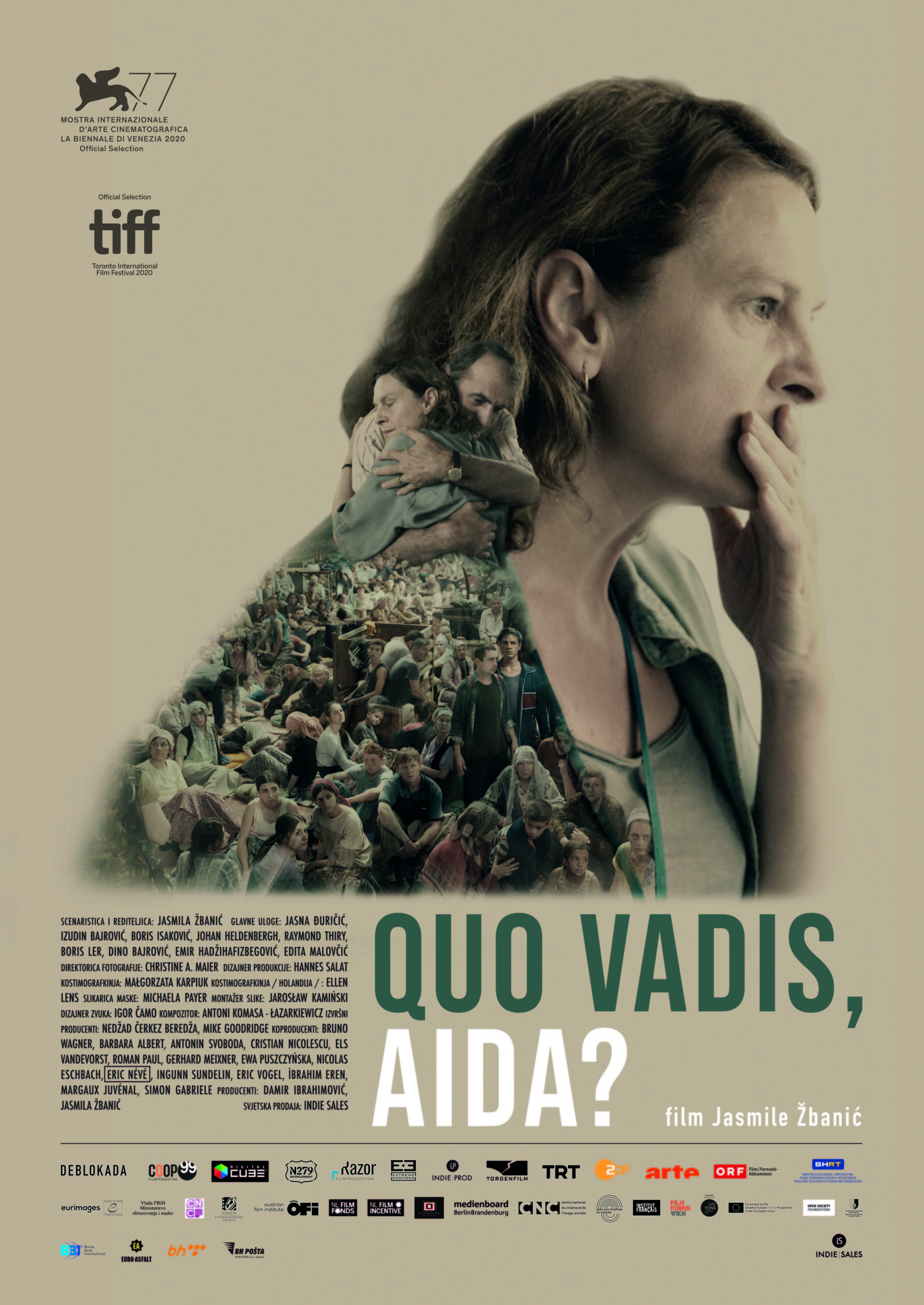
Based on the title, you’d think that Quo Vadis, Aida? would be a more eccentric film, since it combines both an outdated Latin expression with the evocation of Verdi’s opera centred on an Egyptian queen – there’s a hint of the antiquity embedded in this film. However, this was clearly a calculated move on the part of director Jasmila Žbanić, who put together a vivid, horrifying war drama that is as psychologically-exhausting as it is emotionally-profound, one that is deeply modern, especially considering how it is looking at events from only over a quarter of a century ago. The film is an agonizing glimpse into the early days of the Bosnian genocide that took place in the small, mountainous town of Srebrenica in 1995, in which over 8000 people were murdered in cold blood as part of an effort to cleanse the nation of those who were perceived to be inferior racially and ethnically. One of the more harrowing looks into this period, which has not been entirely ignored artistically, but has yet to be presented in a manner as captivating and simple as it was here, Quo Vadis, Aida? is an absolutely essential film, both for how it addresses a deeply disturbing historical event that is recent enough for its after-effects to still resound with a raw, visceral sharpness, and how it combines broader themes of socio-cultural despair with the concept of family, and the lengths to which someone will go to not only do their patriotic duty, but also defend their own interests, even if this means crossing boundaries that could be considered dangerous in any other context. Žbanić is a profoundly gifted filmmaker, and her work here is absolutely staggering – haunting, beautifully poetic (even at its most disturbing) and driven by a very particular set of ideas, Quo Vadis, Aida? is an astonishing achievement that takes the audience on an unsettling voyage into the recent past, simultaneously educating us on a particular moment in time, as well as provoking thoughts that transcend geographical boundaries.
Throughout her career, Jasmila Žbanić has made something of a concerted effort to be descriptive of her nation’s history. Bosnia and Herzegovina is a country with a storied past, which has not always been represented fully in cinema, even if there have been many attempts to piece together fragments of the past. Like any former Soviet Republic, the nation has undergone significant change, with a deep and rich history existing that makes for truly compelling cinema. Quo Vadis, Aida? is certainly not the first instance of Žbanić covering the darker moments in her country’s past, but its the one that seems to be the broadest in terms of being both about the very intimate lives of the individuals affected by horrifying actions, and those who are perpetuating it, making this film one that exists at the perfect intersection between historical events and more personal histories of the countless people who fell victim to a brutal, horrifying system, whether directly or through mere association. Perhaps the very antithesis of casual viewing, Žbanic’s film takes the form of a haunting drama, set over the course of what appears to be only a few days, as the occupants of Srebrenica are evacuated to the United Nations building, where they take refuge from the maelstrom of violence transpiring as the vicious Serb commander, General Ratko Mladić and his men gradually employ their plans to cleanse the region of the Bosniak population – and in the midst of all this harrowing madness, the director still finds time to explore the innermost quandaries of the titular protagonist, a UN translator who comes to learn deeply disturbing facts that could put the entire population at risk – and her decision is based on conflicting feelings between her civic duty, and protecting those closest to her.
Hyperbole should be avoided when discussing any work of art, especially works that have only just been produced, as there is a tendency for recency bias to cloud our judgment in some instances. However, there are certain performances that just deserve to be mentioned as examples of the impossible heights an actor can reach should they be given strong material that allows them to express themselves creatively. Jasna Đuričić gives one of the year’s best performances, playing the titular Aida, a woman caught between her duty as an objective UN translator, and as someone trying to defend her family from imminent danger, which she knows is on the horizon, with her position meaning that he is privy to this information, but doesn’t have the authority to act to prevent harm from befalling those she is supposed to protect. Đuričić is just exceptional – her expressivity is unprecedented, and she finds such a bold elegance in the risks she is willing to take. Aida is not a particularly difficult character to play, since she is mostly an observer for the first parts of the film – a schoolteacher hired to help overcome the language boundary between the authorities she is working for, and the Bosnian population she is a part of. Through her commitment to the role, the actress finds a nuance that many would not expect, plumbing emotional depths with a character that is rarely the central focus of a film like this. There’s a sophistication to her performance that comes across as entirely authentic – every emotion produced on her incredibly impressive face carries meaning, each line-delivery contains a wealth of information, even if they appear to just be expositional. It’s a masterful portrait of an ordinary woman finding herself caught in a deadly struggle, and Đuričić does so much with a relatively simple character, working with Žbanić’s exceptional script to develop her to be evident to the fact that the most valiant heroes are occasionally those we don’t normally expect to find.
Not only does this approach give Quo Vadis, Aida? a somewhat feminist tilt (since it is one of the rare films that does demonstrate the pivotal role women tend to play in resolving wartime conflict), but also develops the film far beyond a callous, unforgiving examination of this period. Showing the atrocities of the Srebrenica Massacre through the perspective of an ordinary civilian, rather than the military or government officials that are behind these attacks, or those trying desperately to resolve the situation and bring peace to the region before violence becomes uncontrollable. The film covers a very limited period of time, and is almost entirely restricted to a single location, from which it is able to discuss a number of compelling issues without needing to burden itself with an overabundance of detail relating to the situation outside of this particular context. This is a film that has a dual purpose – for those who have some knowledge (or even first-hand experience) of this historical event, the film is a heartbreaking ode to those who had their lives lost. For those who may have not been all that aware of the atrocities that took place, Quo Vadis, Aida? provides a thorough and meaningful introduction, giving enough information to situate us right in the centre of the event, but without becoming too overwrought or heavy-handed in the delivery. There’s an admirable quality about a film like this, in which there isn’t a compulsion to package it with an endless amount of expositional context, which is often one of the aspects of historical dramas that give them the reputation of being stifling and over-embellished. Quo Vadis, Aida? is a film that is light on its feet, traversing difficult narrative territory in a way that is rapid, riveting and incredibly insightful, giving audiences the chance to be present and aware of this moment in time, and a witness to some harrowing accounts of one of the most shocking genocides in recent history.
As the well-taut adage has doubtlessly told us on an endless amount of occasions, history tends to be written by the victors, so for a work of art to come around that looks at it through the lens of those who didn’t succeed immediately means we have to stop and marvel at this new perspective. Very few will defend the actions taken by the Army of Republika Srpska in their attempts to employ a warped form of eugenic through the ethnic cleansing of the Bosniak population – but it’s still an incredibly riveting experience to witness the stories of those that were heading towards peril without realizing it. Quo Vadis, Aida? is an astonishing account of a few days in the lives of these people, who patiently waited for salvation, but unfortunately didn’t know that their worst days were ahead of them. There are some moments in this film that are simultaneously awe-inspiring and nightmare-inducing, such as the horrifying moment when we see that the claims of the ruthless general to protect his prisoners and spare their lives were just broken promises. The sequences in this film where it presents the reality of the situation through explicit honesty on the part of its protagonist and the conflict that arises when she’s confronted with obeying orders or protecting her family, is where it thrives the most, since it isn’t only providing a clear portrait of this moment in time and the masses that fell victim to it, but also weaving a moral tale through the struggle of the individuals who were faced with their own mortality. Quo Vadis, Aida? is an astonishing film, albeit one that very rarely gives us any sense of comfort. Anchored by one of the year’s best performances, out of which some truly exquisite, emotionally-resonant commentary is extracted, the film is a shocking but utterly brilliant account of a dark moment in European history. This is far more vital than the over-ornate historical dramas that prioritize elaborate descriptions and excessive techniques, since the intentions here are clear – gritty, dark but strangely profound, Quo Vadis, Aida? is one of the most exceptional examples of character-driven history, and one of the year’s finest achievements.
 The Postmodern Pelican