
Throughout his prolific career Yasujirō Ozu managed to capture so many different kinds of stories, with the emphasis often being placed on older people and their various trials and tribulations. However, there were occasions where the esteemed director took a sojourn into the lives of the younger generation, and crafted vivid stories of childhood and its many idiosyncracies. This serves as the basis for one of his very best films, and the one I consider to be his crowning achievement, the astonishing Good Morning (Japanese: お早よう), a charming comedy that sees the director putting aside the melancholy and serious conversations about life and death, and instead embracing a more offbeat storyline, which hearkens back to his earliest days in the silent era, where he often crafted these kinds of delicate, heartfelt comedies that sought to capture different aspects of the human condition through the lens of remarkable social realism, often having bold strokes of comedy to soften the blow of the more challenging discussions being had. Simultaneously elegant and juvenile, Good Morning is undoubtedly one of Ozu’s finest achievements, a bold but meaningful look into the lives of children, presented by one of the nation’s foremost observers of the human condition. In terms of its premise, it may not facilitate the same serious conversations about the postwar experience, the conflict between tradition and modernity, and the inevitability of ageing and death, but this doesn’t mean that Good Morning doesn’t have its fair share of insights, and through heartwarming comedy and a very sentimental sense of humour that governs his intentions here, Ozu crafts perhaps the most delightful film to emerge out of Japan in the late 1950s, and one that is still so exceptionally relevant to this day.
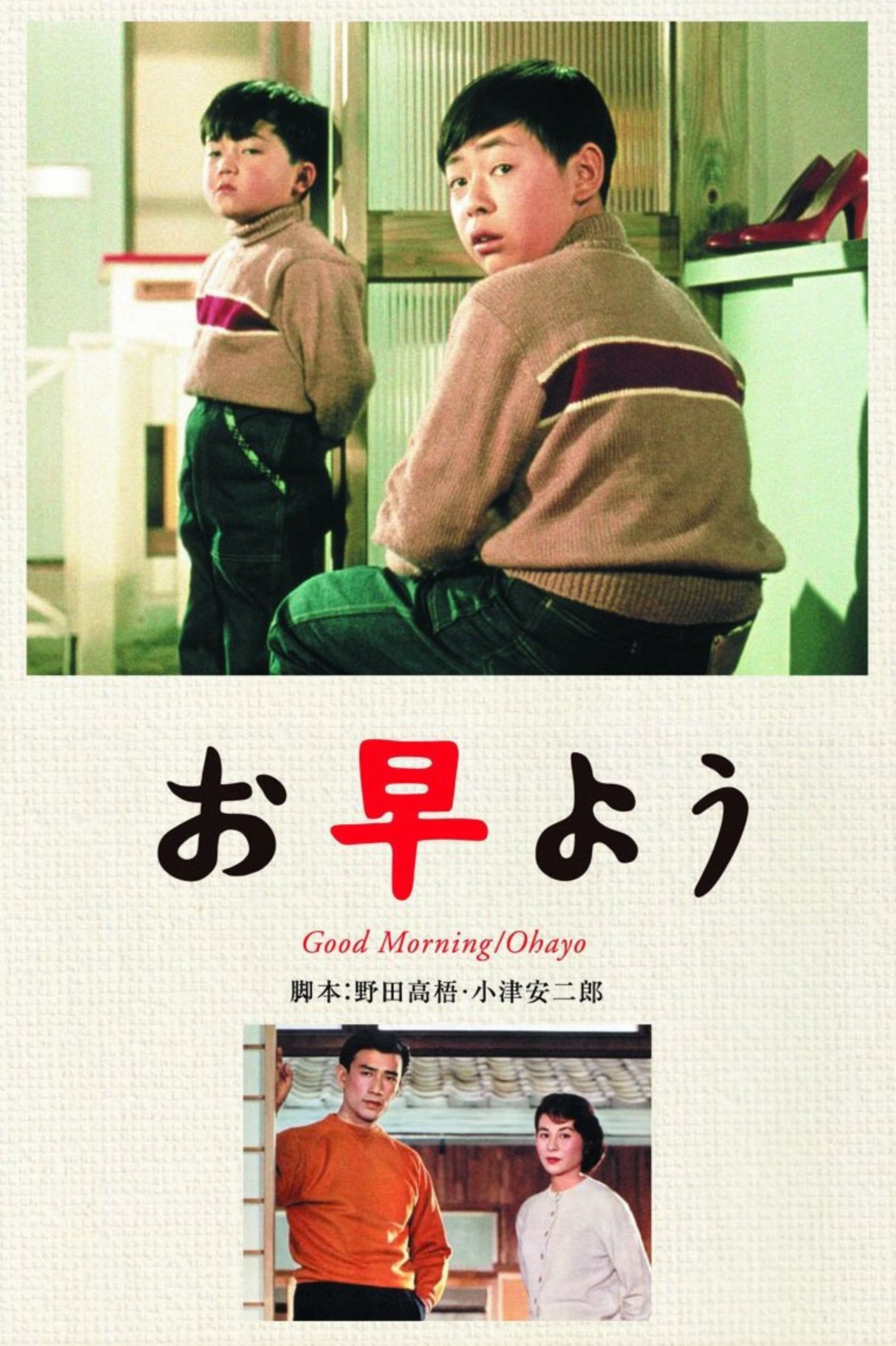
The reasons to admire Ozu as an artist are impossible to count, but one of his most distinctive qualities is his tendency to work within a close range of similar themes, with the premises of his films varying, and emphasis being placed on certain pivotal themes. Good Morning is a film about two interwoven concepts – inter-generational conflict and family, two themes that Ozu was not a stranger to exploring. Through the guise of a heartwarming comedy, the director was able to deftly consider a range of underlying conversations, creating a vivid portrait of a close-knit community and their approach to family. Ozu cherished every one of his stories, giving them a sensation of truly being made with love, and this particular film is one of the clearest indications of how much he valued a strong story. Centring on two young boys who are growing up in a version of Tokyo that is caught between tradition and modernity, as evident by the emergence of technology as a prospect for every household, rather than being restricted to an elite few. Embodied in the story of the boys’ quest to convince their parents to buy them a television, Good Morning gradually incites some profoundly moving discussions about this particular era in Japanese (and essentially worldwide) history, where the march of time meant that traditions were no longer as sacrosanct as they were in the past, and that there is always a chance for improvement. It’s a remarkably resonant story that feels incredibly modern and refreshing, which speaks exactly to another incredible merit that is found consistently in Ozu’s films – a sense of timelessness that speaks to issues at the moment in which it was made, and persists in relevance and profundity over half a century later, the sign of a truly great filmmaker at his peak.
Simmering below the surface of the coming-of-age comedy that Good Morning purports to be is quite a moving social drama about some serious matters. Arguably, the premise of this film isn’t one that aligns itself with some of the director’s more heartwrenching stories – for the most part, it is free of heavy subject matter such as death (which was often a predominant theme at this point in the director’s career), unrequited love or the despair caused by the postwar period. However, these are replaced with a set of ideas that may not be as serious in theory, but carry the same amount of weight. Like any great comedy-of-manners, Good Morning isn’t just a series of hilarious moments, but a collection of vignettes and sub-plots that dovetail into a gorgeous, evocative portrayal of Japanese society at this particular temporal moment. The two main storylines centre on a pair of children who want a television and proclaim a vow of silence until they get it, and a group of mild-mannered women who find their monthly dues to their local social club have gone missing – Ozu uses these two premises as fertile ground for exploring the different avenues of existence from his perspective, extracting heartful humour from the most absurd situations, and employing a sentimental kind of comedy to the proceedings, enough to keep the viewer thoroughly engaged and fully enamoured with what’s being demonstrated on screen. The use of these two broad storylines as the facilitator of a more resonant message about the intersections between modernity and traditions, and the role of different generations in the “new” Japan was a bold choice, and through a comedic approach, Ozu was able to do so much more with some daunting existential and social concepts as he would’ve had Good Morning been more of a straightforward drama.
Despite the underlying allegory and meaning that can be derived from the film, Good Morning is yet another chance for Ozu to implement a moving story through exceptionally entertaining means. He was known for often making more downbeat, meditative dramas, but as made extremely evident here, the director also knew how to have fun, with the buoyant nature of this film not being taken for granted. We can deconstruct the message underlying the film, but where Good Morning really thrives is in Ozu’s insistence on making something both heartfelt and entertaining. This isn’t a particularly complex film in theory or execution – but this is much more of a merit than a shortcoming, with the effervescent nature of the final product being entirely responsible for the joy this film has incited over the years. There aren’t many films that can claim to be inspired by the very concept of the gleeful recklessness present in our childhood – and who else could possibly make a film about two boys gallivanting around their small community, demonstrating their talent for on-cue flatulence and begging a variety of adults to allow them to watch television, and make it so deeply touching at the same time, other than Ozu? It’s a masterful work that knows how to combine serious discussions with a sense of heartful humour – and the director’s ability to balance both sides is another reason to celebrate him as one of the foremost auteurs of his era. Viewers more accustomed to watching an Ozu film and having their heartstrings plucked and tears drawn out would find Good Morning to be a refreshing change of pace – the same earnestness is very much present, and the premise is similar to what he normally put together, just from the perspective of the most charming, idiosyncratic comedy imaginable. Infantile but never inappropriate, this film has such a rich comedic sensibility, it’s impossible to not fall in love with it.
Good Morning is undeniablya staggering achievement that proves that some of the most moving, dynamic works tend to come in the most unassuming forms. Ozu’s mastery isn’t something that can ever be disputed – a long career of fascinating work, stories plucked from the colourful tapestry of humanity that the director seemed to understand more than most, and a generally charming approach to material that could sometimes be quite tricky to appreciate had we not been witness to one of cinema’s greatest minds at the helm, deftly navigating some intrepid territory that would be perilous to a lesser filmmaker. There are so many reasons to adore Ozu – his work is vivid, complex and beautifully endearing, and his artistry is almost unmatched, with his peculiar worldview and unprecedented understanding of the smallest idiosyncrasies of existence being indicative of a master fully in command of his craft. Optimistic to a fault, but still willing to have serious conversations (even when making as magnificent a comedy as he was here), the experience of watching one of his films isn’t something to be underestimated. Good Morning is one of Ozu’s essential works – not only does it distil many of the director’s more complex ideas into a small, quaint package, it also has him operating at his most sincere, finding the humanity in between fart jokes and childish tantrums – it’s a stunning work of comedy that has a serious core, which makes for a truly exceptional work that is insatiable in its pursuit for the kind of touching commentary many artists dedicate their entire lives to finding, but rarely manage to get there quite as regularly, and with as much brilliance, as Ozu and his relentless search for a new understanding of the world around him, and the people who populate it.
 The Postmodern Pelican