
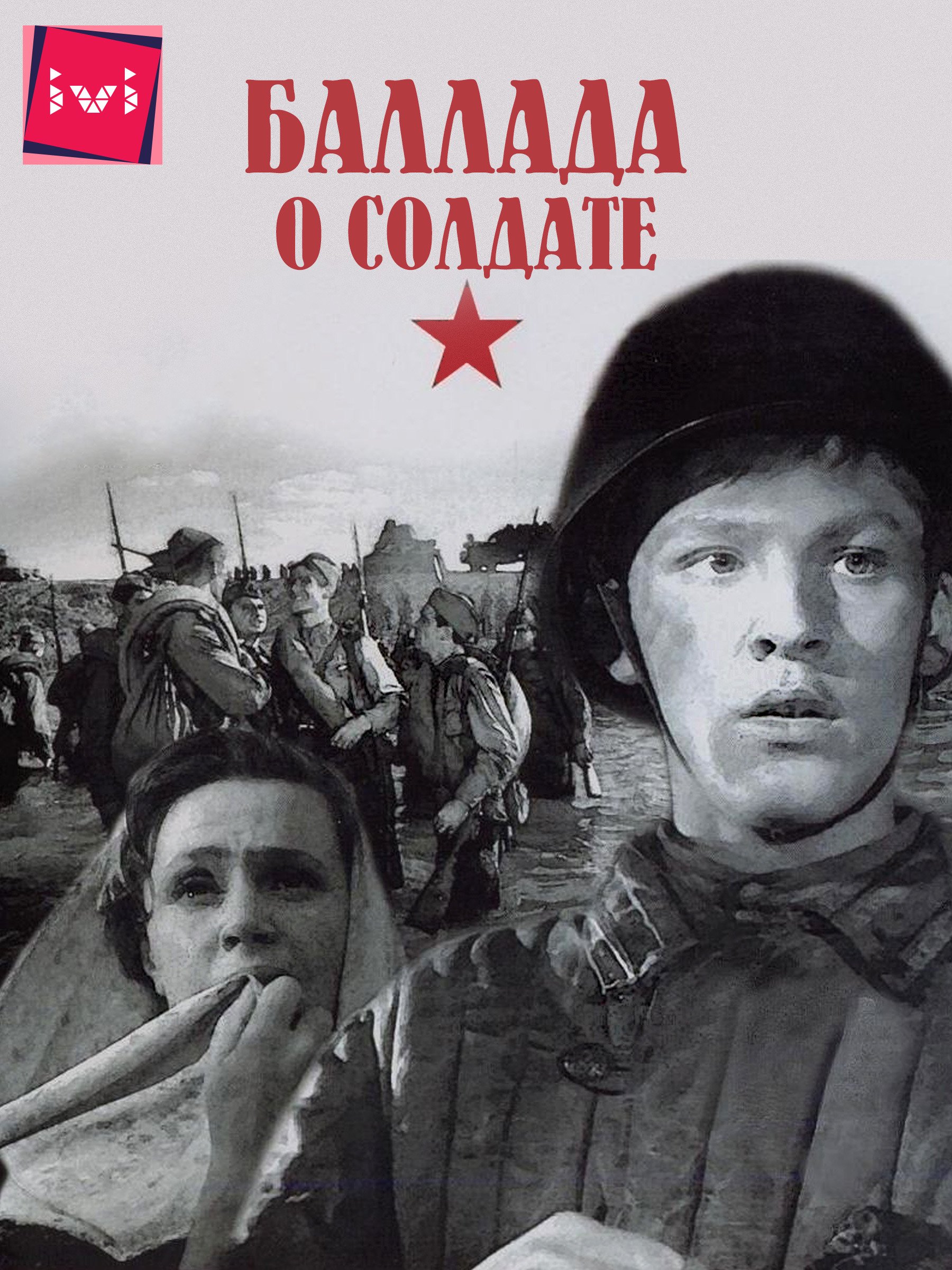
War is a subject that has certainly never been a stranger to film – since its inception, there have been works that have attempted to portray the horrors of war in some way, or at the very least show it as being a time of great challenges for those involved, which is especially poignant considering cinema came into existence around the same time as various conflicts were gradually taking over. However, while there are some works that tend to take a more positive view on the subject (insofar as they present the valour of soldiers as something triumphant and worthy of celebration, which isn’t untrue), there have been several that have taken a far more cynical look at it. The ones that tend to make the most impact are those that come about almost directly after a war has taken place, which leads us to Ballad of a Soldier (Russian: Баллада о солдате), the stunning wartime drama directed by Grigori Chukhrai, who goes beyond the confines of the genre in his search for the deeper meaning hidden behind the veneer of battles, cutting to the core of the psychology of the people who often are forced to fight and potentially lay down their lives for the sake of their country. It’s a harrowing exploration of war that managed to be both warm and haunting, finding the balance between the tone, just enough to allow it to comment critically on the experience of doomed soldiers like Private Alyosha Skvortsov, played masterfully by Vladimir Ivashov, without becoming too overwrought in its exploration of certain themes, with the general aura of this film being one of giving audiences the chance to have unfettered access to the experiences of a young man going through the gruelling nature of war, as well as dealing with the aftershocks that come when one tries to return home, which can sometimes be more difficult than we imagine it to be.
Ballad of a Soldier is an anomaly of a film, because despite being a war story, we don’t see much conflict in the film at all, with the majority of the plot centring on the titular soldier going on a brief leave of absence to visit his village, and the aftermath that unfortunately comes with being involved in something as harrowing as armed conflict. Chukhrai was doing something quite compelling with this film – he was looking beyond the traditional representation of war, and expanding the world outside of the battlefield, focusing more on the internal struggles of soldiers and the various people who are related to them. Despite the title, Ballad of a Soldier focuses on a wide range of characters, exploring a variety of individuals – from a wounded veteran, to a fearful wife, to a heartbroken mother and everyone in between – and how they are impacted by their country being at war. I’ve always admired a war film that can find the time to say something beyond “war is evil”, and insert some resonant material into what is often a very obvious premise. Ballad of a Soldier finds the director doing just this – and at times, we can even question if this can count as being an entry into the genre at all, being more of a film focused on war-adjacent issues – the destruction of a town, the heartbreak of a widow, and the limbo that many are in when they aren’t sure whether their relative is still alive, or if they’ve perished in some foreign country, where they’re likely being laid to rest, far from their homeland. It’s a delicate approach, but Chukhrai’s incredible understanding of the material, and his refusal to bow down to conventions, resulted in an absolutely staggering work of fiction that is as harrowing as it is riveting, heartbreaking but thoroughly authentic in both theory and execution.
Conceptually, Ballad of a Soldier isn’t all that revolutionary, since it employs the common structure of a protagonist going on a journey (in this case returning home for a few days to spend with his mother, who he regrets having not been able to see before he left for the war), and encountering a variety of people along the way. It’s structured like nearly any work of quest literature, with a likeable main character and a variety of supporting roles that show up for a few minutes before the narrative moves onto the next story. It’s a simple approach, but one that has been tried-and-tested numerous times before, and serves the purpose of weaving together an array of lives, each one distinct and fascinating, without overtaking the central thrust of the story. Chukhrai’s direction is sophisticated and assured – his camera catches every movement with such incredible sincerity, building a narrative that speaks directly to the curiosities of its characters, and gradually dismantling a great number of preconceived notions that came packaged with derivative war dramas. It takes us on a journey alongside the main character, and shows us the world in a radically different way – brimming with good-natured humour (there are some moments in Ballad of a Soldier that are quite funny, but with more of a melancholic leaning), but not neglecting the very tender sadness that pervades these stories, the film finds its voice in the moments that occur in between the broad strokes. The intimate glances, the quiet expressivity – it all adds up to a film that concerns itself with giving audiences a glimpse into the psychology of these characters, who are exceptionally real and incredibly earnest, which makes an enormous difference.
As a film focused on human experience, Ballad of a Soldier does very well in many its characters interesting, which entails a combination of a director who understands how individuals would act in various situations, and a group of actors who are willing to go to any lengths to explore the lives of these characters, turning in meaningful performances that are some of the most insightful of the decade. Vladimir Ivashov is incredible as the doomed soldier, someone who has seen the ravages of war, but still refuses to let go of his youthful optimism – there is always a better day on the horizon for Alyosha, but his hope begins to dwindle as time goes on, and he sees the other side of the world for the first time. Amongst the supporting cast, no one other than Ivashov is in the film for very long, but they all make an indelible impression in their limited screentime. Antonina Maksimova is heartbreaking as the main character’s mother, who bookends the film, using her incredible expressivity to say so much about the uncertainty of a parenting sending their child off to war, without even saying a word for the most part. Nikolai Kryuchkov has some terrific moments as the good-natured general who abandons his stricter position to grant the brave young soldier a sojourn, perhaps having developed an appreciation for the importance of family through his wide-ranging experience in the military. However, it is Zhanna Prokhorenko, as the terrified young lady who is trying to make her own way through the world, not realizing how truly perilous it can be. It’s a beautifully complex portrayal by a gifted young actress who finds the nuance in an otherwise thinly-written character. The brilliance of Ballad of a Soldier resides in these characters, and Chukhrai does well in extracting masterful performances from his cast.
Less of a film focused on the savagery of war, and more one that frequently observes the lives of those involved, both directly and by proxy, Ballad of a Soldier consistently shows us a side of conflict that may be obvious, but still comes across as truly genuine through the vision of a director whose interest in the subject is only outweighed by his incredibly sophisticated manner of looking beyond the limits of a genre that often struggles to find a unique approach. The photography is stunning (cinematographers Vladimir Nikolayev and Era Savelyeva manage to capture every nuance of war with such a striking intimacy), the writing is exceptional – nearly all of the hackneyed tropes that tend to accompany these kinds of stories are completely disposed of here, and replaced with a sense of melancholic yearning that comes through in the dialogue – and the performances are staggering. It’s not a work that immediately strikes the viewer as being a massive achievement, but as it gradually submerges us deeper into its story, we see the unrequited beauty that occurs throughout it. This is an essential work of Soviet-era cinema – it doesn’t take a side, nor does it intend to preach on any number of issues. Instead, it’s a simple and delicate drama set during wartime, one that endeavours to show the lives of those who are often dismissed when it comes to more common discourse. History may be written by the victors, but as we see here, the stories of the invisible majority are far more compelling.
 The Postmodern Pelican