
When it came to exploring the postwar experience of Italy, and commenting on the more bizarre sides of society, very few filmmakers were able to match Dino Risi. An exceptionally divisive filmmaker, particularly when looking at his comedies, he was capable of touching on issues that far superceded the general themes of his films. Occurring at the perfect intersection between subversive satire and broad farce, they normally tended to carry hefty meaning in the form of outrageous comedy. Il vedovo (“The Widower”) is one of his more fascinating experiments – made early enough in his career to still see the raw underpinnings of the director at work, but late enough for his underlying talents to be almost entirely established, it’s a deliriously funny film that has a darker side to it. Risi doesn’t receive enough acclaim outside of his role as a pioneer of the Commedia all’italiana movement, which is especially unfortunate considering how cutting-edge some of his films were beyond their vaguely absurdist sense of humour, with their willingness to plumb emotional depths unseen by audiences at the time often going entirely unnoticed. Calibrated with the intensity of someone who had a firm grasp on the collective pulse of the culture around him, and constructed as a comedy in the form of a heartwrenching tragedy, Il vedovo is a masterful work of mid-century Italian cinema, and one of the more haunting glimpses into the postwar experiences of ordinary people in the decades succeeding the social, economic and political upheaval wrought upon their community – and still manages to be hilarious along the way.
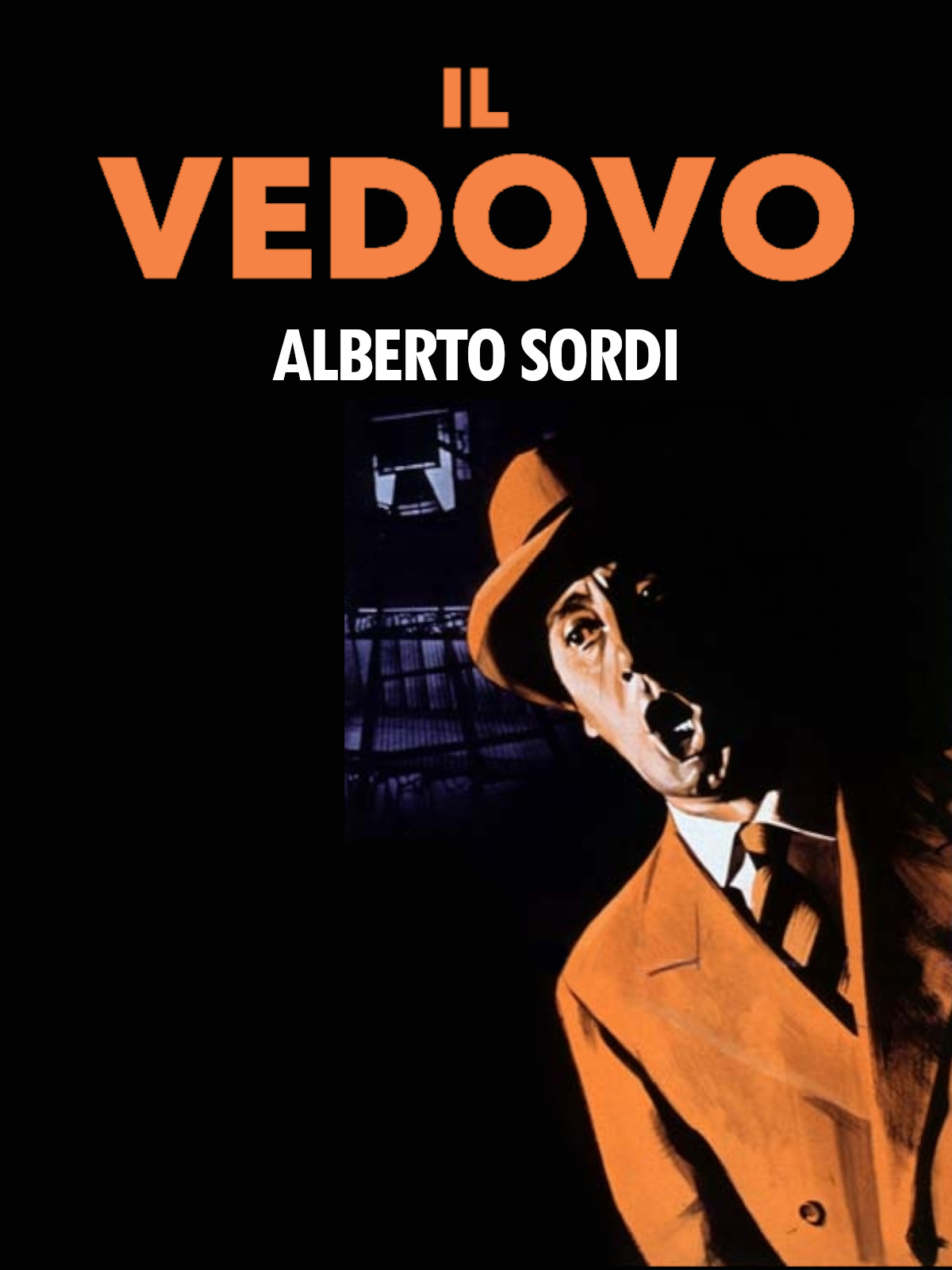
The film centres on Alberto Nardi (Alberto Sordi), a mild-mannered businessman who has big aspirations. He has made his living through running a factory that specializes in building and installing elevators. However, his not particularly good at this profession, and growing rumours that his work is shoddy and dangerous deters others from investing in his company, while Alberto himself dismisses all criticism. He doesn’t have anything to prove, and as far as he is concerned, his factory is just a hobby, since he’s married to Elvira Almiraghi (Franca Valeri), who comes from a long line of nobility and has thus inherited an immense fortune. Over the course of their marriage, Alberto has concocted many schemes to funnel his wife’s money to his business, using her in unexpected ways to keep his business in operation. However, she is not nearly as ignorant as he believes, and it isn’t long before she catches onto him. Fortunately for Alberto, there isn’t much need to worry for quite a while, since he is informed that the train that his wife was a passenger on had become involved in a tragic accident, with all signs pointing towards her perishing, along with all the other passengers. In public, Alberto plays the part of the shattered widower – openly mourning her lose and benefitting from the sympathy given by even his fiercest critics. However, he is privately relishing in her demise – not only does it mean he is free of her domineering control, but he now stands to inherit her enormous fortune. However, he soon realizes that he shouldn’t take anything for granted, particularly when he finds out that his wife may not be as dearly-departed as he thinks, and that there is going to be a bit of explaining to do when she eventually resurfaces.
If the premise to Il vedovo sounds either oddly insidious or outright nihilistic, it absolutely is. Risi shows very little pity for the characters he is depicting here, creating a story without much redemption in terms of having endearing characters or situations that bring us comfort. A pitch-black comedy with a darkened soul to match any other, this film is a wildly inventive social satire that quite simply fails to deliver anything particularly positive. This certainly doesn’t mean that Il vedovo is any less brilliant than more popular satires, but rather that the director and his rowdy band of collaborators were fully-intent on venturing deep into the most horrifying recesses of the human condition, all for the sake of deriving some perverted pleasure from deconstructing some of society’s more troubling hypocrisy. Dark comedies usually tend to have some social message, even when it is embedded deep in the fabric of the work, and they normally tend to create situations that reflect directly on different aspects of our existence. Il vedovo positions itself amongst the upper echelons of society, focusing on the elite (and therefore immediately removes allegations that this is exploitative, as the resounding cry of “eat the rich” has rarely been captured as well as it has been here), and exploring the trials and tribulations of a group of people who have enough wealth and influence to do anything, as we watch – with an almost voyeuristic curiosity – as they allow their immaturity and bawdy disregard for each other to become the root of their malice. It’s an interesting premise that Risi explores with such incredible frankness, being bold enough to take on a group that truly believes themselves to be infallible, which is certainly not the case at all, as represented throughout this masterful work of dark comedy.
Satire has the ability to be extraordinarily triumphant, or fall flat entirely – in nearly every way, Il vedovo occupies the latter category. Once you have become accustomed to a particular genre or movement, it becomes second nature to figure out the progression of the narrative. Satires are one of the few sub-genres that actually genuinely manage to be surprising on many occasions, albeit only when an artist who has a clear direction of where they’re intending to go stands at the helm. Risi was certainly accustomed to social commentary, and his clear understanding of the various problems afflicting the world were present in every one of his films, only deviating in how intense his evisceration or celebration of certain concepts were in different stories. He managed to capture a side of society that was barely seen with such unfurnished simplicity, yet still coming across as complex, vivid portrayals of society. He goes in some unexpected directions, which is most notable when we realize how he doesn’t only play with the narrative, hitting multiple different beats where they were necessary, but also manipulates the structure – the enormous revelation that would normally end a film like this, instead takes place towards the end of the second act, leaving the rest of the film to be a peculiar coda that only adds onto the inherent absurdity of the story, culminating in a climax that may have been even darker than the rest of the film, a nearly impossible task in theory, considering how bleak the main thrust of the story actually was. It’s a complex approach to a very simple story, and it’s persistent quest to take the viewer on a voyage that we may not have experienced before is yet another reason why Il vedovo is a minor masterpiece, and a film well-worth seeking out.
Risi’s control over his craft is simply incredible, and he managed to frequently touch on many fascinating issues through the guise of a compelling dark comedy. There are numerous reasons to seek this film out – it gives us the chance to see another devilishly funny performance by Alberto Sordi, one of Italian cinema’s most compelling actors who could balance outrageous comedy and heartwrenching tragedy equally. It also allows us to get a glimpse into Italian society after the Second World War – there is something to be said about films produced in the two decades after the war, particularly in countries where there was major upheaval – and while Il vedovo may lack the direct insight of some of the more major works (especially with the concurrent existence of Italian Neo-Realism that dominated the period, and which has mostly dominated conversations on the national cinema at that particular point in time), it finds its way to being quite a scathing commentary that is just as harrowing as any of the more haunting postwar dramas produced at the time. Risi uses comedy to cleverly subvert expectations and find his way to the core of the human condition through evoking laughter, and in the process provoking serious thought. Il vedovo is far more than just a lovable romp, functioning as a cold-hearted satire that takes many risks, and gradually becomes a daring human odyssey that may be intimate in scope, but has a set of ideas that are put together with such incredible poignancy and elegance. It’s a stunning achievement that tends to creep up on the unexpected viewer, taking us by surprise and setting us on a course of nihilistic despair – and you’d find it difficult to not enjoy every minute of it.
 The Postmodern Pelican