
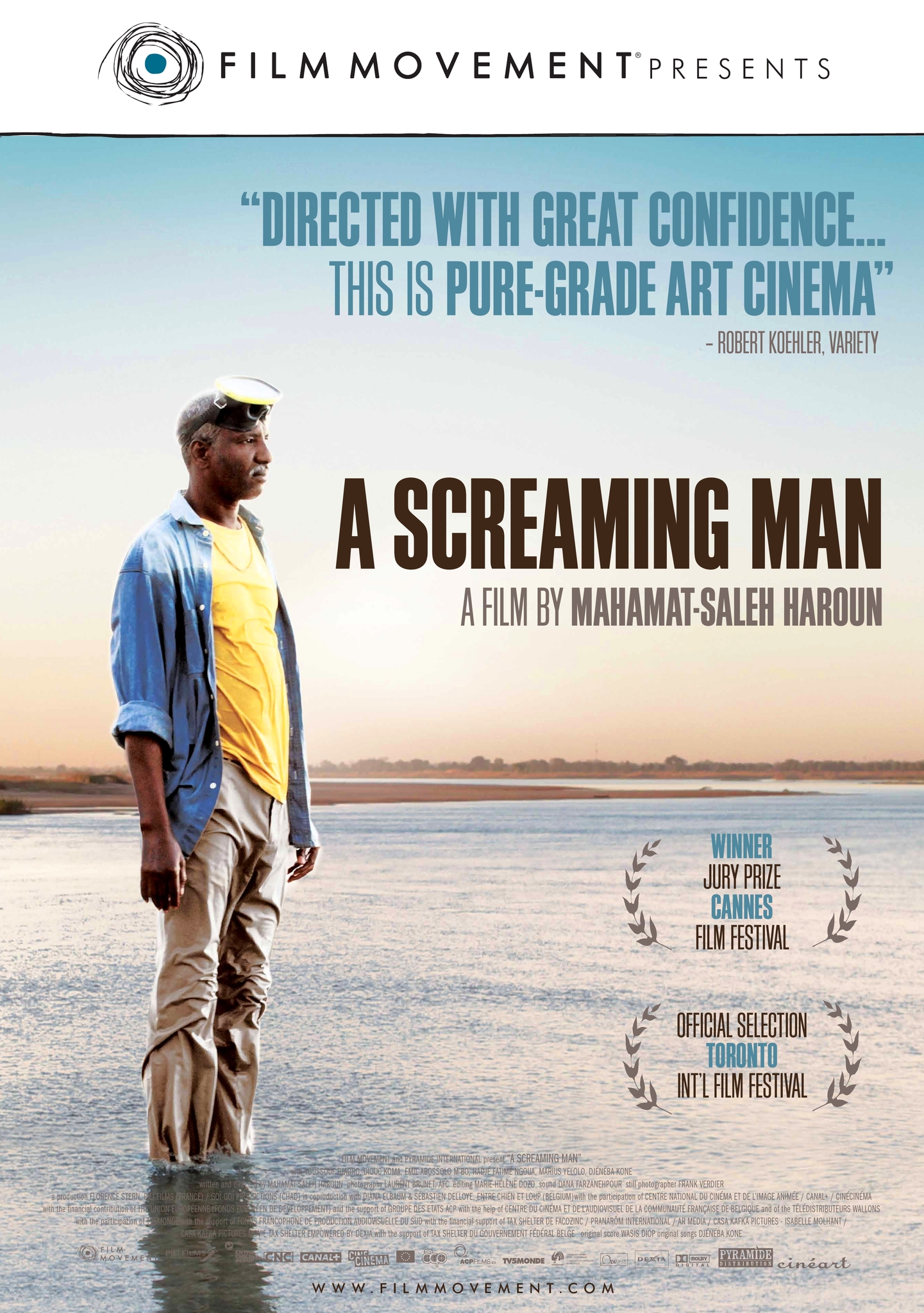
Adam (Youssouf Djaoro) lives in the centre of a busy city somewhere in Chad. He has lived a simple but worthwhile life, with his earlier years being dominated by his reputation as one of the best swimmers in his nation’s history, which has made him into quite a folkloric figure. However, he has mainly spent his time working as the pool attendant at a luxury hotel, and has recently been joined by his son (Diouc Koma), who is just as passionate about the work as his father. Adam is getting older, and as a result, the hotel decides that it is time for him to move on, putting him in the position of the gatekeeper of the hotel, taking him away from his beloved work at the pool, a position now occupied solely by his son. His new job also pays considerably less, and as a result, he begins to think of ways to restore his position. A chance encounter with a debt collector informs Adam of a way out – Chad is engaged in war efforts and are in dire need of volunteers. Without mentioning it to him, Adam enlists his son in the army, and watches as he is dragged from their home, taken to the centre of violence, where his father hopes he will fight and bring honour to the family, all the while leaving the position of pool attendant vacant. However, it isn’t long before Adam begins to regret his decision, especially when he hears stories of how many young soldiers come home broken and battered – if they even come home at all. Suddenly confronted with the realization that he may have pushed his son towards a horrible death, Adam does his best to bring him home, but finds it is far more difficult than he initially imagined, and that his decision may now have long-lasting ramifications on his life, and the lives of others.
African cinema has tragically been the victim of far too much neglect, with very little being done in order to bring it to international attention, despite the fact that some of these stories are amongst the most beautiful and heartbreaking ever captured on film, and with more exposure, they could be easily amongst other canonical works of world cinema. One of the more significant African films of the past decade has been A Screaming Man (French: Un homme qui crie), a harrowing wartime drama set in a bustling city in Chad, and one that looks into the complex psychology of a man struggling to navigate his portion of the world, to the point where he sacrifices what he cherishes the most for the sake of surviving. Mahamat Saleh Haroun truly made an exceptional drama with this film, a hauntingly beautiful portrait of someone doing what they can to make a living, even when it means having to give up the most important parts of one’s life for the purposes of seeing another day and staying afloat. Certainly not the most accessible film – A Screaming Man is a slow-burning, paced drama that spends much of its time on the smallest details, which ultimately converge into a heartbreaking odyssey that feels as profound as it does intimate, with Haroun truly establishing himself as a voice that we should pay attention to, with his work here being utterly shattering, composed by an artist who had his heart deeply ingrained in this story, and is willing to go to any lengths to have it told, even if it meant creating something that is going to inspire the kind of hopelessness the film is actively trying to resolve.
This isn’t a film that is going to appeal to casual viewers, and it does require some degree of knowledge of the social and cultural context in order to fully appreciate it’s many layers – but even without this background, it’s not difficult to see why A Screaming Man is such an effective film. It doesn’t take too much to understand what Haroun was conveying through this film, especially when it becomes clear that this was a story situated at the profoundly human level – the socio-political situation occurring at Chad at the time is important, but only as a background to the story, which is kept fundamentally simple, and doesn’t become too concerned with narrating every detail of the war effort, which gives viewers the chance to get a glimpse into this world, without it becoming a lesson in Chadian social and political strife. This is ultimately a touching drama about a family being torn apart by the war, but through the lens of the patriarch who chooses to sacrifice his son to the combat as a way of providing for the family that is now in danger of falling apart because of his actions. It’s a cyclical work of harrowing psychological drama that gradually becomes more potent as we venture inwards. Haroun makes sure to convey the fact that A Screaming Man isn’t necessarily a morality tale – it’s not up to the viewer to determine if the actions of Adam were appropriate, and whether he did what he was supposed to. Instead, the onus is on us to find the humanity in the story of a man so deeply in danger of losing it, giving up something very close to his soul simply for the sake of another chance at success.
A Screaming Man is anchored almost entirely by the performance given by Youssouf Djaoro, who takes on the role of Adam with immense dedication. This is a film dependent entirely on his work – it’s an intimate character study of an older man trying to hold onto the glory days of his youth, where the nickname “Champ” was worn as a badge of honour, rather than a mocking reminder of the person he once was, which is only made worse after he decides to enlist his son in the army, and every mention of his past successes are secretly eclipsed by a horrifying guilt that erodes at his soul. Djaoro is truly impressive, commanding the film with such tortured sincerity. It’s a simple but affecting performance that feels so incredibly genuine – everything about A Screaming Man is built on a sincerity that gives it a sense of authenticity and pathos, with each emotion coming across as entirely real and earnest. As a character-driven piece, the responsibility given to these actors is immense but easily attained. Even amongst the supporting cast, A Screaming Man finds a lot of value – Diouc Koma is heartbreaking as the doomed son who doesn’t realize what his father is going to ask of him, and Hadjé Fatimé N’Goua is very effective in the small role of Adam’s wife, who has to deal with the aftermath of her only son going to war. Alongside Djaoro, Djénéba Koné gives an incredibly impressive performance as Abdel’s girlfriend, who was just hoping to start a life with him, but now has to face the fact that he is possibly never coming home. Haroun understands the value of a good cast, and makes sure that nothing but honest, direct emotions are extracted from his actors when they’re tasked with telling this story.
Sadly, films like A Screaming Man tend to carry the stigma of being works that prioritize misery and poverty, which is unfortunately a trait that many African films, especially the more dramatic ones, have come to be associated with. The idea that films like these are made to demonstrate suffering, rather than highlighting real problems, is a fundamental flaw in the international perspective, and does a film like this a great disservice, since there is so much more to this film than we see on the surface. Haroun constructed a heartfelt portrayal of ordinary life in the bustling streets of an unnamed Chadian city, which situates this film within the realm of social realism, with its slice-of-life approach being sharply contrasted with the harrowing portrayal of war that occupies the second half of this film – we don’t actually see the warfare, but instead the situation that occurs concurrently amongst those who suffer just as much, such as the families that aren’t sure if they will ever see their son again. It’s a heartbreaking film that finds the humanity in a difficult situation, and while it may be a slower exercise that requires patience, it is worth surrendering yourself to Haroun’s vision, since he makes some profoundly compelling statements that give important insights into a social context many of us may not be aware of. It’s beautifully poetic filmmaking that wears its heart on its sleeve, and employs a delicate heartfulness that is truly stunning, and worth every bit of acclaim it has received.
 The Postmodern Pelican