
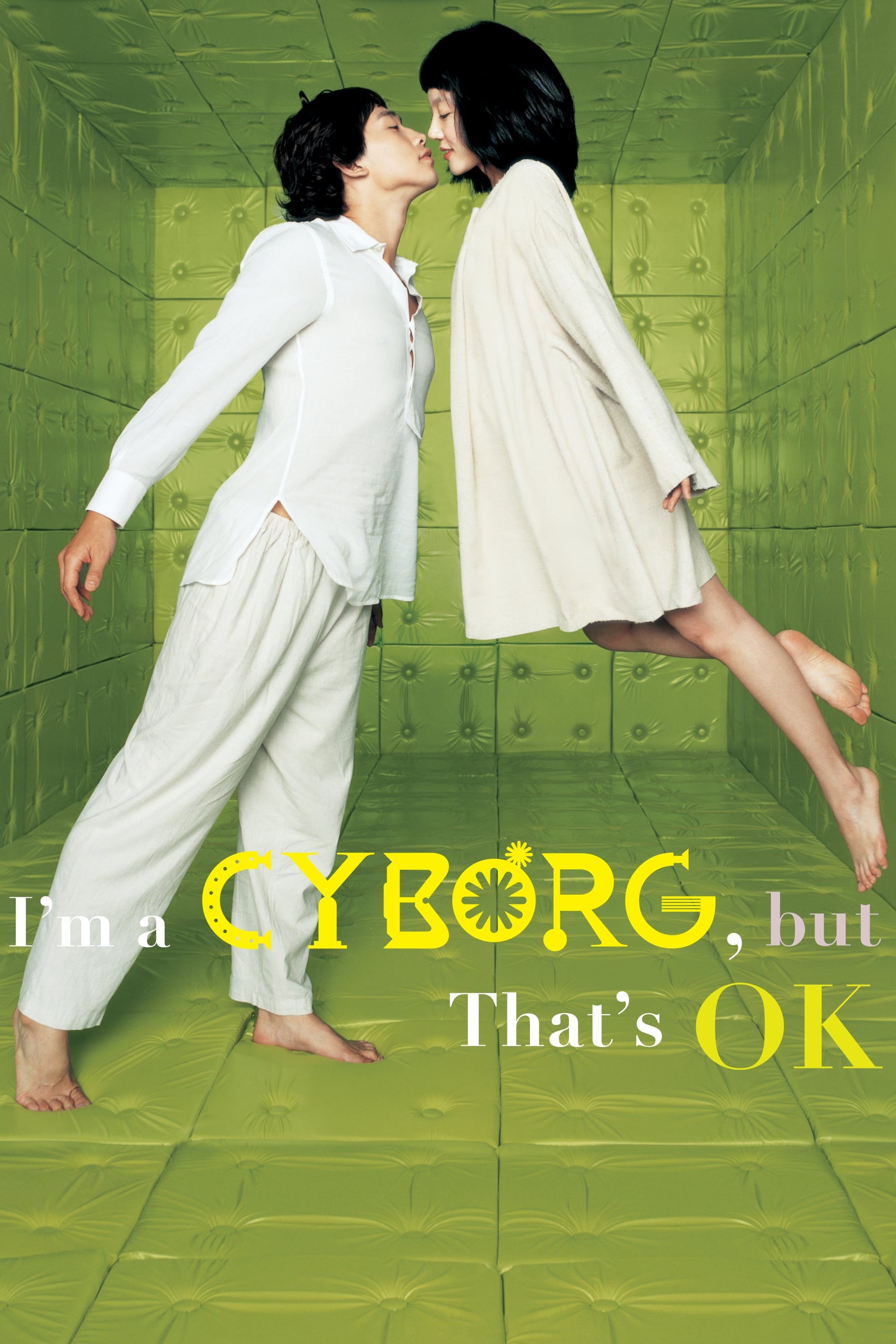
We need to have a brief discussion about I’m a Cyborg, But That’s OK (Korean: 싸이보그지만 괜찮아). I’m not quite sure if this is a good film, or if it’s a bad film – in fact, I’m not even entirely sure if it counts as a film overall. Instead, what is absolutely certain is that Park Chan-wook at some point found a way to put together a series of strange, unforgettable images in a way that resembled a film, but is far too offbeat and eccentric to classify as anything the viewer had seen before. At first, this was a film that came across as entirely bewildering – both in terms of the narrative, and the tone it employed, were profoundly unsettling, and seemed so distant from nearly every principle of coherent filmmaking. However, like with any work of carefully-constructed absurdism, it takes some getting used to, and once we’re acclimated to the film, and Park hits his stride with the story he intends to tell, I’m a Cyborg, But That’s OK becomes quite an unforgettable experience, a beautifully strange love story that finds the romance in the most unexpected places, and gradually reveals itself to be so much more than the nonsensical science fiction comedy that many have dismissed it as being. Coming directly after his overly violent and bleak revenge trilogy (consisting of Sympathy for Mr Vengeance, Oldboy and Lady Vengeance), this was quite a departure for the director, who seemed to be intent on filling in the gaps that were left from his previous films – instead of violence, we have romance, and instead of bleak, gritty social realism, we have an abundance of upbeat comedy that never quite simmers down, resulting in a film that is essentially going to divide audiences between those who find it utterly insufferable, and those who can get onto this film’s wavelength and appreciate the surreal lengths to which Park and his cohorts are willing to go – both sides are entirely relevant (to the point where I find merits in both), but ultimately goes to show that I’m a Cyborg, But That’s OK is one of the most bewildering films of its era, which seems entirely purposeful and ultimately warrants some degree of praise.
Breaking it down to its essential components, it’s not difficult to see why I’m a Cyborg, But That’s OK is such a profoundly strange experience – it feels like the kind of story that emerges out of a fever dream rather than an active collaboration between artists. There isn’t a moment in this film where it doesn’t feel as is Park and his creative collaborators were actively trying to push the envelope, taking this story beyond the realm of surrealism and instead situating it amongst something far more disconcerting – it’s not a horror film in any conceivable way, but it seems like it is only a few paces away from being one, which is certainly a fascinating approach that has reviled as many viewers as it has charmed. Ultimately, this is a thoroughly charming romantic comedy that just so happens to be about two individuals trapped in a psychiatric facility, one of them believing that she is a cyborg, the other a compulsive kleptomaniac that falls in love with this apparently non-human entity. Park provides a masterclass in dealing with an overly ambitious premise without becoming excessive in his own right – it’s a very interesting way of looking at the genre, and through blending romance, comedy and science fiction, he creates something that is undeniably original, almost fatally so. Art is often in dialogue with other works, and the challenge that comes with a film like I’m a Cyborg, But That’s OK is that it doesn’t feel like it is trying to connect with anything, since its central intention seems to be to dismantle everything we know about artistic expression, and instead experience something entirely new. This is definitely the central premise of this film, as evident by an unintelligible first act, where the story rushes towards us so rapidly, it’s impossible to keep track of what it’s saying – but as the film goes on, and Park is able to elaborate on many of these ideas introduced at the outset, we come to realize how even through its form, I’m a Cyborg, But That’s OK is taking a revolutionary approach to filmmaking, one where the audience doesn’t always need to be in control of the narrative, and can be exposed to carefully-curated confusion that clears itself up as the story progresses.
The inherent problem with a film like I’m a Cyborg, But That’s OK is that we are conditioned to be naturally suspicious of thing that we don’t understand or recognize, which creates a certain disconnect between what we understand art to be, and how we approach those that deviate from it. This film seems like one of the rare occasions where a modern work of art inspires the same puzzling response as those at the very outset of the postmodernist movement – audiences recognized that what they were looking at was art, and had some particular message, but weren’t quite sure what to make of it. This all applies so directly to this film, which only increases its potency, since not only is it being a profoundly new artistic experience for viewers, it also urges us to look a bit deeper and find meaning through the process of trying to understand something we didn’t quite appreciate at first glance. This may seem like far too excessive of a reading of this film – for all we know, Park intended this to be an experiment in sewing together various nonsensical images and seeing what different viewers could glean from it. However, regardless of what the intention behind it was (which was certainly nothing short of good-natured and pure), I’m a Cyborg, But That’s OK carries a certain artistic integrity that may not be familiar to us on the surface, but the further we explore this delightfully deranged world Park has set up for us, the more we understand how he was using the form to convey a particular message, abandoning all preconceived notions of what artistry should be, and instead demonstrating the lengths to which it could go without falling apart at the seams, an admirable (if not sometimes unsettling) approach.
Yet, even putting aside the theoretical discussion, it’s not difficult to see why I’m a Cyborg, But That’s OK has become so beloved, the definition of a cult classic that may not appeal to a wide audience, but has achieved a passionate set of defenders who do their best to highlight the merits of a very simple but fascinating work of artistic expression, showing that there is a certain sophistication to Park’s overly eccentric, bombastic sense of humour that seeks to challenge nearly everything we know about the process of representing romance on film. Beneath all the overly serious artistic discourse, there is a very charming romantic comedy at the core of the film – it starts out as a scattered, confusing array of images that don’t add up to much at the outset, but gradually evolve into one of the most touching comedies of the era. When Park finally makes it clear where this film is heading, and the exposition has been done, I’m a Cyborg, But That’s OK verges dangerously close on being an utter masterpiece – just consider the final forty minutes of the film, where every bit of enigmatic commentary and puzzling comedy converges into one of the most tender representations of love, and we can understand precisely what the meaning behind this film was. It doesn’t carry much weight in terms of social commentary – if anything, it is intentionally detached from all forms of recognizable social decorum (helped by the fact that its set almost entirely within a psychiatric hospital that is unlike anything we see in everyday life) – but where it lacks social cohesion, it makes up for it in a bold, exciting approach to unveiling a new kind of romance, which means more than nearly anything else found throughout this film.
Park Chan-wook had his work cut out with him with this film, and it shows throughout the final product. It isn’t easy to take something as commonplace as a romantic comedy and present it in a way that is entirely unique and unprecedented, but he achieves it so wonderfully through I’m a Cyborg, But That’s OK, which finds the humanity in a story that looks at those who feel like they’re on the outskirts of it. Putting together these various components was no easy task, and we can’t honestly say that Park managed it with ease – there are numerous moments in this film where it felt somewhat forced, and didn’t find the depth they were seeking. It’s often best to look at this film as more of a set of ideas than a perfect work on its own, since it helps conceal the flaws if we consider it as an ambitious experiment rather than a singular work. Each moment in I’m a Cyborg, But That’s OK has a certain poetic charm, which is contrasted with an outrageous sense of comedy that allows it to perpetually be on the upswing, even when it is traversing more sobering commentary – it creates an unbalanced sensation which is initially alienating, but gradually grows on the viewer, creating situations where we’re both captivated and flummoxed by what we’re seeing. Ultimately, describing this film is almost as difficult as trying to understand it, since there’s a perceived lack of logic and coherency to it most of the time, which is certainly the reason behind its more divisive nature. However, there’s such a devil-may-care joyfulness, and an immense amount of heart, to this film, we can easily excuse the strange execution and instead embrace it as the work of perfectly-conceived chaos it was always meant to be, and appreciate how it finds the humanity in the most deranged story imaginable.
 The Postmodern Pelican