
It goes without saying that comedy is very subjective, and that what is funny for one individual may not be the same for another. As a result, a great deal of comedy tends to struggle to be carried over geographical and temporal boundaries, which often results in films that are beloved at first, but tend to miss the mark when experienced by other groups. School for Scoundrels seems like the rare kind of comedy since the silent era that could feasibly appeal to everyone, with its straightforward presence, interesting visual gags and general sense of humour appearing to be precisely what a comedy like this needs in order to be effective outside of its particular context. It also helps that the film was helmed by Robert Hamer, who is responsible for one of the finest British comedies ever made, Kind Hearts and Coronets, a cultural institution in its own right. Unfortunately, every fear I had going into this film was met, despite the fact that I was hoping to keep my expectations low, but couldn’t help being enticed by a film that would seem to have a kind of madcap energy that is normally appreciated from a good comedy. Caught somewhere between slapstick comedy and socially-charged satire, you’d think School for Scoundrels was a film reaching for greatness – unfortunately, nearly everything about it moves along at a plodding pace, rarely being nearly as funny as it thinks it is, and ultimately not being a particularly worthwhile exercise, one that can easily be passed over in favour of something with a bit more merit and far more heart than whatever it was Hamer and his cohorts were hoping to achieve here.
In all honesty, School for Scoundrels isn’t necessarily a bad film – part of what makes this such a difficult piece to talk about is the fact that it does accomplish what it sets out to achieve, at least on a narrative level. Taking a series of self-help books written by Stephen Potter, the film didn’t come pre-packaged with a set storyline and a method for relaying the message of the popular psychology books, and instead had to build an entire narrative from minor conceptual threads that don’t normally lend themselves to any kind of screen adaptation. In this regard, we can do very little other than admire what the artists behind this film were trying to do with School for Scoundrels. This kind of intrepid creativity is difficult to argue against, and kudos must be given where its due, and the film does at least earn credit for attempting to do something relatively unprecedented. Unfortunately, this is where the positivity comes to a halt, since the film doesn’t do much more than this, and instead gradually loses its impactfulness as we realize the actual lack of depth throughout it. What starts as a charming novelty eventually turns into something of a chore, a meandering attempt at comedy that really doesn’t hit any of the necessary targets, and rather goes about evoking humour through overwrought meta-commentary and a great deal of exposition that really has no place in a film that seemed to preach the idea of simplicity being the key to success for any great comedy. The result is an unnecessarily convoluted film that really doesn’t get to any discernible point, and instead slowly loses its sardonic edge, replacing it with a meaningless series of moments that just exist to fill up the space.
School for Scoundrels is a remarkably flaccid work of comedy that may not be offensively bad, but also doesn’t get anywhere near the peak of comic genius that it believes itself to be constantly demonstrating. There is an enormous disparity between what the filmmakers believed they were producing, and what the audience perceived it as – the former genuinely thought they were crafting the next comedic sensation, while the latter found themselves thoroughly charmed, rather than all that entertained, by a film that proposes itself to be unbearably hilarious, but instead only manages to be relatively amusing at most. We need to question the motives for this film as a whole, since its premise is certainly audacious, but with a vast disconnect between what it intended to do and how it accomplished it, its hardly surprising that the film as a whole isn’t particularly impressive as it stands. One needs to wonder whether it was a matter of an attempt to do something bold, but the realization halfway through the process that there simply wasn’t enough material to warrant an entire feature film. Indeed, School for Scoundrels seems like a more toothless version of British sketch comedy, which was thriving on radio at the time, but had yet to really make much of an impact on screen, meaning that this approach to evoking humour through stringing together a series of amusing vignettes by virtue of a common them, that audiences would be captivated by what they were seeing. Unfortunately, this wears off relatively fast, and a fragmented narrative doesn’t do particularly well in establishing this as anything more than an unabashedly silly experience that carries very little weight by modern standards.
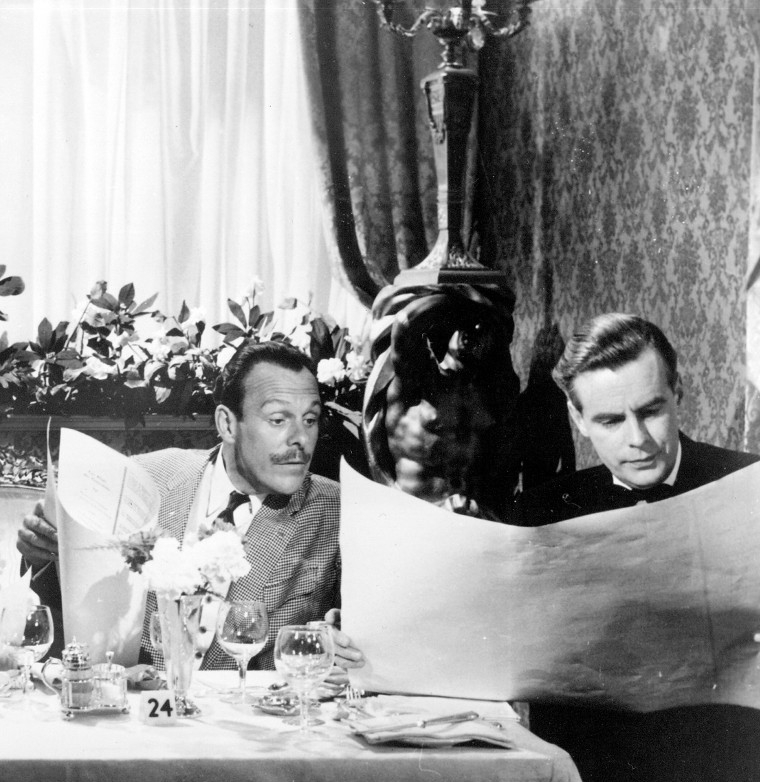
In no uncertain terms, the film is effective in being a series of funny moments, but the question is whether it was all that necessary in the first place. There’s not really much merit to School for Scoundrels than we can glean from far better comedies that handle these subjects in a more nuanced and interesting way. Inarguably, there are some further merits to the film that help make it a relatively effective piece in context – the inimitable Terry-Thomas is a riot as the film’s main villain, a bourgeoisie hedonist who gets his comeuppance after years of terrorizing our protagonist, played wonderfully by Ian Carmichael, who does his best with relatively paltry material. Alastair Sim, a terrific screen presence in his own right, is a lot of fun as the surrogate for the original books’ author, who is woven into the film as a way to tie the narrative to the source material in some way, a decision that wasn’t all that effective (especially since so little of the film actually depends on the text), but at the very least lends it some sense of coherency, which may not be enough to save a fledgeling film, but does manage to do the bare minimum in providing it with a contextual background, rather than allowing it to continue to sink into self-indulgence, which is far from what a film like School for Scoundrels should ever have to fear, but which becomes a legitimate threat for this film, which seems consistently at risk of becoming too enamoured with its own non-existent wit, it may lose its audience entirely. Luckily, it doesn’t quite get to this point, and while it may not be particularly intelligent, it is at the very least an entertaining film.
School for Scoundrels is the kind of film that deserved to be a lot better. Considering the high quality of work done by the director before, and the incredibly talented cast he employs to bring this story to life, the film just falls too flat very often, and seems consistently on the edge of coming apart at the seams, long before it even attempts to make the leap to intelligent, witty comedy that it is so insistent that it is. Context means a great deal, and while its cheap to suggest that social and temporal boundaries have prevented School for Scoundrels from being embraced outside of its particular era, we can’t deny that audiences were most likely enthralled by what they were seeing upon its original release – a bold comedy about ordinary people in various recognizable situations that are presented in a way that leans towards resonant but very entertaining comedy – this is a crowd-pleasing film that most likely played much better at a time when such stories weren’t essentially a dime-a-dozen. It has its moments, and does manage to find the pathos in a relatively weak storyline, but the simple fact is that School for Scoundrels is not a particularly great film, but with some slight smatterings of heartfelt humour, some terrific performances and a general ambition, we can at the very least acknowledge its effort, and praise its persistent attempts at being a good time for the viewer.
 The Postmodern Pelican