
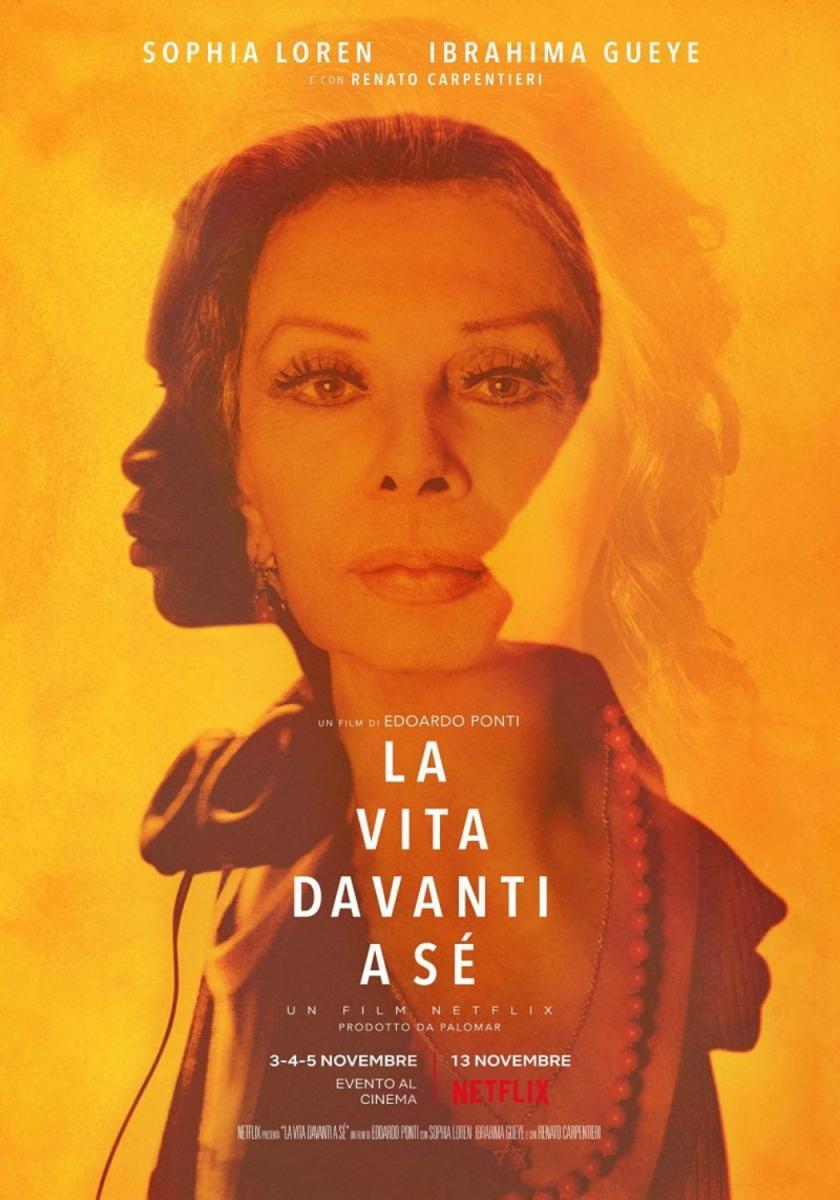
There’s a phenomenon that occurs very rarely, but when it does, almost the entire cinematic community comes to a grinding halt, standing in awe at what we’re seeing transpiring – a film legend emerges from the shadows after years of partial or outright retirement or relative obscurity, and provides us with another glimpse into their brilliance, usually using their advanced age and revered reputation as elements in their performance, almost to remind us of the reasons why he adored them in the first place. Ultimately, it doesn’t get more iconic than the incredible Sophia Loren, one of the very few individuals I can readily call amongst the greatest performers to ever work in the medium, and not fear disagreement, since its almost a canonical fact that not only was she one of the most talented actresses of her generation, and one of the last representatives of the Golden Age of Hollywood, she also defined the concept of the foreign export finding worldwide success, which set the standard for decades of scrappy young performers from all corners of the world seeking out stardom. The embodiment of glamour and talent, Loren is someone who truly made me passionate about cinema all those years ago – so to be able to see her give another stunning performance, seventy years since she started acting, was an opportunity that I simply couldn’t pass up, and based on the enthusiasm that has circulated since her return to film was announced, it’s clear multitudes of others shared the same sentiment. In all honesty, who could possibly pass up the chance to see one of cinema’s greatest sirens giving a performance that proves her mettle as a film legend. Not many 86-year-old women get the chance to play a lead role in a film like this, but when it comes down to The Life Ahead (Italian: La vita davanti a sé), which was directed by Loren’s son – which I’d imagine had a significant part in bringing her back to the screen – simply no one else could’ve done quite what Loren did here.
We can easily debate whether The Life Ahead is a film that Loren deserved to appear in – by all means, this isn’t a particularly major work. Adapted from the novel The Life Before Us by Romain Gary, which has often suffered from criticisms calling it overwrought and treacly, which sadly isn’t entirely elided from Edoardo Ponti’s adaptation of it. However, when we have a legendary actress fully committing to a part that both plays to her strengths, and presents her with some new challenges that she may not have encountered when she was a much younger performer (and at a time when age was seen as much more of a liability, unfortunately), we can easily bypass the glaring flaws embedded in the film itself. Loren is such a magnetic presence, it’s not at all difficult to look beyond the flaws in the story, and how Ponti’s execution of an already heavy-handed source was often a bit too prosaic, which would’ve done a great disservice to a promising set of ideas had it not been anchored by someone like Loren, who is fully dedicated to the pursuit of some deeper conversations that would otherwise not have been had without her and her spirited performance. Had Loren simply just appeared in the film, that would’ve been sufficient in qualifying it as something worth seeking out at the base level – but the fact that she is actually doing some exceptional work here, elevating relatively paltry material to the level where it becomes almost undeniable in her hands. This is Loren as we’ve never seen her before – she’s naturally grown older, and her face may have seen the inevitable passage of time – yet her features are just as striking as they’ve always been, carrying an expressivity that allows her to convey every emotion without even uttering a word. It’s a subtle, masterful performance from an actress who has been through it all, and is now returning with a very simple but affecting performance that outweighs some of the more significant problems of the film around her.
Ultimately, as painful as it is to admit, Loren’s performance deserved a slightly better film than The Life Ahead – while outright dismissing it as an overly-sentimental bundle of inauthentic emotions wouldn’t be quite accurate (and perhaps even somewhat callous, as the film has pure intentions and a readily-available heartfulness that sometimes gets neglected in similarly-themed films), since there is a lot of merit to the story it’s telling, it’s more clumsy handling of the material does tend to dull some of its impact, but not so much that the film becomes a waste of time. Loren isn’t the only star of the film, as the young Ibrahima Gueye is making his film debut here, and proves himself as a major new talent, tackling the role of the impressionable Momo with a stark maturity that avoids being overly precocious, a rare achievement for such a young actor in a role like this. However, unlike Loren, Gueye has an uphill battle of having to not only divert attention away from a bona fide legend (as The Life Ahead is essentially his story, with the presence of Loren actually being somewhat peripheral to the driving narrative that focuses on his journey), but also having to play a character that can sometimes come across too strongly. The role of the lovable street urchin that struggles with his own place in the world, and fights against the systems that seek to repress him and make him complacent, is not particularly revolutionary, and considering the film surrounding him isn’t always strong enough to bolster his character and fill in the gaps that the actor himself can’t be expected to do on his own, it does create a situation where, like his co-star, Gueye is giving a performance that required a stronger approach, and a film that had more assured direction. Ponti should’ve prioritized building the relationship between the two protagonists, instead of deviating into a number of subplots that didn’t have much purpose outside of adding interesting but ultimately unnecessary detail to two individuals that didn’t need so much context to have the audience invest in their individual journeys.
Yet, putting aside the petty grievances, The Life Ahead is a film that benefits from a more lenient approach on the part of the viewer. From the outset, we need to note that this isn’t a film that encourages fine-toothed analysis, especially since the general premise has some problems that do tend to go unresolved, some of the events coming across as being too well-placed to be considered all that authentic. However, Ponti wasn’t aiming to make a film that would be the definitive source on any of its many themes – whether it be bold socio-historical concepts like poverty, trauma and social order, or more intimate matters like ageing, religion or the pursuit of individuality – but rather a heartening exploring of them, an engaging attempt to put an array of ideas on screen, giving audiences the chance to extract meaning from what is essentially a very simple story of an unlikely friendship between an older woman and the child she takes in, both of them put in a position against their wishes. Their better judgment is rendered invalid, particularly when they both realize (without admitting it) that this is the ideal path for both of them. Taking a relatively simple story, and choosing to elaborate on some of the more deeply personal elements was one of the most compelling aspects of the film, and while we may not be particularly convinced at first, especially when the pieces fall into place far too easily to be considered all that realistic, The Life Ahead gradually erodes at our cynicism, establishing a tone defined by hope. It’s not particularly revolutionary cinema, but rather a film that hearkens back to a lineage of compelling dramas that take aim at social systems through navigating the lives of a couple of individuals who are victims to particular institutionalized problems – one can (and should) call into question the director’s occasionally maladroit perspective on these matters, but it doesn’t invalidate the fact that Ponti was operating at a level of artistry defined mostly by compassion, more than anything else – and when dealing with some very sensitive matters, there are worse avenues to take than the one of least resistance. It may not be conclusive, but it’s still certainly still worthwhile.
It’s undeniable that Ponti depends a bit too heavily on the skeletal structure of many similarly-themed stories of two wayward individuals finding themselves in close proximity, and coming to develop an unlikely friendship against all odds, and the film hits all the beats we’d expect – but it doesn’t matter all that much when we look at the broader issues at play here. It all comes down to a few questions we need to ask – have we seen this story represented on screen numerous times? We certainly have (including in the 1977 adaptation of the very same novel). However, is it still worth watching based solely on presenting us with the opportunity to see one of cinema’s greatest artists in her element, giving a late-career performance that proves her mettle as a star of almost folkloric proportions? Absolutely. The Life Ahead is an understandably middling film – it would take a great deal of effort to transform such a commonplace story into something that didn’t veer towards one extreme or the other, whether it be swinging towards overtly saccharine sentimentality on one side, or more callous, hard-hitting commentary on the other. This film does find a happy medium between the two, being very heartfelt for the most part, but not avoiding some harrowing commentary where it was necessary, even if it does come across as being placated by a director insistent on buffing out the rough edges of a film that may have benefitted from the raw emotion that was clearly already embedded in the story. Whether watching it for the sake of seeing a true film legend emerging and giving what is hopefully not going to be her final great performance (although her semi-retirement has limited Loren’s film work to only sporadic appearances), or simply because you want to dive into a sincere exercise in slice-of-life drama with a social message, The Life Ahead is worth the time, even if there was always room for improvement, especially with a story carrying so much potential.
 The Postmodern Pelican