
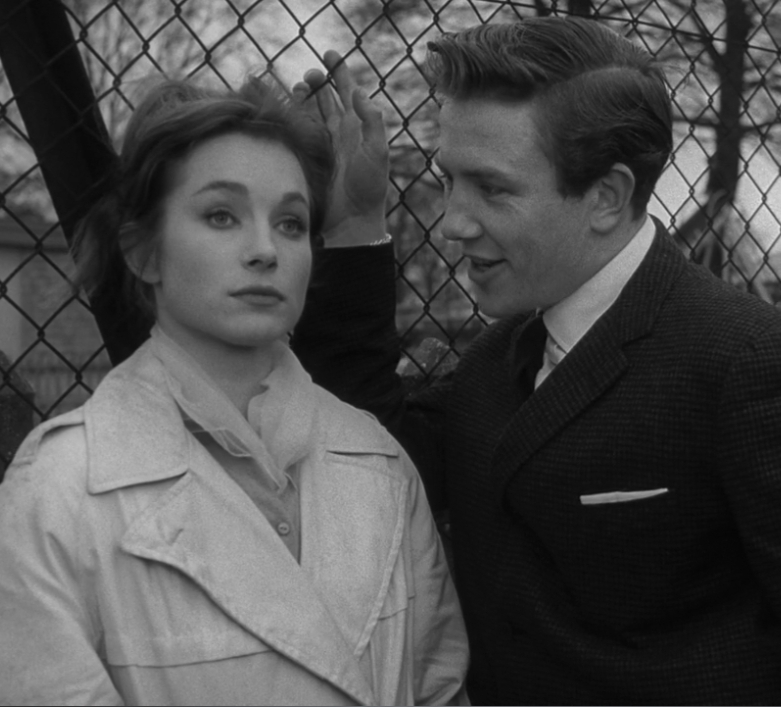
Arthur Seaton (Albert Finney) is an ordinary man – he works a regular job in a local factory in working-class London, and spends his evenings and weekends in pubs and at the local picture show, where he passes the time until he has to return to work the following day. He lives a very simple life, and receives companionship in the form of Brenda (Rachel Roberts), the wife of one of his colleagues, and with whom he has had a long-term sexual relationship, which has been kept a secret from her husband for years. All things considered, Arthur is in a fine position in his life – but this all comes to a halt when he realizes that he isn’t going to be young forever, and his reckless behaviour may eventually become outdated when he loses the edge given to him by youth. Concurrently, he meets Doreen (Shirley Anne Field ), a young woman who immediately captures his attention – feisty, committed to her passions and aloof to the charismatic Arthur’s frequent advances, she becomes an obsession for the young man, who decides that he is going to romance her and prove himself in her eyes. However, she has different plans – she’s someone looking for more than a casual relationship, and is searching for something more meaningful, which goes against Arthur’s principles, even when he realizes that his philandering ways aren’t going to sustain him for much longer. Gradually, over a number of days that blur into weeks, Arthur begins to mature, especially when he faces unexpected consequences from his actions, which gradually start to derail his life and force him to reconsider everything he holds to be true about his very existence – he needs to eventually make a change, but only once he overcomes the stubbornness deeply embedded within him.
Kitchen-sink realism has become such an essential sub-genre of storytelling, it’s difficult to conceive of a time in which these kinds of films were revolutionary – and in order to realize this, we often need to go the very beginning of the 1960s, where the movement gradually started to take shape under the guidance of a few masterful filmmakers who dedicated their lives to capturing the spirit of the postwar generation. One such artist was Karel Reisz, the Czech-born director who found a home for himself in the cinema of the United Kingdom, and directed some of the most touching films of their era. Amongst his most significant works is Saturday Night and Sunday Morning, the adaptation of the novel by Alan Sillitoe (who also wrote the screenplay), and made in conjunction with Tony Richardson (one of the founding members of the movement, alongside Resiz), which is an ambitious and pioneering work of cinematic realism that traverses nearly every conceivable boundary in its endeavour to be a steadfast celebration of life as it is, rather than what it is supposed to be. A film more commonly discussed in deep conversations about this era of British realism, and how it launched decades of filmmakers to go in search of the same principles, more than it is considered a canonical masterpiece, Saturday Night and Sunday Morning is a wonderfully poignant film that combines heartfelt drama with slight comedy, as it explores the machinations of society, as run by its most unremarkable citizens, who are repurposed as the heroes of a beautifully triumphant story of defeating the odds of one’s own personal quandaries, and not losing yourself in the process, regardless of the obstacles in the way.
Simple but poetic, Reisz truly struck a raw nerve with this film, and as a result found himself touching on a side of humanity rarely represented on screen in such outright detail at the time. Saturday Night and Sunday Morning finds itself occupying peculiar territory – on one hand, it’s a straightforward piece of drama that doesn’t have many twists and turns, while on the other, it’s a deeply sentimental exploration of familiar themes, presenting them to us in a few that feels far more brooding and complex than they are in our everyday lives, giving this film a certain veneer of mystery, even when it is (for the most part) a very simple piece of filmmaking. This is inherently embedded in the premise – Sillitoe was the right person to adapt his own novel, since he knew precisely where the intentions in this story stood, and could make the difficult decisions to the necessary elisions, and being able to maintain the underlying message without needing to include absolutely everything. Driven by certain situations, and the dialogue that fills the air during them, Saturday Night and Sunday Morning is very simple, but carries a jagged edge that perpetually keeps us engaged – it never sinks to banality, even when it is at its most prosaic, and where the context surrounding these situations are the epitome of subdued and unfurnished. Reisz finds the emotional and psychological pathos in a story that is far more than just a story of a young man lost in life – he creates a sensational environment for the deepest, most unseen quandaries of the human spirit to manifest in a safe space, which is where the film intersects perfectly with its premise – in terms of the narrative, and the director’s interpretation of the material, Saturday Night and Sunday Morning feels like the embodiment of existence, condensed into a few memorable vignettes that point towards a more cohesive whole.
Naturally, a film like Saturday Night and Sunday Morning depends almost solely on the person playing the protagonist, as the film doesn’t lend itself much credence without a compelling lead. Considering this film came in the first year of Albert Finney’s career (with The Entertainer being his official debut, predating this one by a few months), it’s all the more impressive that the young actor was able to give such a compelling performance. Finney constantly demonstrated such a relentless ease in front of the camera – and whether this was the result of years on stage, or simply the byproduct of an actor who had impeccable control of his craft, it’s clear that what he’s doing here is very ambitious, especially for such a newcomer to the screen. It may pale in comparison to some of the towering work Finney would go on to do in subsequent years – Arthur Seaton isn’t the most heroic protagonist, nor is he someone who we’d necessarily associate with a very strong, historically-resonant performance – so it’s only a testament to Finney’s great work and dedication to the part that we were able to see the nuance he could bring to an otherwise conventional character. He is supported wonderfully by Rachel Roberts and Shirley Anne Field as the married woman with which he has a long-term sexual relationship and a young, naive debutante that he begins to feel a budding passion for respectively. They match Finney almost beat-for-beat, rising to his level, especially when it comes to finding the truth in a pair of very unconventional characters that are supposed to be romantic figures without becoming objects of desire. Finney was the kind of actor who had chemistry with everyone he worked with, so it almost goes unsaid that he brings out the best in his co-stars, and they do the same for him, creating an unforgettable cast that seems to be insistent in not being weighed down by more conventional material.
Saturday Night and Sunday Morning is going in search of something much deeper than what we see reflected on the surface. Kitchen-sink realism isn’t just a throwaway term for gritty films about working-class folk undergoing some challenges in their everyday life (even if this definition has become synonymous with the sub-genre), but rather a complex exploration of very real issues through the lens of the most bare, stark storytelling imaginable. Often mistaken for paltry resources, this brand of realism is rich with ideas that flow through it with such immense rapidity, it can be difficult to keep up. This is absolutely true for Saturday Night and Sunday Morning, which was one of the formative entries into this burgeoning movement when it was still in its infancy, and it’s not too difficult to understand where the film is finding its heart. The “slice of life” narrative is certainly an omnipotent factor in these stories, but it never appears to be weighed down by intentions of simple description – these films always carried a deeper message, which was rarely ever made explicit until the final moments, where ambigious endings and a sense of melancholy lead us to understand the impetus behind this particular work. Yearning for the follies of youth, contrasted with the growing uncertainty in the decades following the war, just as Britain was gradually reconstructing itself, there’s so much to unpack in this film – so it only seems fitting that Reisz outright avoids every bit of overwrought commentary and instead keeps everything fundamentally realistic and earnest, without ever feeling compelled to over-explain the message which gradually unfolds as the film progresses, the ideal model for a work such as this.
Seeing this film traverse so many complex ideas is something worth witnessing, with Saturday Night and Sunday Morning being intent on finding poetry in everyday life, a fundamental quirk of the school of social realism that seems oddly saturated in this film, which appears so simple, yet carries a wealth of meaning in every frame. Reisz was able to extract so much genuine emotion from a premise that doesn’t offer much in terms of a solid storyline, but functions as a series of moments in the life of a protagonist who is neither heroic nor mean-spirited, rather appearing as an earnestly flawed man trying to navigate a world he is gradually starting to realize is far more intimidating than he imagined. As one of the first genuine works in a rising artistic movement, Saturday Night and Sunday Morning had a lot to prove, and it manages to find the honesty in the midst of a story that could have so easily been heavy-handed, but rather comes across as irreverent and effervescent most of the time, while not being afraid to venture into darker territory. Tackling complex subject matter with a cheeky grin and sly wink, and finding the heart of humanity in the simple expression of our collective quandaries, Saturday Night and Sunday Morning is a resounding success, a straightforward but utterly delightful glimpse into life and its many unexpected obstacles.
 The Postmodern Pelican