
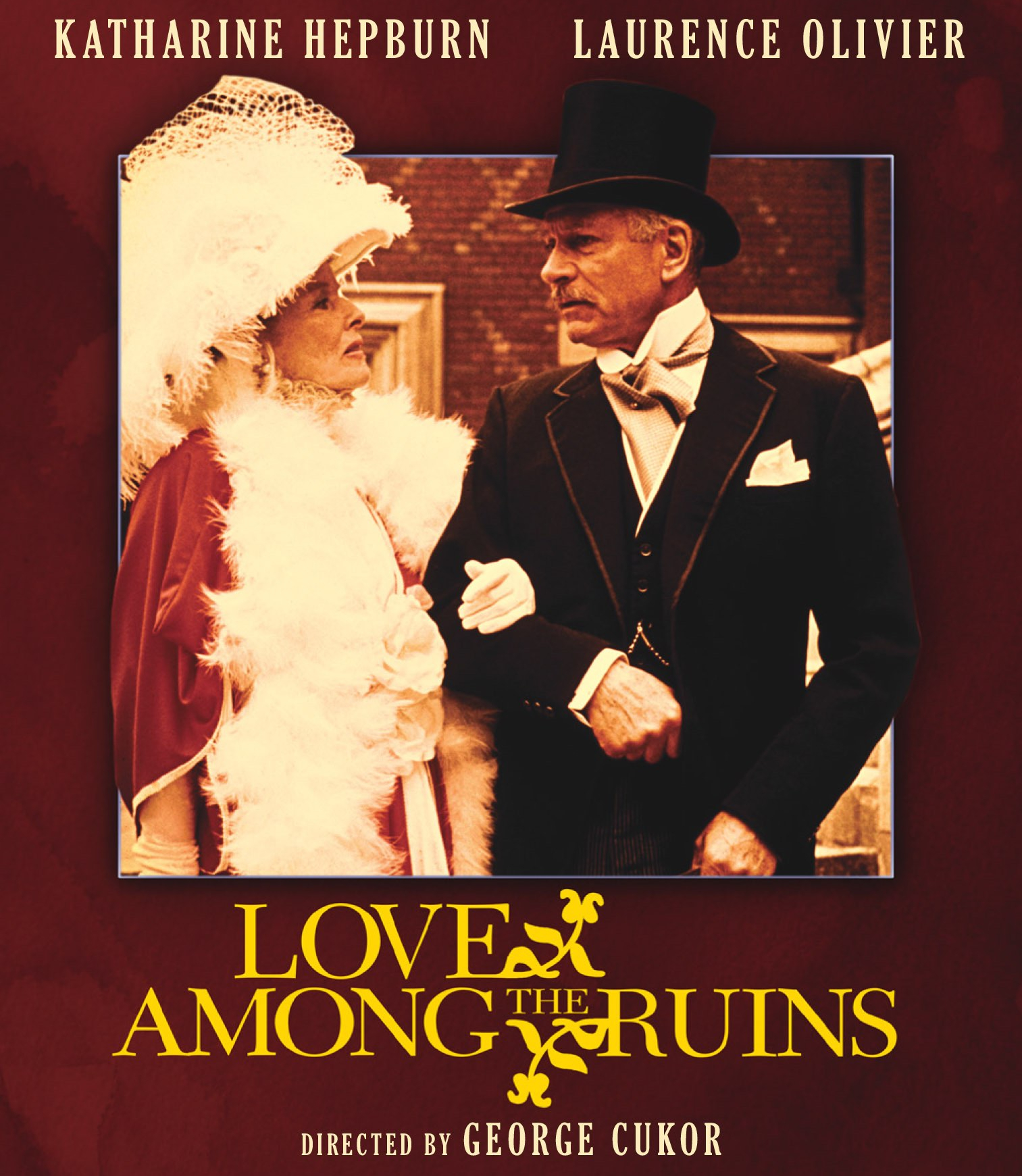
In a career that stretched from the earliest days of the Golden Age of Hollywood, right to the centre of the New Hollywood movement, George Cukor was a cinematic institution – and anyone who has had the great pleasure of seeing any of his films will doubtlessly attest to the fact that he was a filmmaker capable of doing far more than we expected at times, often having certain surprises in store for the patient viewer. While he may be best-known for any of his more canonical films, such as iconic screwball comedies Holiday or The Philadelphia Story (and numerous others), there’s a joy in venturing deeper into his career and finding the gems lurking just out of sight. One of them is Love Among the Ruins, a made-for-television film that sees the director working with two absolute titans of the industry, in a small but charming romantic comedy that wears its heart on its sleeve, and finds the humanity in an otherwise trite story that may not have value on its own terms, but rather functions as a magnificent work when taken alongside the many areas that Cukor and his actors explore through the process. Not nearly as well-known as it should be, possibly because it is eclipsed by superior work on all fronts, but Love Among the Ruins is an absolutely stunning film of immense heartfulness and an unexpectedly valuable sense of humour that makes it a true delight, and something that should be of interest to absolutely anyone with even a passing interest in simple, well-acted films that don’t convey anything we haven’t seen before in terms of the story, but finds a unique and sensitive understanding of the human condition through the various narrative avenues it takes.
The film is set sometime during the Edwardian period, and where Sir Arthur Granville-Jones (Laurence Olivier) is well-regarded as the best barrister in the entire empire. This is not a position that he takes lightly – he is an honourable man who is incredibly respected, and perhaps even feared by those who feel intimidated by his enormous stature in the world of legal matters. However, there is one person that can even bring such a notable figure to his knees – Jessica Medlicott (Katharine Hepburn), a prominent socialite and recent widow who has moved to London after years of travelling and making the world her oyster. After the death of her husband, Jessica pursued a much younger man (Leigh Lawson), who she apparently subsequently left after promising to marry him, leading to a lawsuit, where the young man and his mother (Joan Sims) hope to fleece the wealthy widow of a considerable part of her fortune. As a woman of great influence, she demands the very best representation – and naturally this comes in the form of Arthur, who is naturally very eager to take the case. What no one realizes is that Arthur had more than a professional interest in this case, as Jessica is a spectre from his past. They had met nearly half a century before, where she was a glamorous young ingenue of the stage, and he was a penniless law student, and they engaged in a few days of passionate romance, before parting ways for what they thought would be forever. Unfortunately, this brief but beautiful affair has only remained ingrained in Arthur’s memory, as Jessica has absolutely no recollection of meeting him before – and in the midst of a bitter legal battle, he does his best to remind her of their past, in the hopes of reigniting her memory and hopefully recapturing the spark of unimpeachable romance that he had been holding onto for decades.
Perhaps the most significant aspect of Love Among the Ruins, and perhaps the reason why many will seek this out in the first place (as was my motivation for finding it), was that this is catnip for anyone enamoured with the art of acting. To call Katharine Hepburn and Laurence Olivier great actors is such a gross understatement, it borders on insulting. These two performers were the gold standard for acting, the titans of the industry that nearly every actor since their emergence nearly a century ago have strove to emulate in some way. They’re titans of the profession, and the idea of seeing them lead a film which essentially finds them in constant dialogue, sparring and gently ribbing one another, should be at the very least enticing to those of us who appreciate the art of great acting. Olivier and Hepburn may have had their peaks in previous decades, but this particular era found them doing some of their most interesting work. They were consolidated as the embodiment of quality acting, and were settling into their status as the elder statespeople of the industry – but this certainly did not mean they were growing complacent in their advanced age, with both venturing beyond the confines of what the industry offered actors of a certain age and pursuing consistently great work that allowed them to continue to push the boundaries of what they could do. These are two exceptionally likeable characters already – but it takes Hepburn and Olivier to truly establish them as fully-compelling, and they succeed wholeheartedly. How else do we possibly explain a film that is, at the most fundamental level, an extended conversation punctuated with a few sojourns into legal proceedings, being so exquisitely compelling? It’s all embedded in these characters, and not only are the roles well-written and very interesting, the actors manage to evoke the necessary nuance needed to bring out the deeply sentimental story.
In this regard, Love Among the Ruins is not a revolutionary work for either actor – their performances are solid but not anything we shouldn’t have expected from them. Suitably dramatic for the most part, but fully-capable of handling the moments of upbeat comedy that gives the film its charming tone, the two actors work so exceptionally well together. What is even more fascinating is that both Hepburn and Olivier had egos to match their talents – but here, instead of attempting to upstage one another, they’re in perfect synchronicity, playing to each other’s strengths and demonstrating a keen sense of chemistry that can only come from a couple of performers who were beyond at ease in their craft. Comfortable but never complacent, both actors are operating at the highest possible level they could, committing to these often outrageous characters in ways that not only entertain us, but also make them fully-believable. They had the tendency to bring out the best in other actors – they demanded attention for the most part, but the true marvel comes in how they complement one another. The realization after this film has ended, and we see the considerable amount of names listed, that Love Among the Ruins actually had a substantial cast, is quite something – we tend to forget that there is an entire world outside these two actors, and that they’re often supported by a very good set of character actors that seem to genuinely enjoy being shoved to the background by two actors who command every frame they’re in, so much that there’s barely enough space on screen for another soul to even make an impression.
Less a work of vanity, and more focused on the pleasure of being in their presence (whether directly or through simply seeing them on screen), Love Among the Ruins is such an enthralling work that finds the unexpected pathos where we don’t always expect it. Cukor was a very traditional filmmaker insofar as his work always took the form of the era they were in, or in the case of his later work, appeared to be pastiches to earlier decades. This certainly applies to Love Among the Ruins, which seems like one of his more conventional comedies, insofar as its a quaint, dialogue-driven film that seamlessly blends heartfelt romance with tender comedy – but in the process infuses a sense of progression into the fabric of the story. This is a film about certain issues that weren’t always expected from such straightforward comedies – a quintessential romance, Love Among the Ruins focuses on themes of ageing in ways that are predominant and never played for laughs. It covers tricky narrative territory, giving us glimpses into the lives of two people in the twilight of their lives, but who haven’t settled into the sexless recesses of old age, and who do their best to feel the same electric surge that comes with a great romance. This story would’ve been very compelling in any form, but the fact that it was so insistent on being centred on an older couple, and where their love isn’t seen as outdated or puritanical, makes it so much more effective. I’d imagine part of this film being produced was to give audiences the chance to see two of the finest actors of their generation across from each other, but the decision to situate it amongst more challenging commentary on the way we perceive romance was the driving factor behind the film, and the aspect that allowed it to be so incredibly poignant, even when it wasn’t aiming for it.
Cukor captures the exact tone needed for such a story – this tends more towards the melancholic tenderness of something like Holiday rather than the more upbeat excess of Travels with my Aunt or INSERT, a comedy that has an equal balance of humour and sentimentality. Despite the subject matter that is far more cutting-edge than one would expect from a film of this stature and involving such talent, Cukor never strays from the elegance that was so quintessential to his career – the low-hanging fruit is rarely even considered, and while it may seem somewhat outdated in terms of the values embedded within it, Love Among the Ruins is never stale. It is fresh, invigorating and often very funny – this comes from both a witty script that puts together incredibly compelling characters (to the point where I was taken aback that this wasn’t adapted from a stage play, as it has all the elements that normally go into such productions), but also a pair of astounding actors doing work that may not necessarily be staggering for their standards, but rather functions as late-career entries for two performers who weren’t content with simply nestling into their roles as respected veterans – it took a while for both Hepburn and Olivier to acknowledge their emeritus status, so even when they were older, they were capable doing such interesting work that never saw them resting on their laurels, but instead pursuing something far deeper. They embrace the various aspects of this story with great gusto and even more sincere heartfulness, bringing out the emotions that might not have been present had this story been placed in the hands of less-capable performers, or a director who didn’t realize the value in the smaller moments. It’s an absolutely lovely work that is almost insatiable in its pursuit of some complex understanding of human behaviour, without becoming too academic about it.
Love Among the Ruins is a truly charming work that feels both minor and essential – this isn’t an obscure film, but one that hasn’t received the attention it would normally warrant, which is perhaps the most beneficial quality, since so much of enjoying this film comes with discovering it, whether through word-of-mouth from a trusted friend, or simply stumbling upon it by pure accident. To say one should keep their expectations low seems inappropriate since there is always some form of pedigree that comes with seeing these two actors under the guidance of a director who often defined quality – but for those who don’t quite know what to expect, Love Among the Ruins is an absolute delight, a simple but heartfelt piece that sees two great actors at the peak of their craft, doing what they do best – and what could possibly be better than seeing iconic artists continuing to push boundaries, even when they didn’t need to? An absolutely riveting work that deserves to be seen – and whether you’re a devotee of the director, or someone who appreciates these actors, even when they weren’t doing prestige work, this is sure to be an entertaining experience that may not carry much in terms of narrative heft, but compensates with a stark and honest view of emotion that is almost unprecedented for a film like this. It’s work seeking out, particularly for those with some interest in this kind of simple, poetic perspective on romance, and will certainly be just as delightful for anyone who tends to gravitate towards the immense elegance and sheer pleasure of a story well-told.
 The Postmodern Pelican
A lovely review of a lovely film.