
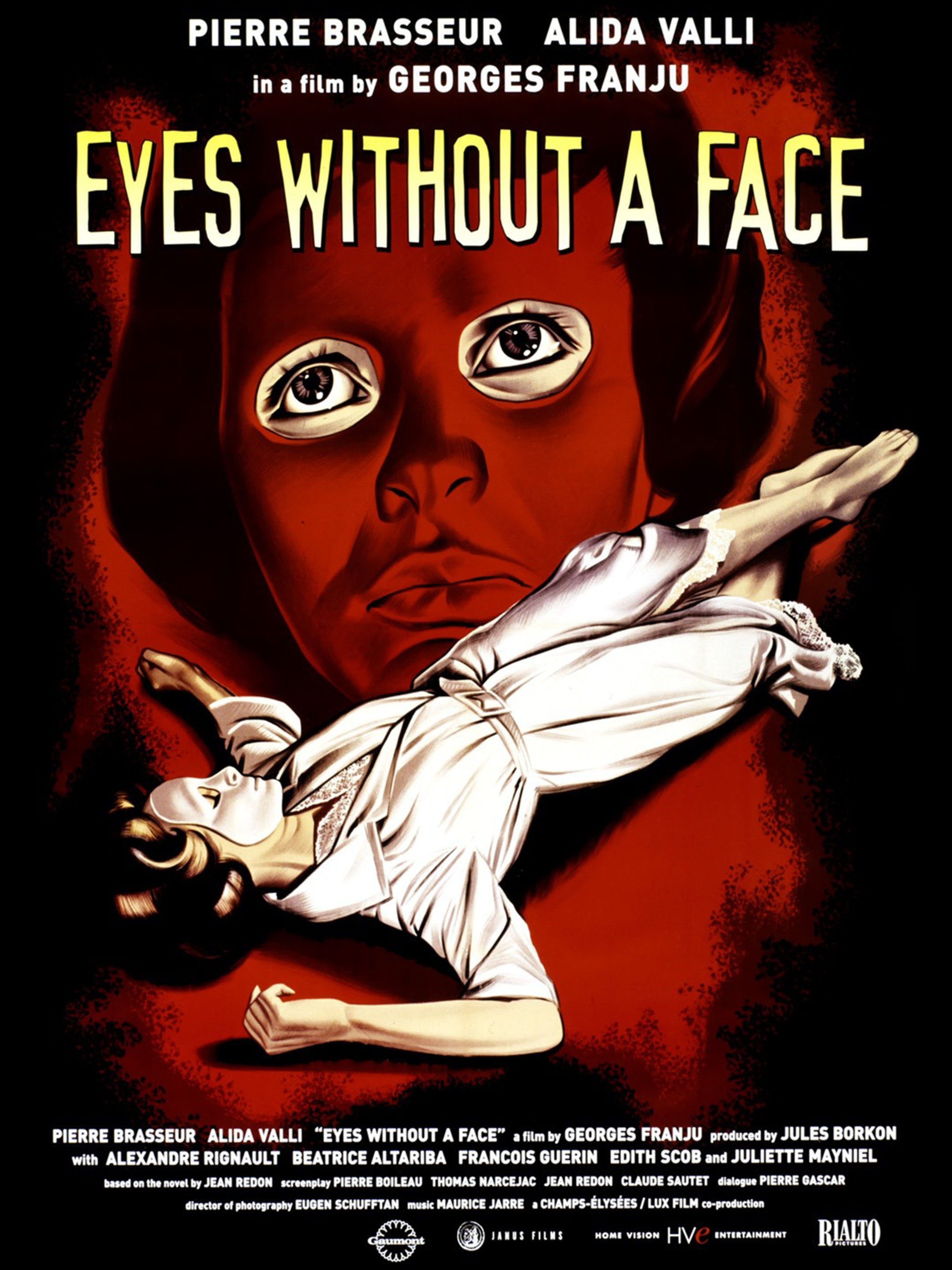
It’s been well-documented that, prior to the late 1950s, horror cinema wasn’t really a prominent area being explored in French filmmaking, especially those that were more focused on more contemporary or alternative stories. One director who contributed his own voice to this disparity with Georges Franju, who I’ve grown to have enormous respect for, even when some of his work leaves a lot to be desired. I have previously praised Judex, his masterful adaptation of Louis Feuillade and Arthur Bernède’s silent-era serial of the same name, which he turned into one of the most compelling works of thriller filmmaking ever committed to the medium. However, what is even more impressive the film that preceded it by a few years, the absolutely incredible Eyes Without a Face (French: Les yeux sans visage), which has gradually grown to be seen as a cornerstone of early psychological horror, and quite simply one of the most effective entries into the genre, both at the time of its release and from modern standards. It’s not always easy for a film made over half a century ago to retain this kind of cultural cache – but when we break it down and look beneath the surface, we can easily understand precisely why the work Franju and his collaborators were doing (especially in adapting this novel by Jean Redon) and why it remains as iconic and utterly terrifying as it did decades ago. In short, Eyes Without a Face is an incredible achievement that is only bolstered by a sense of darkly twisted humour and the outright intention to terrify the audience far beyond what we normally experience in supposed works of unhinged horror. Franju truly achieved something quite stark with Eyes Without a Face, which has never lost its unforgettable sheen of absolute horror, even when so many imitators have tried to achieve similar results, to very little success.
Eyes Without a Face is an oddly cohesive work of fiction – not only does it appeal to devotees to the horror genre, it’s also the kind of film that could possibly convert those who are agnostic to works of terror, since it is fundamentally different from many other entries into the genre, but not so notable a departure that the roots in previous works become inconsequential. Many who naturally feel repulsed by horror may find solace in the hallowed presence of this film, since it is absolutely terrifying, but in a very different way, whereby everything is prioritized from the beginning, and gradually unfolds throughout the course of this absolutely unsettling work of fiction. Franju was a filmmaker who conveyed such a firm sense of control over his work, it’s obvious that he’d attain some degree of success – and Eyes Without a Face has always been considered to be his greatest work, not only because it is perhaps the most direct distillation of the director’s style, but also because it feels like his most complete. There are various aspects of this film that are remarkably well-formed, and both in theory and execution, the director is asserting a very interesting control of both narrative, character and more superficial elements, weaving a tapestry that would unquestionably go on to become an inspiration to legions of subsequent filmmakers. One of the few instances where the effort put into making the film directly reflects the intentions of the source material, which is here used as both a rough guideline, and a source of inspiration to set this story in motion and allow it to flourish on its own unique terms, which isn’t something many films of this ilk tend to approve of – but when you’re dealing with Franju, a filmmaker whose consistent need to push the envelope may have always worked, but the moment it strikes the right balance between genres, it’s truly something to behold.
Yet, it’s not enough to simply note how Franju revolutionized the genre, especially when some of the most notable aspects of his work in horror are most evident here – it’s far more interesting to actually look at the ways in which the director finds the authenticity in what is essentially nothing but an absurd series of situations that bear no real consequence on reality. There’s a tendency for horror films to go for the jugular in terms of scaring us, and as we’ve grown more desensitized to gore, violence and unhinged terror, so has there been an influx of convoluted plots, overly-complicated situations and a sense that something needs to be excessive in order to be scary. Eyes Without a Face is the definitive film that proves this isn’t necessarily true, especially when Franju establishes a clear set of principles that all trace back to the ultimate intention: absolute simplicity. We’re often reluctant to accept horror films that are perceived as being more bare and straightforward, since we tend to appreciate it when filmmakers keep us at a distance, using excessive cinematic tools to keep us entertained, but not in direct contact with the stories, crafting the feeling of necessary fictitiousness. Franju goes the other direction – everything is kept so simple, create the sense that everything what we’re seeing doesn’t have the veneer of fantasy around it. It’s stark, direct and utterly compelling in every conceivable way, which isn’t an easy accomplishment, especially when everything that this film stands for goes back to its incredibly effective execution, the promises very little except the bare necessities, which is more than enough to sustain a film that doesn’t need to rely on too much other than its striking story to be a resounding success.
If the simplicity of Eyes Without a Face is what gets us through the door, what makes us stay is the utterly terrifying sense of horror Franju presents us with from the first moment. Classifying it as a pure horror is immediately called into question, since there are elements of film noir, familial saga, psychological thriller and character-driven drama that all come to the fore at different parts of the film. Rather than being a scattershot bundle of genres, Franju instead goes about realizing this story through directly addressing it – there’s no boundary between the artist and his work, and even when working from something as entirely relentless in its horror as this, the director is consistently calling into question other creative and narrative concepts that are carefully woven into the fabric of this film. Where he precisely manages to extract such incredibly poignant commentary from a premise that doesn’t lend itself to the idea of family-oriented filmmaking isn’t clear – but what is exceptionally obvious is that everything that went into the creation of this film was put there on purpose. It’s difficult to imagine Franju making Eyes Without a Face without such direct detail in every frame, each moment carrying some deeper significance that rarely manifests itself, especially not in pioneering works of horror such as this. An enormous amount of credit must go to the cast – Pierre Brasseur, Alida Valli and Édith Scob are all exceptional actors that brought out such raw, honest emotion in a film that could have so easily been nothing more than a poorly-conceived European horror, but rather strives to be something far more. Instead, through their meticulous agreement to take part in something fundamentally expressionistic and driven by an abstract poeticism, they turn in some performances that define this era in horror filmmaking – and even if it’s Scob and her mannequin-like appearance and movements that has held the most significant cultural cache, the characters in Eyes Without a Face are essentially what lends it the credence it deserves, and so thoroughly earns throughout.
Eyes Without a Face isn’t terrifying for the sake of unsettling the audience, but rather intends to disorient us just enough to keep our interest piqued, consistently inviting us to venture further inward, following the various heroes (and anti-heroes, in the case of the central character of Christiane) who aren’t aware who doomed they actually are, and the maniacal villains that Franju still manages to humanize, preventing them from becoming one-dimensional or mere archetypes. There’s a sinister sense of malice pulsating through this film, inspired by the growing sensation of unease and ill-intent that lurks behind every corner. It makes great use of a very simple but effective premise, and constructs many situations that are quite striking, but never go beyond the confines of what needed to be present. The definition of less being more, Eyes Without a Face is such a stunning work, both in the story it tells (and there have been so many insightful discussions had on the subject of identity, which is so perfectly encapsulated in the character played by Scob, and her periodic moments of liberation, including the final scene where she walks away from the maelstrom her now-deceased father created, dove firmly in one hand) and the manner in which Franju executes some intimidating ideas. It’s a staggering piece of fiction that is so utterly insatiable in inciting a sense of despair and angst, which it interweaves with a poetic understanding of humanity, giving this incredible horror film so much more depth than we’d expect. It’s a wonderfully unique work, and absolutely one of the defining horror films of its era.
 The Postmodern Pelican