
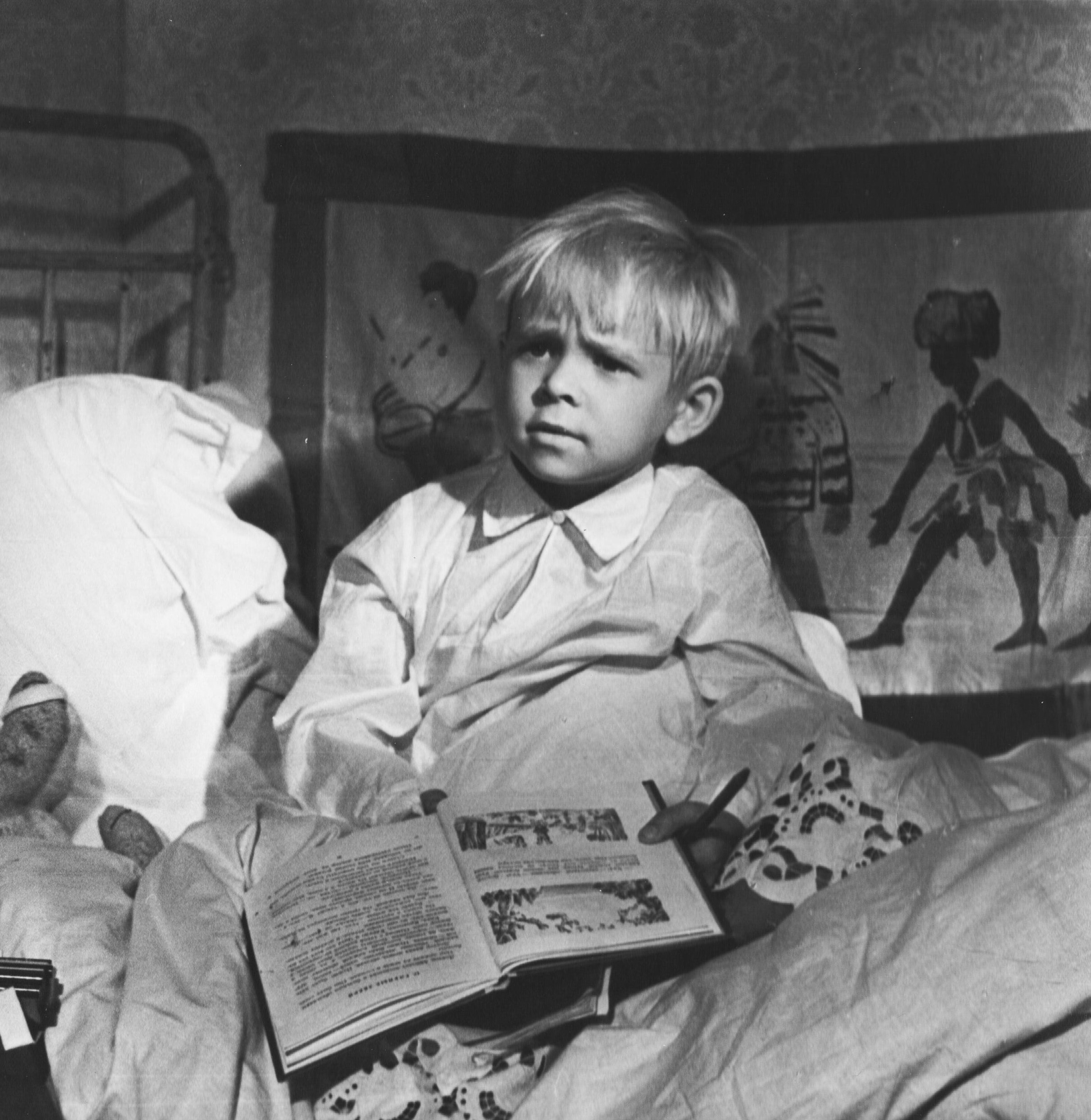
Sergey (Boris Barkhatov) has just turned five – and despite his young age, he has grown to have a keen understanding of the world around him. However, this sentiment isn’t shared by those in his immediate surroundings, who find him to be just like any other precocious child, curious about life, long before he learns some of its hard lessons. In fact, he begins to encounter one at the outset of the story, when his mother, Mariana (Irina Skobtseva) announces that she is getting remarried, this time to Dmitri (Sergei Bondarchuk), the director of the local state farm who is relatively successful, although his humility and insistence on treating others as equal conveying a slightly different idea. Sergey is initially frightened of the new man in his life, but finds his fears being easily overcome when he realizes that Dimitri isn’t nearly as intimidating as others made him seen. He becomes a father figure to the young boy, who in turn looks up to him and finds a perfect role model in a man who embodies every area of success – as a parent, as a working-class individual and as a human being, and in the process teaches Sergey some interesting lessons of his own that he hopes will adequately equip him for the world that’s awaiting him just across the doorstep. Over the next few months, Sergey continues to grow, spending his days in well-meaning mischief with his friends, who lead him into various precarious situations that threaten to get him in trouble, but managing to escape at just the right moment. In the midst of all of these lovable misadventures, Sergey and his ragamuffin friends start to realize that life is far more complex than their small minds could ever comprehend, but instead of fearing what they don’t know, they exhibit a healthy curiosity that may get them into difficult situations, but teach them far more than they could ever learn in school.
Childhood is a tricky time in anyone’s life – and no one has been able to capture this feeling of being lost in a world that seems so much bigger than it actually is than the various artists that have set out to explore our formative years across many different forms of storytelling. Georgiy Daneyila and Igor Talankin handcrafted one of the most poignant glimpses into childhood ever recorded on film with Splendid Days (Russian: Серёжа), a wonderful comedy centred on the trials and tribulations of a protagonist who may be relatively small, but is wise beyond his years, and who navigates a world he may not fully understand, but which doesn’t stop him from making the best of whatever life throws at him and his family. Splendid Days is one of the best representations of childhood, produced at a time in which cinema was continuing to grow, telling stories that were familiar but slightly off-kilter, vaguely detached from the mainstream. The stories that populated these films were plucked directly from reality, coming from a genuine interest in the world around them, with the directors demonstrating such a keen understanding of the social machinations that don’t always manifest quite as effectively as they do here. Splendid Days is such a heartwarming experience that speaks directly to some broader ideas that are more often found in the realm of anecdotal stories rather than fully-fledged films – so the splendour that comes when Daneyila and Talankin manage to distil everything we adore about these stories into a single coherent narrative that does the impossible and finds the depth in a series of vignettes that could have otherwise been nothing but charming but unremarkable fragments of childhood, is quite extraordinary and immediately confirms this as one of the most essential films of its era, particularly in terms of the coming-of-age narrative, which has rarely been as endearing as it has here.
Splendid Days is a quintessentially Russian film, particularly in how it sets out to capture the spirit of ordinary life, never promising to be anything more than what we see on the surface. In this regard, the film seems to be descended from a long tradition of hyper-realism, where directors like Daneyila and Talankin were focused less on grandstanding and creating stories that entertained, but rather prioritizing the poignant expression of reality, taking with its various elements that may not make for traditionally rivetting entertainment, but through their earnest and dedicated vision, grows into utterly exhilarating and often unintentionally hilarious moments that speak more to the portrayal of authentic situations than many other films could’ve ever hoped to achieve. Rooted within a kind of poeticism that seeks out different facets of the human condition, this kind of film uses the platform as a means to comment on certain concepts that rarely find their home in more conventional stories. This means that a film like Splendid Days is more focused on the simple aspects of the story, rather than the bolder and more bombastic elements, and as a result has a relatively straightforward narrative that doesn’t lend itself to much discussion, with everything that makes this work so effective coming from its ability to venture deep into some fundamental areas and gradually uncover some deeper truths that speak to us directly, resonating with every viewer, who will inevitably reflect on their own childhoods and find a sense of comforting familiarity through this film. It’s enough to be entertained, but the true thrill comes in finding something in a work of art that feels like it’s speaking to us personally – and there is certainly not a shortage of moments in Splendid Days, which feels very much aligned with a more simple school of artistry.
The world is a strange place, especially when you’re very young, and the directors effectively employ this principle throughout Splendid Days in quite interesting ways. This film had a bigger task than we’d initially expect from it, having to navigate some deep emotional territory without becoming overwrought. Too many films focused on the experience of growing up tend to be plagued by similar problems – very adorable premises, but an outright refusal to venture deeper, resulting in films that are very compelling, but not nearly as insightful as they’re purported to being based on a surface-level analysis. Splendid Days rectifies many of these problems, but without making it clear that it is going to be entirely different in its intentions. Daneyila and Talankin really did have their work cut out for them, but for the most part they succeeded brilliantly. There’s a sense of underlying poignancy present in every frame that speaks to a much deeper set of issues, gradually developing its characters by placing them in challenging situations – and every moment resounds with a heart-shattering authenticity that is simply not seen all that often, especially when it comes to such small-scale productions. The performances are equally impressive, with the young Boris Barkhatov giving one of the most earnest performances by a child actor ever put on film, especially considering how the emphasis is placed more on his inherent qualities, rather than forcing the young actor to adopt a set of characteristics that make him seem overly precocious. While they may be entertaining, children playing characters that act much older than they are is rarely ever effective, and in a film like Splendid Days, where everything about it is built on authenticity, it helps to have the main protagonist be lovable but realistic, which the directors accomplish with great ease throughout this film.
The emotions underpinning this film are so genuine, we’re gradually enveloped into this world, and Daneyila and Talankin make it quite obvious that their intention was to present us with something meaningful without needing to go too far into unnecessary narrative territory. This is not nearly as prosaic as many similarly-themed films, but it also doesn’t break new narrative ground – but this is essentially the point, since everything that makes Splendid Days so compelling can be reduced to the intricate development of its characters, but also its consistent attention to being as simple and likeable as possible. The directors are singularly uninterested in doing anything against the well-conceived principles of the story – and while it isn’t all that unique in both form and execution, this film has a heartfulness that compensates for the minor shortcomings, which gradually become part of the story’s charm, since its imperfections are precisely what makes it such a riveting piece. Childhood is not an easy time – it’s confusing, messy and filled with surprises, so it’s not difficult to see why the directors believed the best approach was to replicate these disorienting feelings, but coupling it with a sense of adorable mischief that works wonderfully in the context of the film, and allows Splendid Days to flourish with such consistency, it’s difficult to not fall absolutely in love with this quaint comedy that carries some incredible depth. There are certain moments in this film that incited roaring emotion, whether hearty laughter or wailing sadness – and this all goes towards the experience of watching a truly incredible work that wears its heart on its sleeve and is willing to have a lot of fun in between inciting some truly thought-provoking conversations.
 The Postmodern Pelican