
With the exception of one or two, the films of Sofia Coppola tend to arrive more as a whisper than they do with a bang, which is very much what we have come to expect from someone whose work is impelled more by description than discussion. They emerge quietly, rather than bursting onto the scene, normally being more elegant, poetic affairs that occasionally have some lavish style to them, but mostly retain a sense of quiet intimacy, which immediately has made the director one of the more beloved auteurs working today. On the Rocks isn’t necessarily a return to form in the traditional sense, as Coppola hadn’t lost her edge – rather, it’s a throwback to some of her more simple and straightforward works, dialogue-driven films that look at distinct characters navigating peculiar corners of the world and trying to find their place within it. It’s one of her better achievements for this reason alone – she is someone that tends to make the most substantial impression when her work is more direct, cutting to the core rather than being blinded by the visual splendour that is often gorgeous to look at, but serves as much a purpose as the particular narrative quirks of her most subdued films. Perhaps the most appropriate way to describe On the Rocks is as yet another addition to the career of one of cinema’s most enigmatic directors, someone who oscillates between genres and conventions, and creates vivid works that are either creatively ambitious, or narratively profound (and at some points seem to be able to intersect), and it manages to traverse a few different concepts that come to the fore with rigour and a strong determination to lay the foundation for what is to be a very simple, but deeply poetic comedy that shows the necessary restraint when employing the inevitable overtures of sentimental drama that comes from a story that is essentially one about a tumultuous relationship between a talented young woman and her loose-cannon father.
While Coppola is undeniably playing in a minor key with this film, the joy that comes from her laid-back enthusiasm and willingness to address more challenging themes, proves that the audacious filmmaker who made such an impression with The Virgin Suicides and Lost in Translation earlier in her career is still able to find the balance between raw emotion and forthright sophistication, which makes an enormous difference when considering how this film succeeds on its own, and in dialogue with both Coppola’s previous works, and her own personal journey as an artist. A few have tried to draw correlations between the central premise in On the Rocks and the director’s relationship with her father, but without having insights into their lives, it’s impossible to make a definitive statement on the autobiographical aspects of the film – not only is it wildly inappropriate, but it also removes the exquisite beauty of the film as a whole. Rooted in experience, but propelled by Coppola’s creative genius and ability to plumb emotional depths unseen by audiences outside of her work, she finds such an incredible balance between a multitude of ideas, it becomes almost too overwhelming to try and pick up every nuance that persists throughout the film. On the Rocks is such a rich, layered tapestry of a film, where there is meaning in every crevice, which is bolstered by Coppola’s incredible warmth and ability to make even the most abstract concepts entirely tangible through her distinct approach to the material that would often be dismissed as insignificant or unnoteworthy in the hands of someone without the particular qualities that the director had, and which has made her such an enduring figure in the American arthouse.
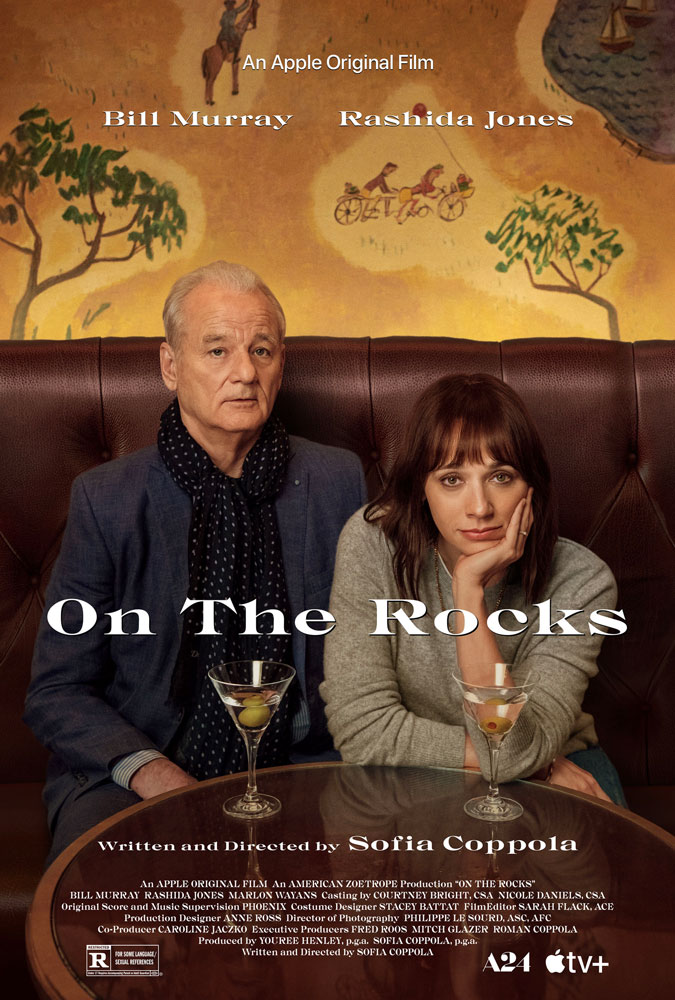
On the Rocks is the kind of film that had an aura of prestige from the moment it was announced, no less because it represented the reuniting of Sofia Coppola with Bill Murray, with their first collaboration being a definitive moment in their respective careers. While it is true that they did collaborate recently on A Very Murray Christmas (which was a delightful but otherwise minor affair), this was their first time properly working together on a film, and they manage to recapture some of the magic they managed when they were in the bustling metropolis of Tokyo in 2003. There’s a spark that comes out when these two work together which incites a truly endearing quality. Murray does not disappoint here – inarguably, he’s still playing off the prickly, aloof older man archetype that he has come to be defined by in recent decades, but there’s a wry charm that Coppola captures that gives his performance so much more nuance than we’d expect. She knows how to catch the small intricacies in his performance, and is one of the few directors who actually knows how to use him to his full potential, rather than just equating his presence to some form of quality. However, the star of the film is undeniably Rashida Jones, who once again proves to be a bright talent that should be leading projects more frequently. Her wide-eyed melancholy, contrasted with her impeccable comedic timing and incredible warmth, makes her performance as Laura something to behold. She’s genuine, heartfelt and honest, to the point where authenticity seems to have been her main priority. She shows remarkable chemistry with Murray, and the two actors strike up quite a bond through these characters, demonstrating a clear sense of understanding each other as performers, and making their pairing so memorable, since not a single false note resounds in any of their scenes together, yet another quality of Coppola’s work that makes her such a notable filmmaker.
On the Rocks comes together beautifully through the collision of emotion and narrative, with the perfect balance attained making this such an incredibly poignant work that manages to be both heartbreaking and funny in equal measure. Coppola isn’t necessarily a comedic filmmaker, but she constantly manages to find humour in the most unexpected places, normally through presenting an everyday situation in an amusing, heartfelt manner, and deriving some kind of gentle humour from it. This film in particular has her exploring the genre of comedy with more focus, actively seeking out the genuine absurdity that underpins this story. Contrasted with the incredibly simple story of a married woman and her playboy father becoming amateur private detectives by investigating her husband for signs of infidelity, the film becomes a wonderfully upbeat little comedy about ordinary people placing themselves in bizarre situations, and gradually coming together to be a delicate portrait of a father-daughter relationship that has its flaws, but is ultimately loving. Despite the title, which has dual meanings in regards to the copious amounts of alcohol consumed throughout, and the more metaphorical meaning relating to the tumultuous relationships that are the subject of the film at various points, On the Rocks is remarkably free of hysterics – when presented with the chance to default to excess for the sake of moving the story along, Coppola instead chooses a more humble route of using authentic emotion in every possible scene. She isn’t only using the camera as a means to record actors performing her script – she’s writing the story through how she shoots these scenes, lingering on a hesitating character’s face a few beats too long, or cutting away at just the right moment. This is where the heart of On the Rocks resides, in the most seemingly inconsequential moments, which gradually dovetail into an ambitious, but still massively restrained, eruption of complex sensations that come across in nearly every frame of this film.
On the Rocks is a delight in every possible way, and while it may not be a particularly major work, especially considering the heights its magnificent director reached in the past, it has a lot of merit in how it presents us with a very simple and elegant premise that ultimately works towards conveying a deep sense of emotional connection, which makes this film entirely worthwhile on its own simple idealism. Coppola strikes gold several times in this film – whether it be the touching dialogue that gets to the root of both a marriage that may be falling apart, and a complex relationship between an erratic father and his level-headed but deeply insecure daughter, or the incredible performances given by Bill Murray and Rashida Jones, both of whom are doing some of their best work here. On the Rocks is the pinnacle of Coppola’s brilliance, solely on the fact that she could weave together such a compelling story, filled with humour, pathos and honesty, and still present such a unique and earnest perspective. It doesn’t announce itself as a work that is going to be definitive, and its smaller-scope is one of the elements that gives it a certain quiet sophistication, since it doesn’t allow for anything other than the truth to filter through each frame. It’s a lived-in, quietly meditative excursion into the lives of regular people living their lives, presenting us with a snapshot into their various existential quandaries and underlying anxieties, resulting in an absolutely stunning work that frequently manages to convey so much through saying very little, leaving everything up to the smallest, most intimate moments that Coppola puts on screen so exceptionally well, keeping us engaged and enthralled, and perpetually mesmerized, for the entirety of the film.
 The Postmodern Pelican