
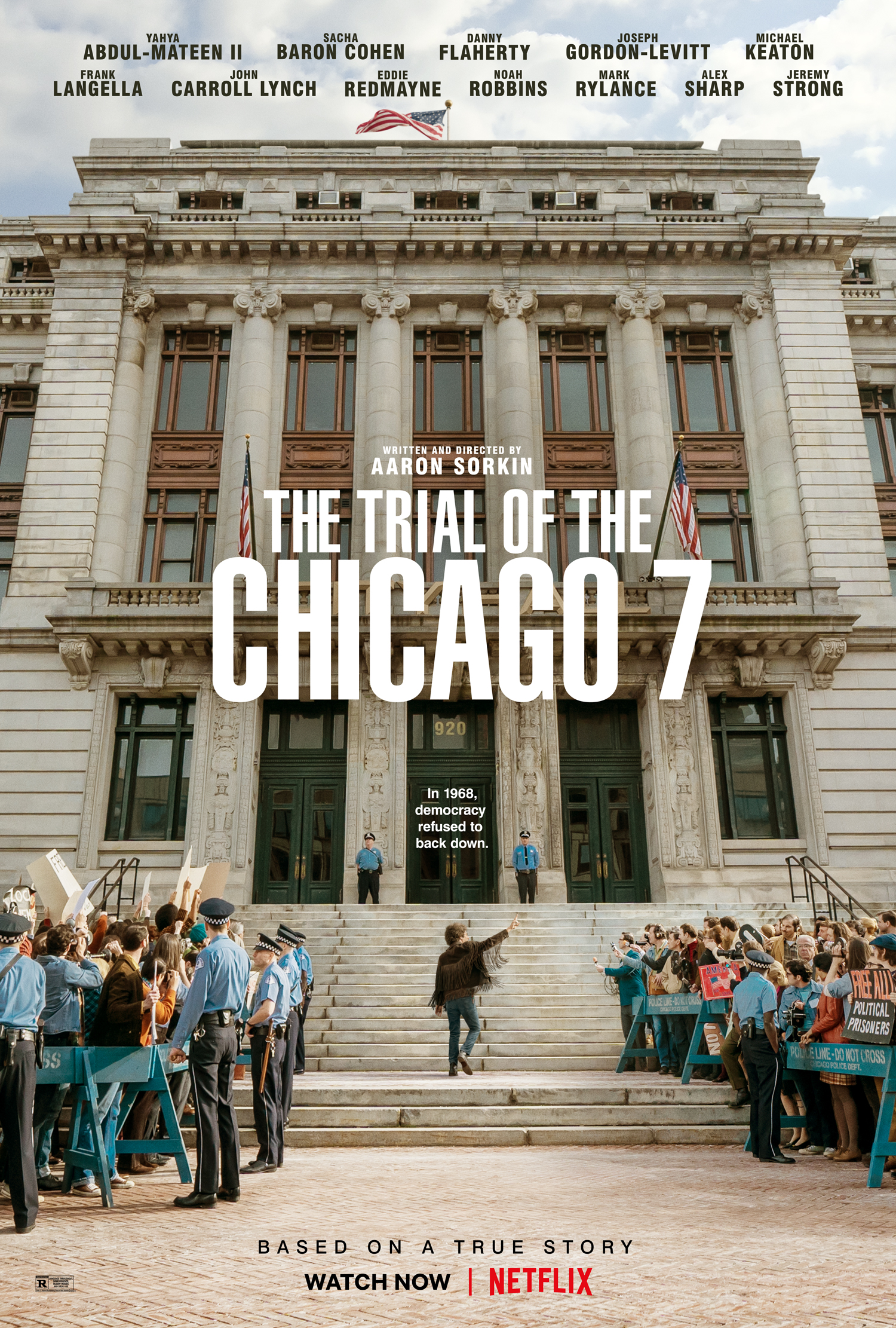
When it comes to Aaron Sorkin, you normally get exactly what you pay for – by-the-numbers stories that are heavily focused on political or other highly-resonant cultural situation, with predictable plot points and an array of interesting characters that are very often portrayed by actors who are giving performances that belong in much better productions. Sorkin is an excellent writer, albeit one that hasn’t ventured too far out of his comfort zone over the past two decades, and has instead focused on honing his craft, which has seen him traverse familiar territory with very little deviance from a fundamental set of ideas, which has often been both the source of great praise and enormous criticism. The Trial of the Chicago 7 was his second film in the director’s chair, and you can easily see exactly where this led to both the merits and shortcomings of the final product, with Sorkin still undergoing the process of finding his directorial voice, resulting in something that is passable, and not much more. Unlike some of his more notable work as a writer on The West Wing and films like The American President and The Social Network, where the resonance of those works came from skilled directors bringing his writing to life, Sorkin is fully in control – and for better or worse, it makes The Trial of the Chicago 7 one of the year’s more interesting experiments, a bold and ambitious courtroom drama that tries to be more. Whether or not it achieved this is up to individual interpretation, but in terms of what can be seen throughout the film, he did make something relatively worthwhile, making sure to show some degree of restraint (which was always a legitimate concern for someone who has shown himself to be driven more by the idealistic underpinnings of his texts than anything realistic), and while it may not make for a perfect film, it finds value in even the tritest of areas, and ultimately becomes something adequate at meeting a particular set of criteria, which is exactly what we’d expect from a film with Sorkin at the helm.
This isn’t to dismiss him as a writer – throughout his career, Sorkin has come to be known as someone who takes writing very seriously, to the point where he’s often referenced his writing process as composition, put together with a sense of musicality that makes his work very interesting to watch, at the very least. It doesn’t mean everything he has ever done has been a triumph – and in no uncertain terms, The Trial of the Chicago 7 is far from his best work and doesn’t even once come close to the some of peaks he reached sporadically in his career – but it certainly does mean that he is always going to be the source of interest, even if the final product isn’t particularly good. Sorkin’s work here is solid – and there is something to be said about the fact that he took a commission from over a decade ago, and turned it into something that bore all the traits of his authorial vision, which immensely helps in turning this into a relatively worthwhile endeavour, particularly for those attuned to this kind of socially-charged filmmaking, where the intricacies of a certain historical event and its resonance to the present day, are made exceptionally clear through the dialogue and certain situations, which Sorkin very clearly uses as a platform to comment on more recent situations, drawing parallels that can often be deeply predictable, but still convey their message relatively well, hitting all the expected notes, while contributing very little, but still managing to be quite effective in its portrayal of one of the most impactful cases in modern politics. It’s not always the version of this story that these individuals depicted deserved, but its merits do outweigh the more unnecessary deviations into the kind of narrative filibustering Sorkin is often prone to infuse into his projects, equating it with quality.
The use of the word “timely” is often inappropriate – any film made at a particular era is done so with the sense of speaking to that present period, so despite being set in the late 1960s, The Trial of the Chicago 7 is still very much a film that comments on the present state of the world, albeit going about it in a way that isn’t quite so obvious. For this reason, Sorkin does deserve some praise – we’ve seen many immensely talented filmmakers struggle to find the balance between replicating history on screen in a way that speaks to current issues, and outright thrusting their intentions at the audience in unsubtle and gaudy ways. Allusion and implication are key to this film, and position it as something quite thought-provoking. This doesn’t mean The Trial of the Chicago 7 is immune to criticism because it successfully shows a time in history that can be directly related to the present world (particularly at a time when protest actions are widespread and influential) – and many of the flaws come in the fact that there really isn’t much heft to the message Sorkin is conveying. The story itself is very strong, and he does well in representing the intricacies of the real-world events – but it just simply lacks the energy we’d expect from such a socially-relevant film. The director perpetually downplays moments that couldn’t been triumphant – cliched dialogue replaces moments that could have been genuinely moving, and the overuse of exposition means that it becomes somewhat clunky, especially when it loses the idiosyncratic charm it had at the beginning. It also doesn’t help that The Trial of the Chicago 7 struggles to find a clear tone – it often feels as if Sorkin is caught between making a serious courtroom drama, and a satire of 1960s politics – and while this may become tedious at times, it occasionally works – and like most of what he has done in the past, the moments that leave the biggest impression are those of genuine brilliance, which may be few and far between, but are there when they’re necessary.
Naturally, you’d assume that a major reason to watch this film is to see Sorkin’s dialogue in action – it’s not enough for his words to exist in isolation, but rather they need great actors to bring it to life. Logically, a film like The Trial of the Chicago 7 is going to require a strong ensemble, and Sorkin does deliver on this promise, albeit through employing an incredibly eclectic cast that appears bizarre in theory, but does work relatively well in the context of the film itself. It’s a motley crew composed of veterans and actors currently on the verge of a breakout – and as a whole, the film makes good use of most of them. It’s a large cast, so it’s difficult to pick a particular standout, since it’s a true ensemble in every sense of the word – but there are a few that make quite an impression. Eddie Redmayne and Sacha Baron Cohen are the de facto leaders of the titular group, two radically different individuals with varying ideologies, sharing the common goal of trying to end the war. Both are doing strong work, and while the former does tend to be more subdued than the rest of the cast, he does manage to find the nuance in a very complicated character. Cohen is very good, but mainly as a source of comedic relief, since most of his story was just portraying the great counterculture revolutionary Abbie Hoffman as an endearing, likeable rebel who had a strong set of morals that weren’t often discussed outside of his noted eccentricities. The slightly smaller roles are just as good – John Carroll Lynce (a character actor extraordinaire) continues to prove to be a wonderful presence, and Michael Keaton has a couple of strong scenes as the man who essentially changes the narrative when he testifies late in the film.
However, the three most notable performances are those given by Sir Mark Rylance (who is the common thread between all the characters, and the closest thing this film has to a main character), Yahya Abdul-Mateen II and Frank Langella. Rylance is effortlessly likeable as the dedicated lawyer sent to represent the Chicago 7, and who does his best to give them their liberty, even if it means putting his own principles and reputation at risk. Abdul-Mateen is well on his way to being a star, and as the iconic Bobby Seale, he is given a great deal to do, despite the fact that his storyline exists almost separately to the rest of the characters, and sadly concludes far too early for the actor to reach the heights he was clearly capable of. Finally, Langella is an absolute riot – a gifted actor in every sense, it did seem as if he genuinely believed he was in a comedy, giving a performance that resounded with the sensation of satire, each moment he is on screen coming across as having some underlying sarcasm and biting wit. It isn’t clear what Langella was going for, except for the fact that the man he was playing – the notorious Julius Hoffman, whose incompetence is his only defining trait that has lingered since the end of the trial – needed to be portrayed with a kind of excess, since he is the antithesis of the logical, principled jurists that are supposed to preside over these cases. It isn’t clear if Langella is giving a quietly brilliant performance, or if he is deliberately ignoring all restraint in favour of going far too over the top, but he is almost reason alone to watch this film, since his work is more memorable than a lot of what Sorkin was going for as a whole. However, it’s a fool’s errand to pluck particular performances out here, because the cast is symbiotic – they work well together, without much showboating to distract from the ensemble nature of the story It’s a good approach, and helps conceal the more distinct flaws present throughout it.
The Trial of the Chicago 7 was always going to be something of a tricky film to sell as a whole, since this is less about the actual events that took place in 1968 (which are barely seen in the film, and mainly reside in characters mentioning what happened, other than two very effective recreations of the riot and the later arrest of the main cohorts in the apparent conspiracy), but rather the aftermath – so this is ultimately going to be a film that really just functions as a by-the-numbers courtroom drama, without much beyond it. This is immediately going to make this somewhat divisive – the film doesn’t quite take off after an impressive first act, where we get to know the main characters and sample from the actor’s very unique interpretations of the individuals they’re playing. It isn’t aided by the fact that the central tension that should exist in a film like this doesn’t really rear its head nearly enough to be convincing enough. This is the definition of a crowd-pleasing film – it has all the makings of a movie that will appeal to those who enjoy triumphant glimpses into the legal system, or those with a passing interest in historical events that essentially shaped American politics, but hasn’t been done much justice cinematically until now. The story at the core of this film is fascinating, and under the direction of a more skilled filmmaker, this could’ve been something special – Sorkin just falters when it comes to representing the intricacies necessary to such a film, not realizing that the moments of quiet humanity that exist in between scenes of immense grandstanding are just as important, as it gives such a story nuance and depth, which isn’t always as present here as it should’ve been. It doesn’t invalidate the merits, but prevents them from hitting the peaks they were capable of achieving with just some tweaking to the general fabric of the film, which would’ve resulted in a fundamentally better film.
The Trial of the Chicago 7 is a very solid film, and has some merit in how it takes on the story – but through his relative inexperience as a director, and his inability to look beyond dialogue-driven narrative (which should have been fundamental to this film, since so much value could’ve been extracted from a more nuanced execution of these ideas), Sorkin does sometimes struggle to stay afloat consistently. His writing is sharp, and there are some terrific moments, but there is also an abundance of the most trite clichés imaginable that does counterbalance it at some points. However, The Trial of the Chicago 7 is a film difficult to dismiss outright – it may lack energy for the most part, and the ending is truly the cheapest way to end a film like this – but it is perfectly adequate, and does well in representing this story, even if so much more could’ve been done with the premise (consider the fact that two of the titular seven defendants are given nearly nothing to do, despite clearly having interesting perspective). It has a strong understanding of the historical events, and for that reason does manage to sufficiently cover them satisfactorily, enough to do it justice. There are moments where it is wonderfully riveting, but an equal amount of where the film seems a bit too prosaic, which is even more shocking considering it hails from Aaron Sorkin, who has often been cited for the musicality that comes from his writing. As a whole, The Trial of the Chicago 7 is not a film that is going to have much cultural cache, outside of being a great showcase for some terrific actors, and a chance to have this story told. It’s enthralling when it needs to be, but could’ve done so much more with a premise that was positively brimming with potential – and while the final product isn’t poor in any way, it evokes so many ideas of what a more solid director could’ve done with the material, which would’ve made this a much better film in many ways, especially when this is a vital story that absolutely deserved a more thoughtful execution, especially considering how essential this is to the present state of the world.
 The Postmodern Pelican