
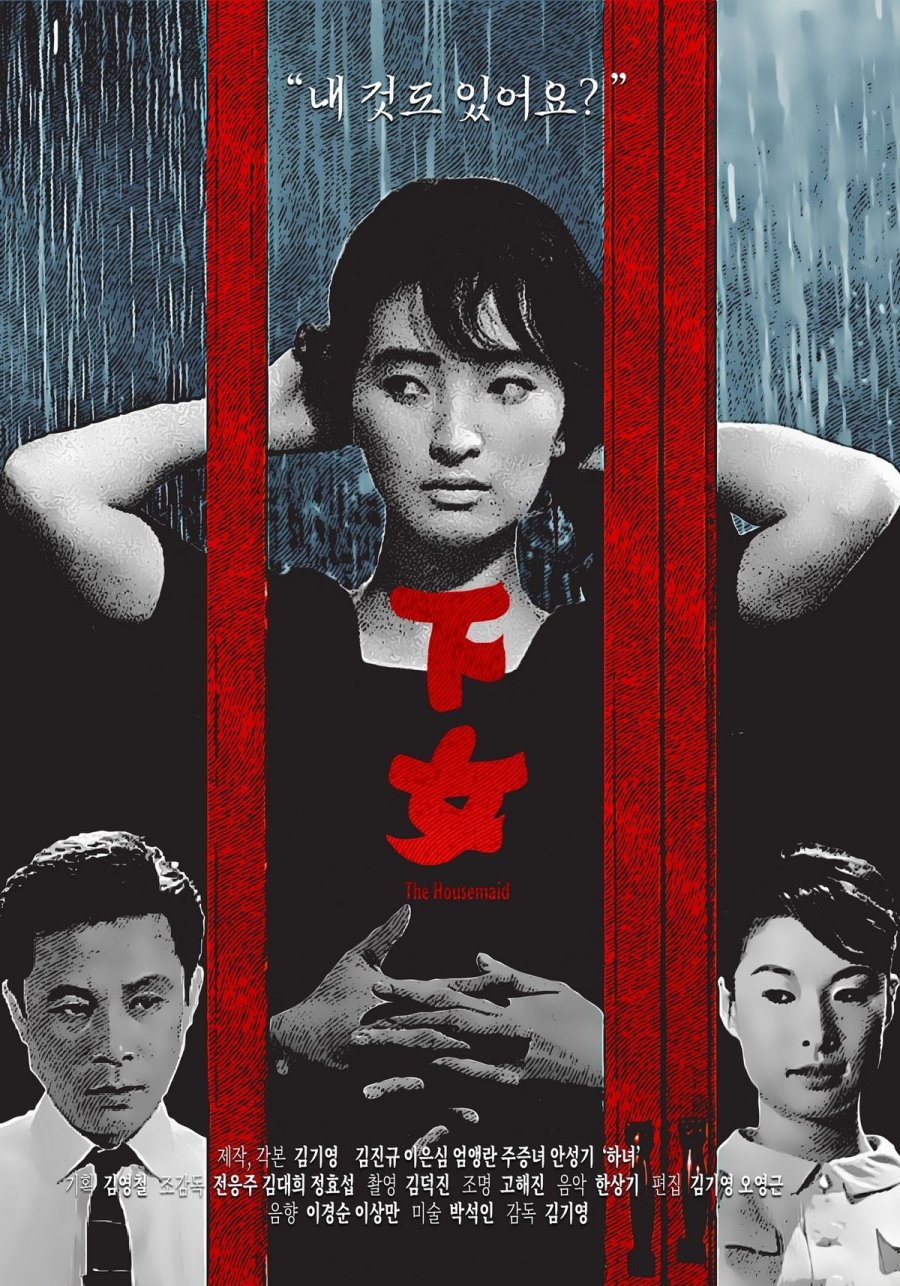
When it comes to discussing films that take a very strange approach to their premises, The Housemaid (Korean: 하녀) sits perched comfortably at the very top. It is the apex predator of psychological thrillers of its era, an intrepid meta-commentary on social issues that boldly goes where very few films would dare to go, especially considering the time in which it was made. Ultimately, Kim Ki-young made a film that is so unconventional and offbeat, to describe it in ordinary terms wouldn’t only feel like a disservice to the work he did in constructing this film, but also a wildly inappropriate way to look at a work of such abstract brilliance, it can’t be considered through a conventional lens. The Housemaid is the forerunner for many incredible thrillers that were to come in the subsequent years – there are even direct connections between this one and later entries into the niche category of the domestic horror (amongst them Joseph Losey’s The Servant, Claude Chabrol’s La Cérémonie and Bong Joon-ho’s recent worldwide sensation, Parasite), all of which owe some kind of debt to Kim, who set the gold-standard for darkly comical depictions of domestic disturbance, and the twisted underbelly of humanity that tends to manifest in our most vulnerable moments. The Housemaid goes in some truly unexpected directions – this is one of the most off-the-wall thrillers of its era, a labyrinthine series of puzzles and obstacles that keep the viewer on edge and fully engaged with what the director is providing us with, resulting in one of the most enigmatic, yet oddly compelling, films of its period, and one that has somehow managed to stand the test of time, and is quietly awaiting more substantial exposure, since this is the epitome of what fearless filmmaking looks like, in all its unabashed and unconventional glory.
The Housemaid joins an elite group of films that carry such an immense self-awareness, but conceal it so effectively, it appears as if the film is about to be derailed at absolutely any moment. However one wants to categorize this film – as a dark comedy, psychological thriller or horror (or perhaps a blend of all three, which is where I tend to find myself settling) – it’s clear that Kim was doing something quite different here, keeping the details of the story so concealed behind the veneer of a variety of genres, we can’t tell in which direction it’s venturing. It’s absolutely unafraid of pushing the envelope, which is normally something we’d attribute to a film produced half a century later, rather than one made in the aftermath of a war, and in the midst of the twentieth century’s most lengthy and harrowing socio-cultural battle – but this is rarely ever the concern of the film, which is more interested in the more human side of such situations, whereby it can explore the trials and tribulations of individuals living in the shadow of an oppressive society, whether in terms of direct policy, or (more hauntingly) the more institutionalized beliefs that drive it forward and keep everyone in conformity. Like many great works of fiction, The Housemaid infuses such commentary into its story, but not in a way that is overly obvious or prominent, with the director’s acidic approach to real-world issues being disseminated in far more intelligent ways, gradually unfolding as the film unravels into the delightfully irreverent piece of darkly comical horror that it ends up being. It’s difficult to not recognize the unconventional brilliance of this film – how it manages to not only subvert common themes and ideas, but actively eviscerate them in favour of a more daring approach carries enormous merit in itself – so the fact that it still finds the space to do more than this, and never come across as being too overstuffed or gaudy is an incredible achievement, and all the more reason to celebrate The Housemaid as one of the most idiosyncratic films of its time.
However, we can easily wax poetic about Kim’s intentions with this story – there is so much that can be said for what clearly went into the genesis of the film, we could easily lose ourselves in such a discussion. Yet, putting all the external commentary aside and focusing on the film itself, it’s not difficult to see why The Housemaid has become as cherished as it has. Inarguably, not quite the generation-defining classic that many genre films from its era can profess to be (and while I’m hesitant to say others pale in comparison, there are certain films from around this time that attempted to carry the same kind of subversive edge, but failed dismally), but rather an unquestionably powerful work of idiosyncratic storytelling that cuts to the centre of some very resonant themes, there is something of value in nearly every frame of this film – there’s a reason why this film is consistently held up as one of the finest examples of Korean filmmaking, both at home and internationally, where it has found the perfect balance between niche discovery and cherished arthouse masterpiece, which suits a film like this perfectly. Ultimately, The Housemaid is always going to be a difficult film to sell to those not acclimated to this style of filmmaking – firstly, it’s one that vastly rewards anyone venturing in without some degree of foreknowledge, since the twists and turns it takes are all the more satisfying when we take on the tabula rasa approach. Secondly, even if we are fully aware of the directions this film is going, some of the content is truly bewildering, and could be a challenge for those who aren’t prepared for the sheer insanity that Kim actively employs to get his message across. The director wreaks pure chaos throughout The Housemaid, and seems to relish in doing so – and while this may be wildly exciting for those who subscribe to this form of filmmaking (especially since the meteoric rise of alternative Korean cinema in the last twenty years), for audiences sixty years, ago, there’s very little doubt that this film would be quite an ordeal if they weren’t fully aware of its message, which is itself not the easiest aspect of the film to find.
The Housemaid is such a profoundly different film in every way – it’s not necessarily the first film to oscillate between genres, sampling from each one in an effort to extract the essence of success from every one one of them, nor is it the film that does it the best. However, it’s value doesn’t come in comparing it to preceding works, or those that came afterwards, but rather through understanding how precisely Kim managed to execute what is essentially one of the most complex thrillers of its era. Presented in a way that feels unexpectedly simple – with the exception of a few scenes, the film almost entirely takes place within the small home of the protagonists, with all the horror playing out in restricted locations, giving The Housemaid a sense of insatiable claustrophobia, inciting the feeling of entrapment that can only come with the realization that escape is possible in the physical sense – nothing is stopping these characters from stepping out the door and retreating, but rather the psychological consequences of becoming involved with someone who defines the very essence of psychopathy that bind us and prevent us from ever truly being liberated. A great thriller isn’t one that just offers a few unexpected turns throughout, or a sense of surprise on occasion, but rather a film that carries a simple story that, unbeknownst to the viewer, lingers on long after the film has ended, burrowing itself into our subconscious and inciting nothing but despair at the inopportune moments when it rears itself. Psychological thrillers and horror films tend to be the rare kind of artistic expression that is measured as being effective based on how uncomfortable it makes you – and despite a very sophisticated execution, The Housemaid is seemingly very content with its ability to thrust us into a world of pure discomfort, which only makes it all the more effective, since it stays with us much longer than we expected.
Essentially, what makes The Housemaid so incredibly effective is how it feels like a film that not only tells a compelling story, but seems to be aware of the audience watching these events unfold. Even without spoiling the film (as it has a terrific twist), we can note how Kim created a story that frequently seems to be beckoning towards the audience to venture further inwards, accompanying it on this bizarre and often grotesque metaphysical journey that takes us to some very disconcerting places, many of them within our own minds, which only exacerbates the sense of dread and unease that persists throughout the film. Ultimately, The Housemaid is an extraordinarily challenging film, in the best possible definition – it not only tests the boundaries of what can be done narratively, it openly dismantles conventions, weaselling its way out of the regular obstacles that tend to plague even the most ambitious and original of concepts, and emerges as an insidious, brilliant work of social commentary that quite literally points directly at the audience and tells them how this may appear like fiction, but it carries far more meaning to reality than we’d expect. A film that provokes us to question everything we genuinely believe to be true, and address some of the darker sides of our nature (without becoming too enveloped in the context it provides), The Housemaid is really quite incredible, and its ability to find the nuance in a premise that is built almost entirely out of chaos is all the more reason to praise this as a work of truly unmitigated genius, and one of the defining works of the early 1960s, which remains just as relevant and horrifying today as it did when it first terrorized audiences over half a century ago.
 The Postmodern Pelican