
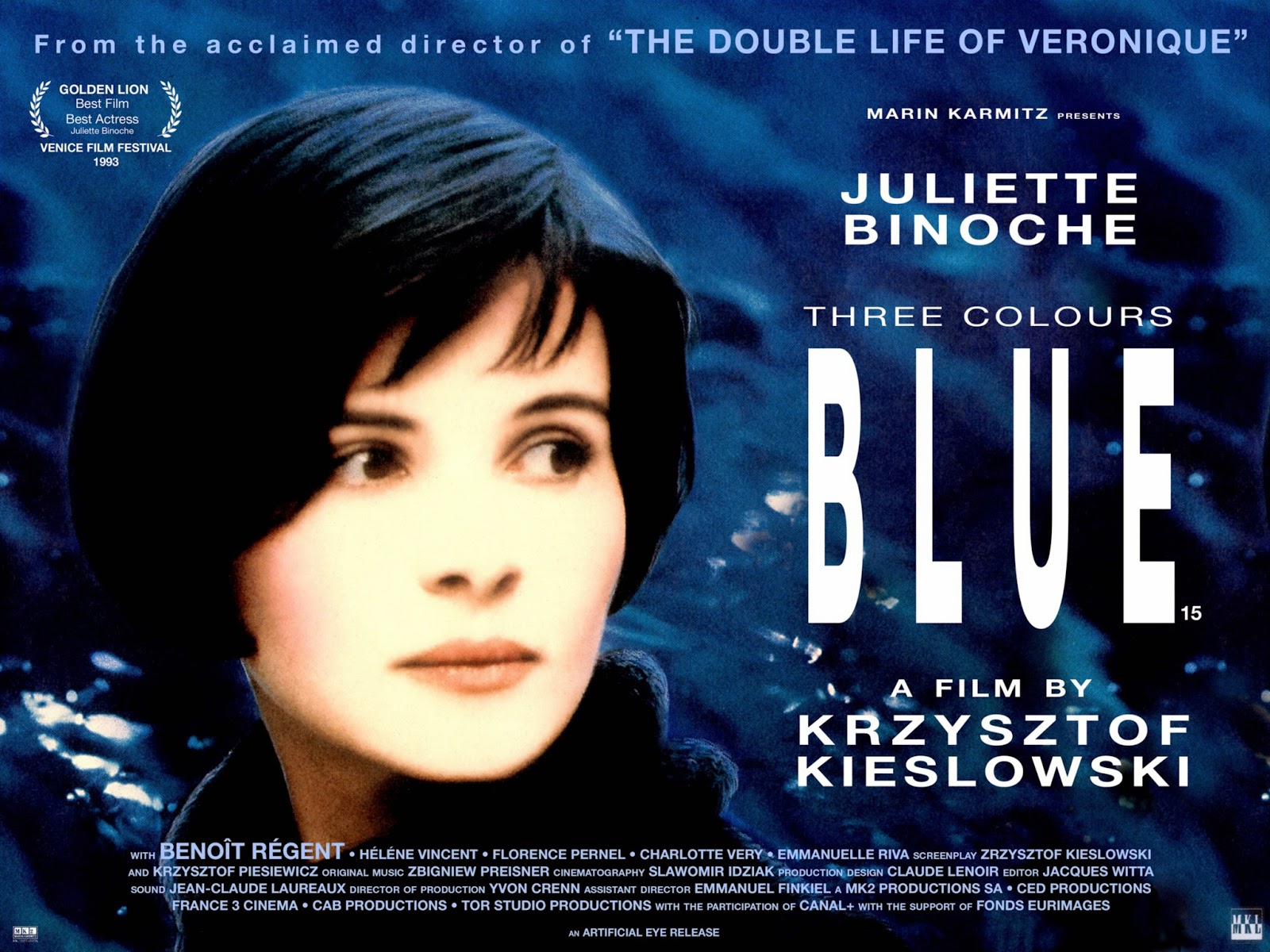
When he set out to make his bold trilogy of films that touched on the human condition, Krzysztof Kieślowski was quite right in realizing that the path towards this isn’t through overly ambitious explorations of every aspect of our existence, but rather intricate, intimate dramas that centre on ordinary people living their lives and coming into contact with various challenges that cause them to question reality in different ways. The first of his trilogy was Three Colours: Blue (French: Trois Couleurs: Bleu), a film that has only increased in both status and brilliance as the years have progressed. Not necessarily the easiest film to understand in the traditional sense – it’s often intentionally impenetrable, and leads us to see the world in a very different way – but as incredibly complex and layered as anything else the director made, especially when it situates itself amongst some narrative territory that should be resonant to many of us in some way. There are certain schools of thought that believe this film could be Kieślowski’s most towering achievement, since many of the themes that went into most of his other films are woven into the fabric of this one. Personally, I found Three Colours: Blue to be a film too powerful to ignore, the rare kind of work of unhinged artistic expression that just finds its way into our subconscious where it takes up residence and continues to provoke thought long after it has ended. Frank, honest and unconventional in both the themes it centres on and the methods the director takes to explore them, Three Colours: Blue is an incredibly deep film that wears its heart on its sleeve at all times, guiding us through a world that seems familiar, but presenting it in a way that is distinct, unique and entirely unforgettable.
It has been well-documented that each of the director’s entries into the Three Colours Trilogy has a distinct theme, with this one being centred on the idea of liberty and freedom. However, instead of looking at any of the historical or social events that define this as one of the nation’s principles, Kieślowski chooses to focus on this idea through a more intimate storyline. We’re introduced to a young woman who loses everything she holds dear to her in a matter of seconds, after her husband and daughter are killed in a car accident. Left without any direction in life (and doing her best to avoid the feelings of irreconcilable guilt at having survived while her family met their demise), Julie is faced with a grim prospect for the future, and decides the only way forward is through complete emancipation from her past. It’s unlikely that many of us haven’t fantasized about starting life all over again, abandoning everything that defines us and getting a fresh start elsewhere – for most, it’s nothing more than an amusing fantasy, or a cathartic reaction to the banality of everyday life. However, Three Colours: Blue takes this principle far more literally, and looks at a woman who does indeed abscond from her regular existence, retreating into another life entirely, in the hopes that her trauma and guilt will stay behind as well – we all process grief in radically different ways, and Julie’s natural instinct is to retreat. Naturally, this isn’t the case at all – and as she soon discovers, not only do these factors continue to linger with her, without the comfort of her past life, she has nothing left but the feelings of loneliness and despair that she’s so insistent on leaving behind, but which follow her closer than ever before.
Loneliness is a subject that has been explored extensively in art – in this regard, Three Colours: Blue is far from the first film to look directly at a lonely character trying to find solace after a tragedy. It’s a common theme, and the film doesn’t propose to say anything we haven’t seen or heard before. Where the film does deviate and become quite brilliant is in the director’s approach to familiar material. Kieślowski was an exceptionally gifted filmmaker who combined visual panache with more abstract themes, weaving them together in his films in a manner that implies something deeper to every frame. Less of a single coherent narrative, and more an experimental series of vignettes into the life of the protagonist, each one giving us further insights into her mental state, Kieślowski constructs an incredibly poignant exercise in narrative storytelling with Three Colours: Blue. As is quite conventional for the director, this is essentially a film preoccupied with the psychology of its characters, getting to the root of their various existential quandaries, which it explores through carefully-curated techniques that allow us to witness them battling their personal demons, but in a way that feels incredibly natural. Authenticity has always been the primary focus of the director’s work, even when he is at his most expressionistic, and the complete lack of overwrought emotion, but also the ability to demonstrate these situations without the impulse to deconstruct the form beyond necessity. Kieślowski’s films occupy an ambigious space between gritty and enchanting, each one carrying the sensation of commenting on reality in multiple different forms, allowing creativity to flourish, but not get in the way of the genuine roots of this beautifully compelling story of existence.
As a work fundamentally built on the character-driven side of a story such as this, Three Colours: Blue depends almost entirely on the performance given by Juliette Binoche, who was doing staggering work, years before she entered into the public consciousness as one of the most significant European arthouse stars of her generation. As Julie, Binoche is absolutely astounding, which is only made more incredible considering how this is not an easy character to relate to, with Binoche needing to adapt to some peculiar constraints in playing the part. Julie is a character we’re supposed to be emotionally invested in, but only to the point where we don’t disregard her clear flaws as a person – she’s not unlikeable in the traditional sense, but she’s far from the most endearing character, and Binoche does well in exposing some of her more complex nuances in a very meaningful way. The actress cuts to the core of what makes Julie such a compelling character, giving a very internal performance that never fails to hint at the raw, brutal emotions that underpin her journey. It’s an elegant performance from an actress whose work often occurs at the perfect intersection between beautifully sophisticated and deeply humane, finding the balance between the gritty despair and the ethereal gracefulness that Binoche has so successful navigated throughout her character. Despite being almost entirely focused on Julie and her journey from trauma to acceptance, the film has a rich cast of supporting characters that all contribute massively to the narrative, normally only appearing in a few scenes, but leaving an indelible impression. Florence Pernel (as the mistress of Julie’s late husband), Emmanuelle Riva (as Julie’s mother who is steadily growing into dementia) and Charlotte Véry (as one of Julie’s neighbours who moonlights as an exotic dancer) are all wonderful in their limited scenes, and leave an indelible imprint on a film that uses its characters not as a vessel for the story, but also as a means for it to quietly explore other sides of the human condition.
Three Colours: Blue is an achingly beautiful glimpse into the processing of trauma, and the challenges that come with losing what appears to be your entire livelihood. Kieślowski is tapping into something quite remarkable here, whereby the story itself isn’t concerned with the direct aftermath – so much of the plot takes place in the months after a tragedy, and centres on the long-term ramifications, rather than the direct impact, which is often far more harrowing since the outright shock is replaced with a sense of long-lasting despair, which takes a lot longer to process, and which can never fully heal. One of the best representations of grief ever committed to film, as well as one that avoids becoming heavy-handed, replacing the overwrought sensationalism with a more direct and intimate exploration of a character undergoing the challenges of losing her loved ones. It’s a simple premise, but one that works exceptionally well in the context of the message Kieślowski is conveying here. All of this, coupled with stunning visual palette he presents to us, creates an unforgettable drama that is shattering but not excessive. Everything seems so fundamentally human, and it never neglects to find the truth in every situation that it finds itself looking at. There’s so many possible interpretations of what Kieślowski is doing here, narratively and creatively, but what is almost certain is that there is something of value in every frame – the heartfelt investigation into trauma, the deeply sentimental understanding of life’s most fundamental challenges, and the importance of holding onto hope, even in difficult situations. Not necessarily optimistic in the traditional sense, but undeniably impactful in showing the value of not giving up, Three Colours: Blue is a masterful drama that takes some unexpected turns, but still manages to be one of the defining works to look at some of the most complex themes imaginable, without losing its tender, meaningful heart in the process.
 The Postmodern Pelican