
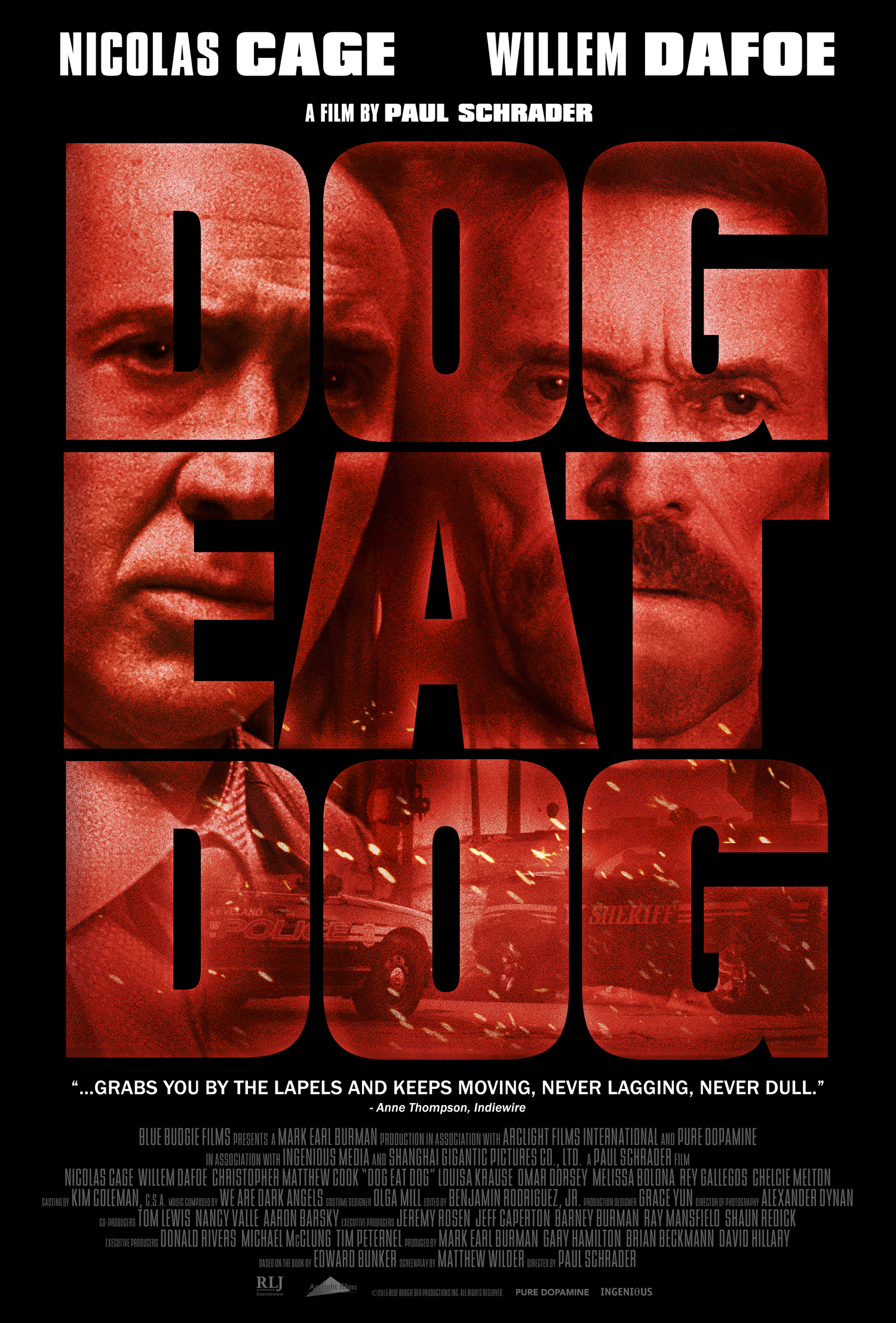
What do you get when you combine Nicolas Cage at the peak of his descent into over-acting (and his gradual realization of his reputation, and the subsequent relishing in it), Willem Dafoe at his most excessive and Paul Schrader’s unhinged vision of crime and violence? The answer is Dog Eat Dog, the bewildering dark comedy that reunited Schrader with two of his most interesting collaborators, as they undergo a journey of self-discovery, leaving a path of complete violence in their wake. This is not the film we’d expect from someone known for their more elegant approaches to crime – far from Taxi Driver and American Gigolo, this is Schrader at his most chaotic, and as a result we are either invited to partake in the bizarre proceedings, or utterly repulsed by the message he’s imparting there. I can’t honestly say that Dog Eat Dog is a great film – in fact, I’m not even quite sure it counts as a film, being more akin to a bundle of overly violent scenes that come together to form a manifesto on the challenges that come pre-packaged with a life of crime. However, what can be said without any hesitation is that Schrader was working from a place inspired by his own incredible ambition, and while it may not have worked particularly well throughout this film, for those accustomed to the director’s style, as well as his more bold intentions, Dog Eat Dog is a worthy addition to his canon of off-the-wall genre films that may lack the nuance and intelligence of some of his more prominent work, but is at the very least a step forward after a few years of treading through less-ideal narrative terrain. Less of a return to form, and more a sequence of horrifying situations that only escalate in violent brilliance, Dog Eat Dog is certainly something to behold.
Schrader’s vision has always been one that has profoundly fascinated me – as a screenwriter, he was able to make works that focused on the life of a lowly, misanthropic taxicab driver, or the trial and death of Jesus Christ, and be completely convincing in both cases. Extremely gifted, even when occupying the director’s chair, Schrader is consistently seeking something more raw and unlikable, getting to the core of the human condition, even if it means he has to take the root of the most visceral and cumbersome violence imaginable. Dog Eat Dog seems like the most unrestrained demonstration of this, and has understandably been a bit of a puzzling experience for the most part. Even the most devoted admirers of Schrader seem to not know quite what to think of this film, which may be the entire point, since he has never been one to quite play by the rules, at least not in the way that we’d expect. Perhaps the first sign is that Schrader (and screenwriter Matthew Wilder) are adapting a novel by author and convicted felon Edward Bunker, who wasn’t only a fascinating figure in his own right, but also someone whose vision was uncompromising in both violence and otherworldly ideas. This is Schrader laying claim to the niche genre of noir absurde, crime films that utilize a blend of dark comedy, excessive violence and eccentric characters to emphasize, and simultaneously criticize, both society and those who participate in its more sinister machinations – and this is quite a good descriptor of exactly what he is achieving here. This combines unhinged comedy with gritty, violent chaos as a means of not only commenting on the brittle nature of society, but also openly subverting the more unspoken rules of “good taste”, which Schrader is so vehemently against, it becomes quite notable how far he is willing to go here. The rationalization behind Dog Eat Dog is very clear – there’s no reason why it desperately needed to be so dark and twisted, but it only makes it all the more compelling.
Dog Eat Dog is also anchored by a duo of performances that are equally as fascinating, and essentially the aspects of the film worth the price of admission. Reuniting for the first time on-screen since Wild at Heart, Willem Dafoe and Nicolas Cage are just as unhinged here as they were under David Lynch’s direction, and once again seem to be playing slightly against type. As the more level-headed and logical Troy, Cage is truly compelling – he is desperate to not go back to prison, but realizes that he has chosen a life of crime, and whether or not he is rehabilitated is inconsequential, because once the state has had its way with you, no amount of apparent “forgiveness” will allow you to lead a normal life. Naturally, this manifests in behaviour that shows a steady decline in sanity – he begins to see himself as something of a modern-day Humphrey Bogart, armed with the distinctive drawl and mannerisms, which he believes will set him in good stead, since everyone adored the original angel with a dirty face. Conversely, Dafoe is playing a very different kind of character to Troy, in the part of Mad Dog. He’s been out of prison for a while, but has succumbed to the madness that his friend seems to only be showing symptoms of now – the hedonistic embodiment of trailer trash, Mad Dog is a great character that Dafoe plays to perfection. He’s a deranged, psychotic lunatic, but only an actor with as immense a control on his craft could manage to humanize a character like him, and convince us that he’s a good-natured, well-tempered individual who is simply misunderstood. It’s an outrageous performance from an actor whose persistent search for deeper meanings within all his characters intermingles with his deft ability to have fun with any role, and this has rarely been more evident than here.
Cage and Dafoe play off each other so well, and manage to convince us that Dog Eat Dog may be a better film than it actually is, and even dares the viewer to see beyond the senseless violence that Schrader seems so intent on exploring here. Occupying the strange space between his more divisive output, and his recent renaissance, Dog Eat Dog is a strange film that seems like it is striving for something a lot more profound than it actually delivers. It proposes to be an absurd, extremely violent crime thriller that shifts focus away from the actual act of crime (since the storyline of a group of ex-convicts hired to kidnap a baby for ransom isn’t so much abandoned as it is shifted to the background), with attention instead being directed to the more complex parts of the criminal mind, with the director hoping to penetrate the psyche of these characters and offer insights into precisely what it is that makes people like them choose a life of crime. The three central characters all represent different kinds of criminals – the measured and logical ringleader (Troy), the violent and brutish heavy (Diesel, played to perfection by Christopher Matthew Cook) and the psychotic madman who is far beyond the point of salvation (Mad Dog). Arguably, there’s nothing Dog Eat Dog does that couldn’t have been executed with a more straightforward story – Schrader is normally one to veer more towards logic and sophistication, even in his most harrowing works – but then it would seem like the film is losing one of its most fundamental merits, where the unhinged chaos underpinning the story actually contributes to the haunting message being imparted at each moment. We’re consistently kept guessing where this film is heading, and while its twists and turns may be incredibly absurd (and some of these moments defy the very nature of logic), it’s all incredibly effective when considering the film not only as a crime film, but also as a provocative exploration of the human mind, which Schrader is a master of exploring.
As a keen observer of the human comedy, Schrader is a consistently fascinating filmmaker whose insights are sometimes more unsettling than we’d personally prefer, but ultimately play a pivotal role in turning his films from mere works of fiction into powerful testaments to various sides of existence. Dog Eat Dog isn’t his best film (and the idea that he has somehow returned to his peak is laughably absurd, because even those who adore this film can’t truly believe that what Schrader is doing here was anything close to what he achieved in the past, especially tonally and narratively). I tend towards seeing this film as a more outrageous attempt at critiquing society, where pitch-black humour and over-the-top violence are used not simply for the sake of it, but as an underhanded means to displace the audience. The film doesn’t play by the rules of reality – death is shown to be curable to an extent, and as demonstrated by the coda, the director is intent on placing us in a version of the world that doesn’t even feel all that realistic to begin with. The final scenes of Dog Eat Dog are hilarious and chilling in equal measure, and we’re never quite sure of what precisely Schrader is intending to tell us with these moments of absurdity. However, what is exceptionally clear is his masterful ability to blend violence, comedy and character-driven drama in what is essentially a provocative, deeply disconcerting thriller that frequently dares us to look deeper into ourselves, and see that there is something about the modern world that tends to drive even the best of us to the point of insanity from time to time.
 The Postmodern Pelican