
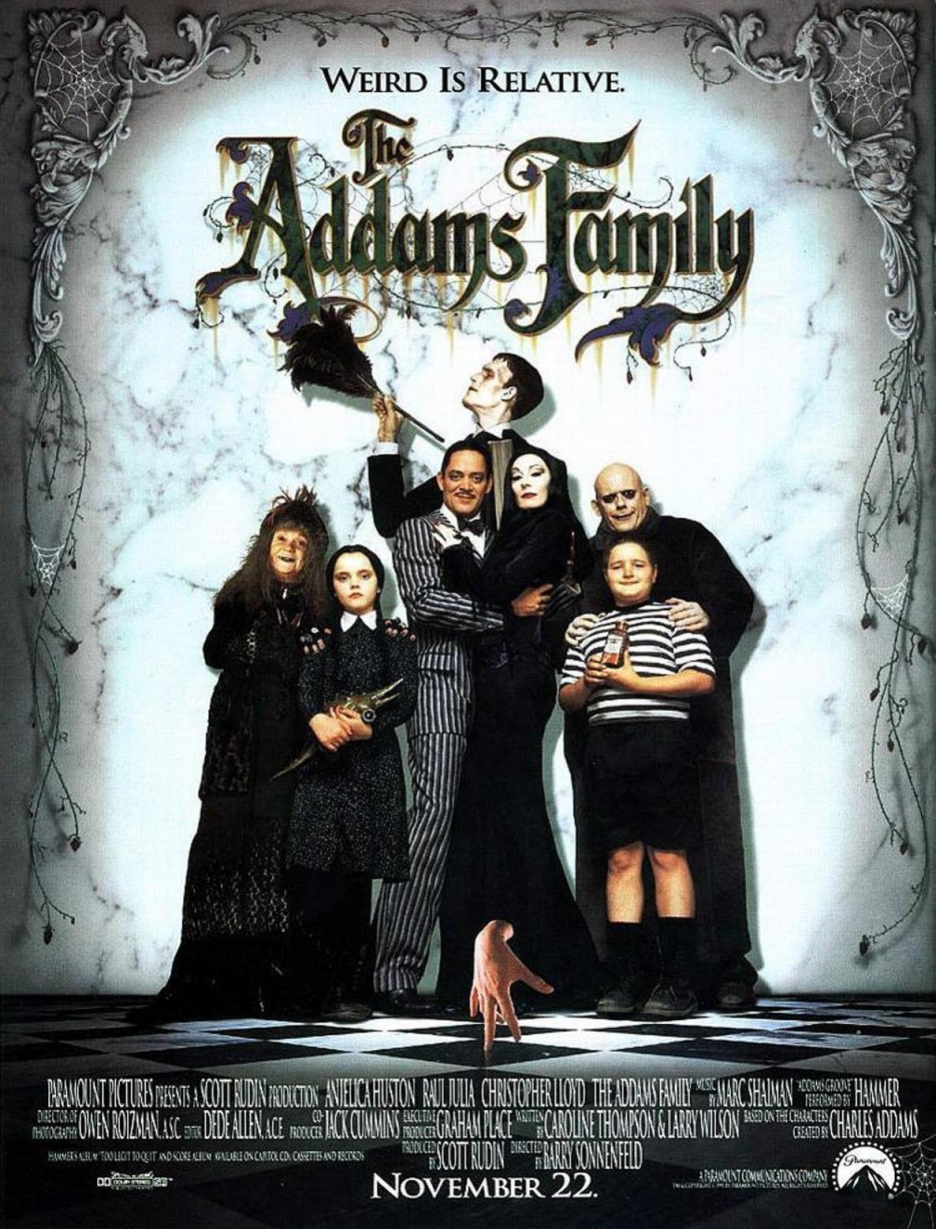
Revisiting films from your childhood is always an interesting experience – very often the sensation of uncompromising nostalgia fools us into believing that these are still perfect films that are free of any discernible flaws and where the tender, fond memories we had when first encountering them are once again evoked by what is often the umpteenth viewing. In other instances, we’re delighted to find that they still work just as well today as they did back then, entertaining us in the same way, but also carrying that unique spark that made them so memorable in the first place, with the story ageing particularly well, alongside the more formal elements that go into making a memorable film. The Addams Family is adored by so many people across multiple generations, so the joy of realizing that it still holds up as an exceptional work of eccentric comedy is incredible, and all the more reason to proclaim this as one of the most enduring pieces of family entertainment of the 1990s, and perhaps the most thorough realization of Charles Addams’ original comic strip we’ve received to date. Barry Sonnenfeld immediately established himself as someone with a flair for the absurd with his directorial debut here, and while it may seem somewhat predictable (and have plot holes large enough to take a leisurely stroll through), his version of The Addams Family is quite (f)rightfully a classic of alternative comedy, a darkly comical foray into the trials and tribulations of everyone’s favourite gothic aristocrats, that is just as invigorating today as it was three decades ago.
There has never been a shortage of material across every medium based on The Addams Family – books, television shows (animated and live-action), video games and most pertinently, films. This was the first major attempt to translate Addams’ timeless work to the silver screen, with Sonnenfeld and screenwriters Caroline Thompson and Larry Wilson going through an enormous amount of effort to bring these characters to life for a much larger audience, in a bigger format. This adaptation (along with its sequel, which we’ll talk about very soon) are often cited as the definitive entries into the entire franchise, not only because they’re the most widespread, but also because they’re fully committed to realizing the potential underpinning the source material, turning what was previously best-known as a charming but otherwise slight sitcom into an enthralling piece of cinematic adventure appropriate for the entire family. This isn’t an easy accomplishment, and everyone involved deserves enormous credit for taking part in a wonderfully creative endeavour that resulted in something so enjoyable, we sometimes can ignore the narrative problems (since this was essentially turning bite-sized chunks of humour into a feature-length film, which isn’t as simple as it would appear) and rather surrender ourselves to the upbeat humour that persists throughout the film and makes it such a riveting exercise in darkly comical storytelling that takes a bold approach that may not be as intrepid as it would appear, but utilizes exactly what it intended to in the creation of a really charming work.
Speaking on the subject of Sonnenfeld’s work in the franchise as a whole is certainly interesting, but there are some ideas that encompass it all without getting to the root of why this film in particular was so effective. We’ll discuss some of the major successes with Sonnenfeld’s vision when we get to the next film, but looking at The Addams Family on its own, it’s not difficult to see why this is such a cherished piece of filmmaking. It blends warmhearted humour with bizarre storytelling techniques, both in terms of the thematic underpinnings and the general execution of some of its ideas, and creates an exceptionally unique version of the family comedy. Sonnenfeld isn’t afraid to submerge the viewer in darker narrative territory – The Addams Family is quite literally built on the idea of the macabre, and Sonnenfeld not only realizes the value in this, but also addresses it directly, never wavering in his intention to do something unique with material that wasn’t nearly as easy to adapt as one would imagine. It required a kind of restraint – you want to captivate your entire audience, but also not be too infantile on one end of the spectrum, nor too bawdy on the other. The director strikes the perfect balance, and delivers a delightful diverting piece of family-friendly entertainment that is approachable by every member of the prospective audience, being bold and exciting enough to keep the younger viewers engaged, but with the right amount of risque humour to compensate and keep older audiences just as entertained. It’s a difficult balance to achieve, but it does so with such incredible aplomb, it’s difficult to envision how this didn’t spur so much more adoration at the time, leaving The Addams Family to become a cult classic, which does seem fitting for the kind of film this is.
It also helps tremendously that the film features impeccable production value, with Sonnenfeld doing everything possible to ensure the film appeared as striking as its story. The ensemble employed is actively brilliant – Raúl Julia gives one of his most iconic performances as Gomez Adams, Anjelica Huston is at her most elegant and Christopher Lloyd is as wonderful as always, not to mention the scene-stealing performance given by Elizabeth Wilson, who steals the film from right up the main cast, playing one of the most sneering villains of the 1990s – but they’re more reliable than they are distinct, and they often find themselves simply supplementing the gorgeous creativity done by those behind the camera (more discussion will be had on the cast soon, since they really come into their own in the subsequent entry). How would Huston’s performance be nearly as effective had she not donned the stunning costumes by Ruth Myers, or the pleasure that comes from seeing Christina Ricci gleefully trot through the mansion, terrifying the wayward souls that found themselves in the wrong place at the wrong time, without the stunning production design that gives The Addams Family such a distinct appearance? It’s a massively successful film in evoking the macabre marvels that Addams set out to create – and what is even more impressive is that everyone involved, on both sides of the camera, know the exact amount of restraint to show. It’s campy and outrageous, but never gaudy – Sonnenfeld used his industry insider knowledge so well, you’d genuinely believe this wasn’t his directorial debut, but rather a film shepherded by a far more seasoned veteran. It makes for a very compelling 90 minutes, each one of them absolutely essential to the unhinged delight that lurks beneath this film, making it all the more entertaining.
The Addams Family is a terrific film, and sets the foundation for a very promising series that may have been on the precipice of peaking, but still had some way to go, which is less of a criticism and more of an observation. The film isn’t always perfect – there are several ambiguities that prevent it from being entirely successful, at least in terms of the plot – but it doesn’t matter al that much, when the broader product is such an irreverent, delightful comedy that seeks to charm more than it does attempt to be wholly original. Part of a movement towards blending upbeat comedy with more grotesque forms of dark humour (as was the case with Beetlejuice a few years prior, which seems to be something of a blueprint for this film), The Addams Family is a very effective bit of storytelling that goes to great lengths to be entirely unique, never neglecting the more important aspects of the production. More prominently is its incredible ability to just be fully-captivating, keeping us all so engaged – and whether viewing it for the first time, or revisiting it again after a while, there’s no doubt that The Addams Family holds up spectacularly well, especially since it delivers exactly what it promises. There have been so many entries into this franchise across numerous media, but this is perhaps the definitive version, which is always something quite remarkable to assert on a film that stuck to what it knew it was capable of, never deviating from its promising structure and being entirely insistent on a kind of simple pleasure that it achieves in abundance.
 The Postmodern Pelican