
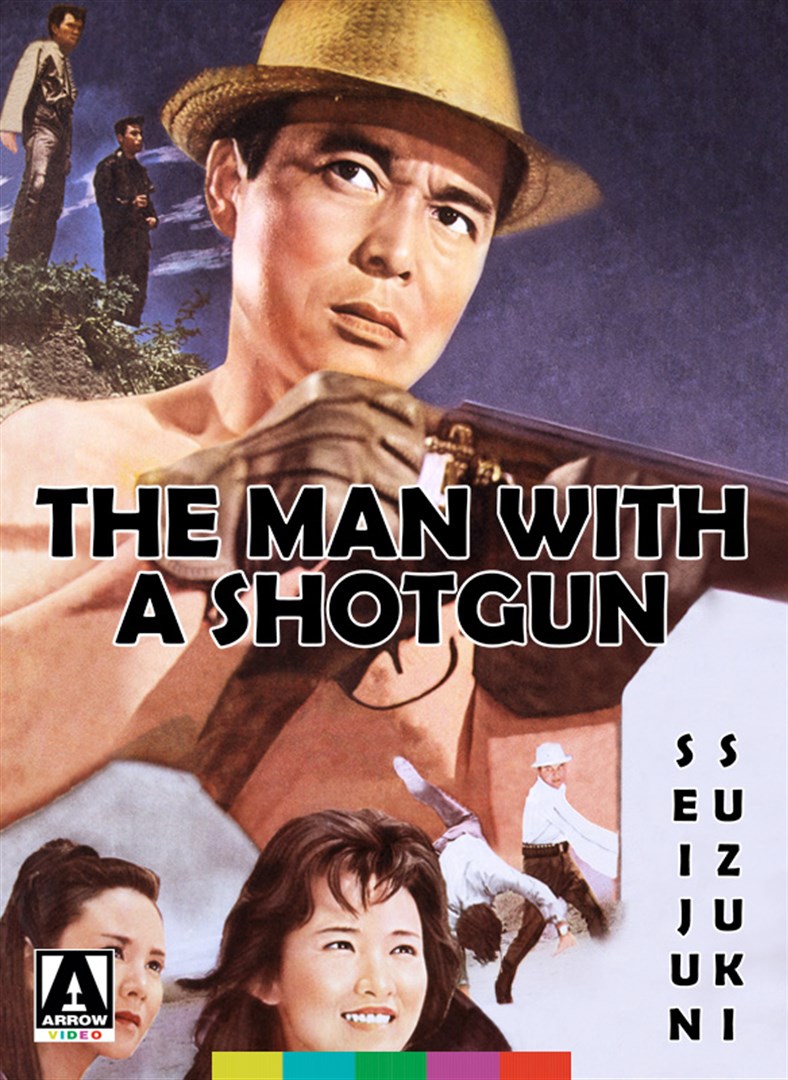
Even before he came to be known for his more nihilistic dark comedies that were propelled by their sense of effortless cool and roots in absurdism, Seijun Suzuki was consistently playing with cinema. In the first five years of his career. Suzuki directed a staggering twenty-four films, each one a distinct work of genre storytelling that saw the director experimenting with form and content in some very creative ways, and while some of these films may be somewhat dismal in quality, many of them are remarkable achievements. This is most evident in one of his more popular pre-fame films, The Man with a Shotgun (Japanese: 散弾銃の男), in which the director was once again working in the realm of the familiar, but through the lens of a highly original set of ideas that may have had some common traits with many films produced in other parts of the world, but still stood as its own piece of fascinating filmmaking. By no means the director’s finest work, nor his most noteworthy or memorable, The Man with a Shotgun is just another enthralling moment for a filmmaker whose pursuit of combining genres and doing more with the form than many of his contemporaries were at the time, and is more than adequate as a work of unhinged entertainment that manages to be funny, action-packed and thrilling, while never losing the rugged sheen it was built on, and consistently ventures towards, meeting various obstacles along the way, but ultimately succeeding where it absolutely mattered, making for a compelling but otherwise middling effort.
The best way for audiences to approach Suzuki, particularly earlier on in his career, is to not expect much – for someone as prolific as him, who rattled off films as if it was a mere pastime, not everything he produces is going to be particularly unique, and while it is easy to reduce what he’s doing in a film like The Man with a Shotgun to merely copying the work done by American and European filmmakers, we need to take everything in context. This film in particular seemed to preempt the Spaghetti western movement, which was already gradually becoming a feasible genre, but was still half a decade away from reaching its breakthrough moment. Suzuki didn’t invent it as much as he did anticipate it, which is already quite a fascinating insight into the world he created here, and a more than sufficient point that solidifies The Man with a Shotgun as something worthwhile as a piece of original storytelling, and a good launching-point to discuss the various merits that underpin this film, of which there are several if we look beyond the more derivative surface. There are certain aspects of this story, and the manner in which Suzuki executes it, that feel almost eerie in how prophetic it was to the later move towards other forms of filmmaking. Predating both the peak of the spaghetti western and revisionist western, but somehow having many of their most essential qualities, The Man with a Shotgun is an unexpectedly prophetic film that may not have done it intentionally, but stands as one of the more compelling examples of the roots of what was to become an incredibly influential genre later in the decade.
Honestly, The Man with a Shotgun is a film we’ve all seen before – it’s influence on later films may be unexpected and intentional, but are very clear. This is essentially the story of a small town in the middle of rural Japan (although Suzuki does well to not situate it anywhere entirely specific, leaving many details somewhat ambigious, giving it a universal appeal) that soon finds a stranger in their midst, a mysterious individual who comes armed with both weaponry and wit, of which he is more than willing to use both to get his way. He stands between villain and vigilante, there to spread his message and achieve what he set out to, but not without making use of some very necessary conflict. The Man with a Shotgun is obviously not a revolutionary film in the traditional sense, and Suzuki keeps everything too vague to actually understand what his approach way, but considering when this film was made, and how it bears traits that weren’t quite going to come into fashion for a few years, it’s fascinating how he manages to almost revise a genre that hadn’t even come into its own yet. Arguably, it’s possible to claim that The Man with a Shotgun and later spaghetti westerns weren’t directly related (in the sense that the latter flourished from the former, as if Suzuki was the guiding force behind it), but rather have a common ancestor – in this case, samurai films, a trait this film shares with Yojimbo by Akira Kurosawa – but even then, Suzuki seems to be operating with the clear intention of doing something very unique from what his compatriots had been doing for years. Suzuki was highly-inspired by American films – the next year’s Teenage Yakuza is one of the earliest examples of his liberal borrowing of ideas and tropes from across the Pacific – so it’s not surprising at all that this film seemed to carry some influence as well, which it implements throughout the story in some very creative ways.
Undoubtedly, there isn’t all that much to speak about when looking at this film – it doesn’t necessarily embody the idea of originality, or something that will suddenly convert viewers to Suzuki’s work, or alternative Japanese cinema as a whole. Both in terms of the plot and the way it is realized, The Man with a Shotgun seems very familiar, so whether the viewer enjoys it or not depends entirely on how willing they are to look beyond the incredibly predictable storyline and instead surrender all sense of logic to a director whose intentions were always to do something entertaining prior to making bold statements or striving to be entirely original. Suzuki would enter into this stage later on in his career, but at this point, his early work was populated by a growing sense of Americanization of the nation, and a blend of genres, which was not pioneered by Suzuki, nor perfected, but definitely stands as a central part of his career, and with which he managed to make sound profoundly entertaining films, of which The Man with a Shotgun is certainly one. A relatively minor work, and one that can really only be appreciated by those accustomed to Suzuki’s style, this film is very fun, but still struggles to find its own voice outside of a bold and ambitious story of violence intermingling with more elegant forms of cultural narrative. It’s an enjoyable work, and that’s about it, and with very little in terms of a strong storyline, it just doesn’t strike as an essential film, with the exception of a few interesting characters and some stunning set-pieces. As a whole, The Man with a Shotgun is a lot of fun, but still a relatively slight effort from a filmmaker whose most interesting approach – whereby he set a foundation for the growth of the spaghetti western later that decade – was most likely inadvertent, but still quite fascinating, intentional or otherwise.
 The Postmodern Pelican