
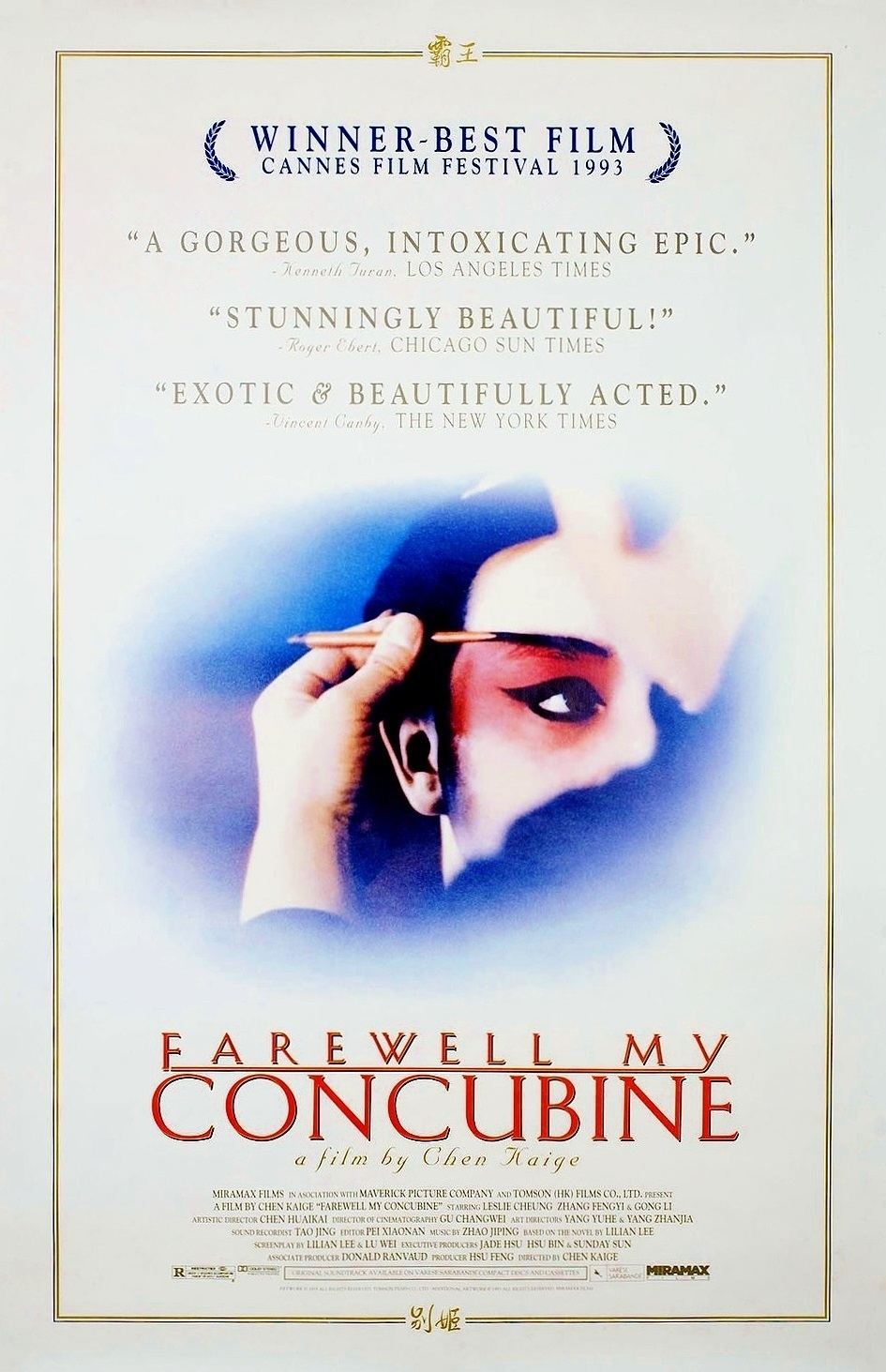
Farewell My Concubine (Chinese: 霸王別姬) is one of those films that has been consolidated as such a masterpiece of arthouse cinema, it’s almost a rite of passage to eventually watch it. Chen Kaige’s exploration of Chinese culture in the early 20th century has received its fair share of acclaim and adulation throughout the years, and not entirely without reason, since this is a film that understandably lends itself to a kind of praise, and Chen has consistently received some glowing recommendations as one of the foremost artists capturing the history of Chinese culture and society through his films. However, the experience of seeing this film and realizing that what it means and what it does are worlds apart was quite a disconcerting moment, since this is supposed to be some masterwork of Asian cinema, when in actuality, I found it to be passable at best. Not necessarily a disaster of a film, but also one that feels clumsy at times, Farewell My Concubine feels more important than it does enjoyable, and there are numerous moments when it seemed Chen was slightly losing sight of what he was attempting to say – his most ambitious project by the time he set out to make the film, this appears to be the epitome of an artist taking on far too much than they could feasibly handle, resulting in a film that feels more like a chore than it does a beautiful cinematic experience. The film consistently dares you to love it – and indeed there are some moments of absolutely stunning beauty – but it all tends to fall a bit flat after a while, a result of both the director losing control of the narrative, and the film itself not being able to carry the weight it intended to take on. All of this goes into explaining why, despite its prestige and rapturous attention, Farewell My Concubine felt far too lifeless to have any merit beyond the superficial.
Starting from the top, Farewell My Concubine is not off to the best start – its opening scene is very promising, as two aged actors enter an empty theatre and begin to narrate the story that brought them there. We’re then launched into an extended flashback sequence to their early life, which is the precise moment the film starts to gradually derail. What could’ve so easily (and more ideally) been two or three short moments of exposition that explain the origins of the characters becomes a self-indulgent series of scenes that are certainly interesting, but not enough to justify a quarter of the film, which was already far too long as it stood. Clocking in at just under three hours, Farewell My Concubine could’ve elided the first few chapters and not only gotten rid of the clunky sequences that feel very much out of place in this film, but also reduced it considerably, keeping the audience engaged and attentive for when it begins to hit its stride towards the second act, which is really where it shows promise. Considering the amount of historical context this film had to cover, we can forgive it for being a bit rushed – essentially, it looks at roughly half a century of Chinese socio-cultural history (not to mention some of the most tumultuous events in the nation’s history, such as the rise of Mao Zedong in the 1920s and the Cultural Revolution of the 1960s), and was bound to come up against some formidable challenges in putting everything in there, and actually trying to make it seem meaningful, and not just a meagre dramatisation of a history book. However, this isn’t even the most substantial flaw – the film has the time to explore these aspects of history, but not the willingness to actually say all that much about it. This is a film that so desperately wants to be rivetting, but doesn’t seem to have the good sense to connect the academic underpinnings to the artistic form that it’s taking here.
However, this isn’t to dismiss the film as a whole – Farewell My Concubine is an exceptionally important film, and anyone with even a passing interesting in Chinese history will find some immense value in it. As a historical and cultural text, the film is terrific, giving us insights into the past in ways that are quite effective. It’s when we consider it as a film that we start to see how it comes apart at the seams. Historical epics are often an acquired taste, and we very often know exactly what to expect when venturing into them – but there’s something so amiss about Farewell My Concubine that really doesn’t allow it to reach that pivotal point where these epics come into their own and captivate the audience, forcing us to abandon our preconceived notions of history, even if they can tend to rely too heavily on sensationalism or construction to convey a certain message that blends education and entertainment. They’re sumptuous and beautiful to look at on one hand, and rivetting in how they replicate history and interpret in certain ways on the other – finding a good balance is definitely the key to succeeding with any kind of period drama, especially one that purports to cover a considerable segment of a nation’s history, as is the case here. Farewell My Concubine just doesn’t seem to realize this, with Chen actively attempting to make a poignant exploration of the cultural context he was born into, but without finding a plausible manner to say it without coming across as too heavy-handed. The film is ultimately gorgeous, but it just doesn’t do enough to fully earn its length or visual aesthetic that make it stand out, often appearing to betray the very impressive ideas that undoubtedly went into its creation. Constructed with nothing but good intentions and a very promising set of concepts that would’ve made a masterpiece with the right approach, Farewell My Concubine just feels like an enormous missed opportunity in several areas.
Despite its length and inarguably impressive production values, the film was simply lacking in the areas where it really mattered the most, and there needed to be so much more to it in order to justify some of the choices Chen was making here. It’s not quite clear where the film falters the most, but perhaps the most logical place is in how Chen perhaps shows too much restraint. Farewell My Concubine is the kind of film that deserves some kind of excess, but within reason, which is normally cultivated by a filmmaker who not only has control of the ideas that were conceived of initially, but also the good sense to find a way to explore them fully throughout the process. Chen is a capable filmmaker, but one who seemed to fall victim to the expectations that he was making a definitive work of Chinese historical drama, rather than an intimate character-study, which is essentially what Farewell My Concubine should’ve been. The film goes in far too many directions to be effective, and struggles to find a cohesive way to explore a wealth of material – it’s almost as if the film was too scared to leave some pivotal historical detail out, it inserted as much information into a single frame or piece of dialogue, in fear that we’d not have the context to understand what we’re seeing otherwise. Moreover, it also doesn’t help that the film harbours the worst kind of excess, where the emotions are pitched at a much higher level than reality would ever allow. The melodrama in Farewell My Concubine is something to behold – it’s three hours of characters who are constructed to be complex, brooding individuals, but actually come across as motifs more than people, interacting and navigating various challenges. This isn’t grounds to dismiss the film, but rather the key to understand where the film goes wrong, with its tonal control being far too scattershot to be compelling. The huge emotional crescendos feel limp, and the drama is far too convoluted to make much of an impression, leading to a series of climactic moments that are thrilling, but not all that memorable.
Despite the stunning final scene – which is one of the most touching in the entire film, and a moment that almost makes the preceding experience entirely worthwhile – Farewell My Concubine just struggles to come to terms with its own intentions, which is an unfortunate problem, since this isn’t a work that lends itself to failure – and even the use of that term feels wildly inappropriate to describe such an ambitious project, and there is some merit embedded deep within it, which is more of a testament to the film’s insistence on being a stunning achievement more than exploring it through a profoundly moving narrative. In no uncertain terms, this isn’t a bad film, nor is it a mediocre one. Instead, it’s a serviceable drama masquerading as a historical epic, and in the process confuses itself to the point where it loses sight of its own overall objectives, which was to be a detailed tapestry of the changes in China in the early 20th century, through the perspective of two opera actors and the various individuals who weave in and out of their lives. Farewell My Concubine is a film that could’ve been a masterpiece, but instead fumbles too much along the way, and instead becomes an overlong, melodramatic muddle of ideas that may manifest in some gorgeous imagery, but is extremely difficult to embrace. There are moments of unrequited beauty generously peppered throughout, enough to compensate for some of the narrative and tonal shortcomings, but it turns out to not be all that worthwhile, since so much of what matters is executed with a maladroit ambivalence that points towards the idea that this was more about the spectacle than it was the story – and while this often works for other historical epics, something as profoundly interesting as this period in Chinese culture should’ve made for a much more effective piece, instead of this serviceable but unnecessarily challenging experience.
 The Postmodern Pelican