
Maria (Chiara Mastroianni) lives a tumultuous life – she’s a well-regarded academic and university professor who has a penchant for starting relationships with younger men, with many of them being her students, who doubtlessly relish in having a chance at a relationship with such a fascinating woman. However, she has been married for twenty years, to Richard (Benjamin Biolay), who is a good husband, albeit one who has grown somewhat complacent and dull as they’ve approach middle-age, leading Maria to constantly seek out the excitement of younger people – she justifies her actions by acknowledging that, as wrong as infidelity is, such relationships are only devastating to a marriage if there’s an emotional connection that goes into it. She approaches these affairs as nothing but meaningless flings that satiate a carnal desire, since her heart will always be with Richard – or so she thinks. When he accidentally stumbles upon evidence towards her affair with a student, Richard is apoplectic, and in a fit of rage asks her to leave. Feeling similarly-emotional, Maria ventures across the road to a hotel, where she spends the night observing her apartment (and the husband in it), and ruminating on her relationship, pondering whether or not this signals the end of it. Her thoughts are cut short with the arrival of a familiar face, a much younger Richard (Vincent Lacoste), from when they first married. Suddenly, Maria is in the presence of the young, desirable man she fell in love with over twenty years before, and over the course of the evening, they reminisce on the early days of their relationship, which also brings in Irène (Camille Cottin), Richard’s former piano instructor, with whom he had a decades-long relationship before she cut it off when he was set to marry Maria. The three are now caught between the past and the present, and gradually find themselves in pursuit of the truth, thinking of the past and deciding what the right approach for the future would be, and whether or not it is worth salvaging a marriage that may have been loveless from the start, or at least had that illusion when perceived in retrospect.
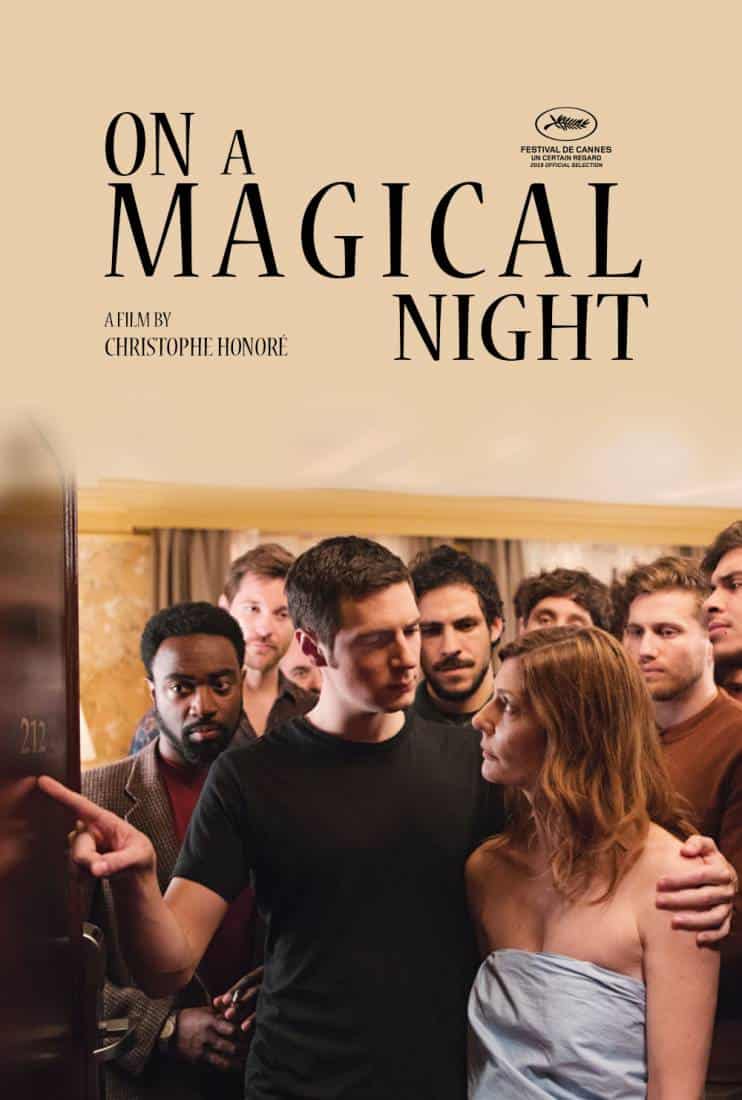
There are some films that strive to be nothing more than just purely entertaining, which is a good way to look at Christophe Honoré’s wonderful On a Magical Night (French: Chambre 212), a boisterous and charming romantic comedy that explores a deteriorating marriage over the course of one evening, and delves deep into the various machinations of a long-term relationship, and the history that tends to go unexplored in more straightforward ventures into this subject matter. DIR has been known to build narratives around certain subjects heavily-rooted in reality (and thus often works within the realm of a more optimistic kind of realism), but which take very interesting approaches to the themes they’re exploring, often being dynamic works that are propelled by their enormous understanding of very human issues. It’s far more difficult to make something like this work than it would appear, and Honoré masterfully keeps everything incredibly simple, but not without neglecting to add a touch of flair to the proceedings, making On a Magical Night a wonderfully delightful film for how it eases us into a position of comfort, since it does tread through familiar territory in terms of the overall premise, but gradually reveals itself to be somewhat more complex, with its idiosyncratic approach to some familiar ideas setting it apart from some of the more trite and predictable romantic comedies of recent years, with the director even going so far as to use these lesser works as a basis for this film, building a memorable narrative out of what is often see as a more insignificant genre, but which is repurposed here as fertile ground for some fascinating discussions and profound commentary on some interesting issues, all of which go into constructing On a Magical Night as one of the more unique modern romances of recent years, in both form and the concepts it’s built from.
Honoré masterfully constructs a quaint little comedy that may be quite brief (clocking in at only 87 minutes), and could be seen as somewhat slight, especially since the premise is very simple, but ultimately all functions into making On a Magical Night such a jubilant work of modern romance, an intelligent and insightful exploration of the human condition from the perspective of two people who think they’re falling out of love, and in the process of distancing themselves from the relationship, come to realize how much they actually adore each other. On a purely conceptual level, there’s nothing about On a Magical Night that is all that revolutionary – the idea of a couple questioning their marriage after decades together is not one that is all that unknown to literature. Where Honoré succeeds in this film is through how he uses this primal concept as a means to make some bold statements, all the while not deviating too far from expectations. Undeniably, enjoying the film requires the viewer doing their due diligence and suspending disbelief for a few short moments, especially since the film flourishes from the director interweaving romance, comedy and fantasy together to make a wonderfully poignant marital story, which often tend to use the idea of recapturing the “good old days” of the relationship. The difference is that, in the case of this film, these ideas manifest directly into the form of spectres of the past visiting the meditative Maria, who begins to wonder whether or not she’s making the right decision. It’s a pleasant premise, and immediately positions On a Magical Night as a wonderfully appealing film – but there’s so much more to it, and under the guidance of a director who may not have the experience of being a keen observer of the human condition like Honoré, we might not have gotten something quite as thrilling as this. The success of this film lies not only in the endearing premise but also in the execution of these ideas, which are surprisingly a lot more complex than they seem on the surface.
On a Magical Night is a film that thrives on how it endeavours to simply be about real people, without any overt sensationalism used to make these characters more likeable or appealing to us in any way. Everything about these individuals resounds with authenticity, which means that they’re constructed as people with imperfections, from which most of the compelling parts of the story are derived – we become invested in their journey, and even when their flaws are extremely prominent. Despite being something of a fantasy film in how the director uses the idea of the proverbial “ghosts” that haunt Maria, the film never feels as if it’s on some absurdist tangent – this is clearly an allegory for the metaphysical ponderings those in long-term relationships have when ruminating on whether they are happy, or just going through the motions. On a Magical Night has some truly interesting thoughts on the idea of romance, with Honoré making sure to assimilate a healthy blend of fascinating insights with a slightly more effervescent execution, creating a sensational glimpse into a relationship, which in itself becomes a character in the film, a source from which so many deeply profound discussions could be had. Honoré facilitates a deeply thought-provoking set of ideas with this film, but it never feels as if he’s venturing too far out of the realm of reality – On a Magical Night is more metaphorical than anything else, and the manner in which the director takes on something as simple as a marriage, and presents it in a way that feels invigorating and entirely fresh, is worth noting all on its own.
There are some truly fascinating concepts pulsating throughout On a Magical Night, and the film uses its cast extremely well to explore these ideas, establishing a strong ensemble that interprets each individual character with elegance and a profound understanding of their very human underpinnings. The incredible Chiara Mastroianni leads the ensemble, playing the enigmatic Maria with such a conflicted gracefulness, finding the human core of a woman who is struggling to come to terms with the fact that her marriage may be falling apart. Mastroianni is an actress who is always in command, and this film affords her some of her most interesting work – and despite playing a character that we may think is initially void of any discernible complexities, she develops the part in such a way that we simply can’t imagine the role without her at the centre of it, with Honoré’s work being tailor-made for the actress. Funny when she needs to be, but also not afraid of going to more serious territory, Mastroianni is such a magnetic presence, with everything she does, whether delivering a memorable line or conveying a wealth of emotions through the most simple gesture or expression, being a masterful example of character construction. Vincent Lacoste and Benjamin Biolay are both very good as the younger and older version of Maria’s husband respectively, with Lacoste finding the depth in the youthful arrogance, and Biolay the quiet resignation to middle-age, both of which are pivotal in putting these characters together and convincing us not only to their own common source, but also their relationship to the protagonist, with both actors having remarkable chemistry with Mastroianni (the fact that Biolay and Mastroianni were married only adds more fascinating depth to their relationship in the film). Camille Cottin is also very memorable as the other woman to a woman is often seen in that role herself – there were moments where I found myself yearning for another film that follows the journey of Irène, since (with the exception of Maria), she has the most fascinating part in the entire story, and Cottin is absolutely sensational in the role. More than anything else, each actor is doing something slightly different here, but are bound by an irresistible understanding of the need to make these characters both entertaining and genuine, which they all consistently succeed in doing.
On a Magical Night is just such an effortlessly charming film, and finds unique ways of treading through familiar narrative territory. Propelled by its ambitious premise, rather than weighed down by it in ways that made similarly-playful comedies tend to be, the film is a rousing success that takes some unexpected turns throughout, but quite rightly never deviates all that far from reality, even when it does have smatterings of buoyant fantasy thrown in quite consistently. It is an energetic romance that finds poetry in even the most unexpected places, where the most seemingly inconsequential moment harbours such depth that go into giving this film context, and provides much-needed buoyancy to elevate the story far beyond the confines of the cliched, melodramatic romances that often populate our screens. There’s some real artistry that goes into the film, and even when it veers towards much lighter subject matter, there’s never any sense that the film isn’t taking its central message seriously, with the characters being extremely authentic and the situations entirely believable, which is a credit both to the director’s strong control over his story, and the exceptional cast, who do very well in interpreting these often intimidating ideas. On a Magical Night proves that something can be extremely entertaining, but still have a deeper meaning, which Honoré so magnificently demonstrates through the intricate meanderings that persist throughout the film. Joyful and very funny, but not in any way slight, this is a wonderfully charming piece that is both incredibly romantic and deeply sentimental, finding the humour in some downbeat situations, and managing to make bold statements without ever feeling overwrought, which is yet another reason why Honoré made an absolute gem of a film in On a Magical Night, which is never afraid to have a bit of fun.
 The Postmodern Pelican