
Charles Dickens and Armando Iannucci are two names I never thought I’d read in the same sentence, which is only made more curious by the fact that they’re both fascinating writers who are voices of their generation, observers of the human condition that used their craft to create varied tapestries of the world they saw before them. However, on a purely superficial level, there’s never been anything to indicate that their work would be in any way compatible – so you can imagine the nearly universal surprise when Iannucci announced that he was adapting one of the iconic author’s most famous novels, David Copperfield. None of us truly knew what to expect – Iannucci is an artist who has always had a firm grasp on the cultural pulse, but whose more callous and vulgar style (which very intelligent) didn’t suggest a straightforward Dickens adaptation was something that would be a good fit. The Personal History of David Copperfield is indeed not a traditional adaptation, but not for the reasons you’d expect – Iannucci has momentarily stepped away from his more subversive, satirical method of telling stories, and instead directed one of the most impeccable adaptations of the author’s works yet seen – by all means, this film is probably the closest realization to what Dickens was attempting to convey, a lush and lavish literary odyssey that combines numerous genres, explores various situations in episodic chapters and cuts to the humanistic core in each one of these characters (who are in turn interpreted by an absolutely incredible cast), and pays homage to the esteemed writer in a way very few works inspired by his novels have managed to. In short, The Personal History of David Copperfield is quite an achievement, both in terms of how daring it is, but also in how Iannucci finds the space to look at some ideas that are often lost in the shuffle when it comes to other adaptations of the works.
When it comes to looking at the areas in which The Personal History of David Copperfield succeeds, it is important to note that (despite the presence of a director known for his edgier approach to his material) that this is a work that more or less follows the plot of the Dickens’ novel quite faithfully, only changing a few chronological details and character motivations, as well as eliding some of the more unnecessary themes (since the source material is a notoriously dense work that is rich with so many details that couldn’t be feasibly placed into a film). Even the title is taken from the full name of the book – The Personal History, Adventures, Experience, and Observation of David Copperfield the Younger of Blunderstone Rookery (Which He Never Meant to be Published on Any Account) – which indicated that Iannucci wasn’t at all interested in using this opportunity as means to deconstruct the author’s work, but rather openly celebrate it in a way that was different, but didn’t take away from the original. I absolutely adore Iannucci and consider him to be one of the finest satirists working today, whether it be in his small television work in the 1990s (such as Time Trumpet and The Day Today), or his more established, celebrated comedies of recent years (such as the exceptional Veep, or his masterful films In the Loop and The Death of Stalin, two of the best satires of recent years). The Personal History of David Copperfield is a considerable change of pace for the director, who leaves his penchant for eviscerating the very essence of humanity in favour of something far more hopeful and charming, which doesn’t invalidate his previous work, nor indicate that he should leave his more popular stylings behind, but rather that he’s capable of something radically different, putting aside the outrageous comedy and instead going for a film that is more gently humorous than it is riotously funny – and it all works out, since The Personal History of David Copperfield is one of the year’s best films, for a number of reasons.
The approach the director takes to the Dickens novel is remarkable, because while it appears he is doing something a bit more exuberant (since most of the adaptations of Dickens’ works have adopted a more gritty approach), The Personal History of David Copperfield is a lot of aligned with what I’d imagine the author was trying to do with his work. David Copperfield in particular has been a source of a lot of discussion – many have cited it as something of an autobiographical work, the closest Dickens came to inserting himself into his stories – and the one fatal error many adaptations of this story tend to make is they go about portraying the trials and tribulations of the titular character as a grim, dour affair with moments of joy peppered through. Iannucci clearly doesn’t care too much for this, and seems to realize that Dickens was writing with the intention of not only telling of the hardships he saw around him, but also of being playful and motivational. Thus, it only makes sense that The Personal History of David Copperfield is quite simply a feast for the senses – a colourful, boisterous blend of heartfelt drama and outrageous comedy, it becomes a whimsical journey into the life of one of literature’s finest heroes, a dashing young man whose optimism in the face of even the most disconcerting challenges helped him lead a storied life that ultimately turned him into one of the most fascinating heroes in all of literature. Iannucci captures the tone so well, taking us on an adventure that feels effervescent and charming, but not neglecting the depth underpinning the story, which makes for a rich and immersive journey into the mind of an iconic fictional character that has been repurposed wonderfully by the director and his creative collaborators, who breathe new life into a familiar story.
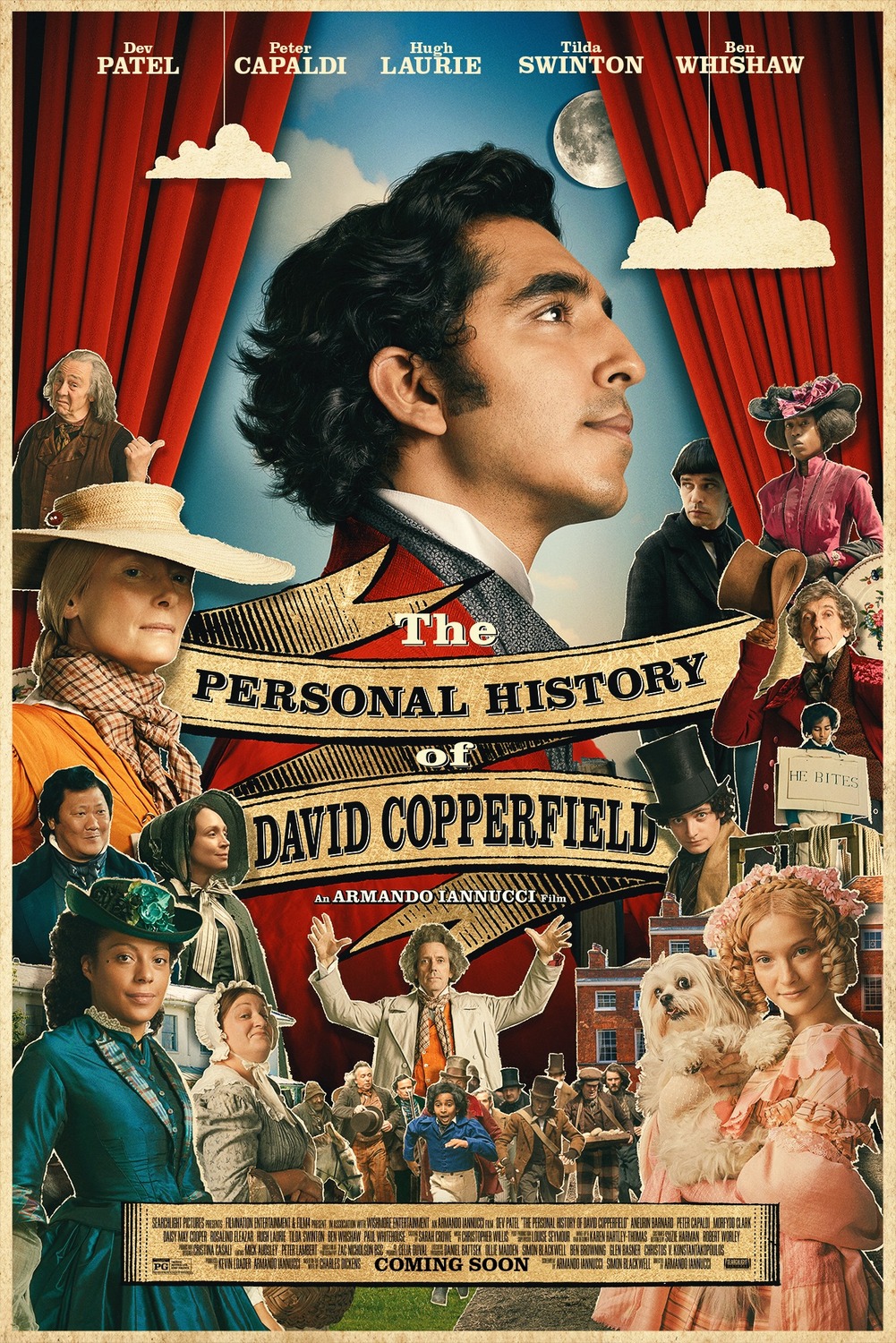
A byproduct of proving your mettle as one of the most exciting voices in contemporary comedy is that one tends to have many incredible actors bursting at the seams to work with them. Iannucci is certainly one of them, and he once again assembles an incredible cast to tell the story of The Personal History of David Copperfield. Leading the cast is a dashing Dev Patel, whose genial charm and ability to plumb some profound emotional depths make him a perfect candidate to play the Victorian hero. Patel is such a masterful actor who can play both daftly comedic and boldly dramatic without coming off as inauthentic at any point, which allows him to take command of the film and steer it forward, especially when working alongside a supporting cast that were intentionally far more eccentric, balancing their off-the-wall performances with a more grounded, genuine personability. The rest of the ensemble is filled with a blend of familiar veterans and promising young upstarts – Tilda Swinton is as wonderful as ever, fully surrendering to the absurdity of her character (as she’s prone to doing), and delivering a hilarious performance as the eccentric Betsey Trotwood, with an equally-deranged Hugh Laurie alongside her at most points (and later joined by a very eccentric Peter Capaldi), all of them bringing such pathos to otherwise strange roles. Ben Whishaw makes for a very compelling villain in Uriah Heep, finding the true malice in one of literature’s most unlikeable antagonists, while not making his sinister machinations too absurd. Morfydd Clark and Rosalind Eleazar – two promising young actresses – are wonderful as two of David’s friends and later love-interests, and hold their own against a very formidable cast of performers. As a whole, The Personal History of David Copperfield is a film that cares deeply about its characters (the sequence towards the end where David describes each of his acquaintances was heartbreakingly beautiful), and the performances are very much aligned with these intentions and often go above and beyond what is expected.
The Personal History of David Copperfield seems like a film targetted to very specific parts of the audience – literary devotees, fans of whimsical period comedies, and whatever stragglers venture towards it in the hopes that Iannucci has delivered yet another callous and outrageous dark comedy. However, this is one of the year’s most essential films simply because of how universally binding it is – it has a wonderful sense of humour, a beautiful approach to the production (the costumes, production design and visual splendour of the piece is just incredible) and some astonishing performances. However, where the film really thrives is how it is brimming with unhinged joy – this is a work that carries an immense amount of depth, and despite telling a story that has been portrayed in various forms for nearly two centuries, has been made to appear fresher and more profound than ever before, a result of a group of creative individuals coming together to bring life to an old set of ideas in a way that feels original, but without abandoning the spirit of Dickens’ work. The Personal History of David Copperfield is a marvel, and while it may be more charming than it is funny, its the kind of film that keeps a genuine grin plastered on the face of every viewer from beginning to end – its most substantial asset is its enormous heartfulness, and soulful ability to extract nothing but beauty from the most inconsequential moments of human introspection. This may appear like yet another quirky period comedy with a large cast giving bombastic performances, but there’s absolutely no doubt that The Personal History of David Copperfield is something incredibly special in every conceivable way, and an absolute delight of a film that should be seen by as wide an audience as possible.
 The Postmodern Pelican