
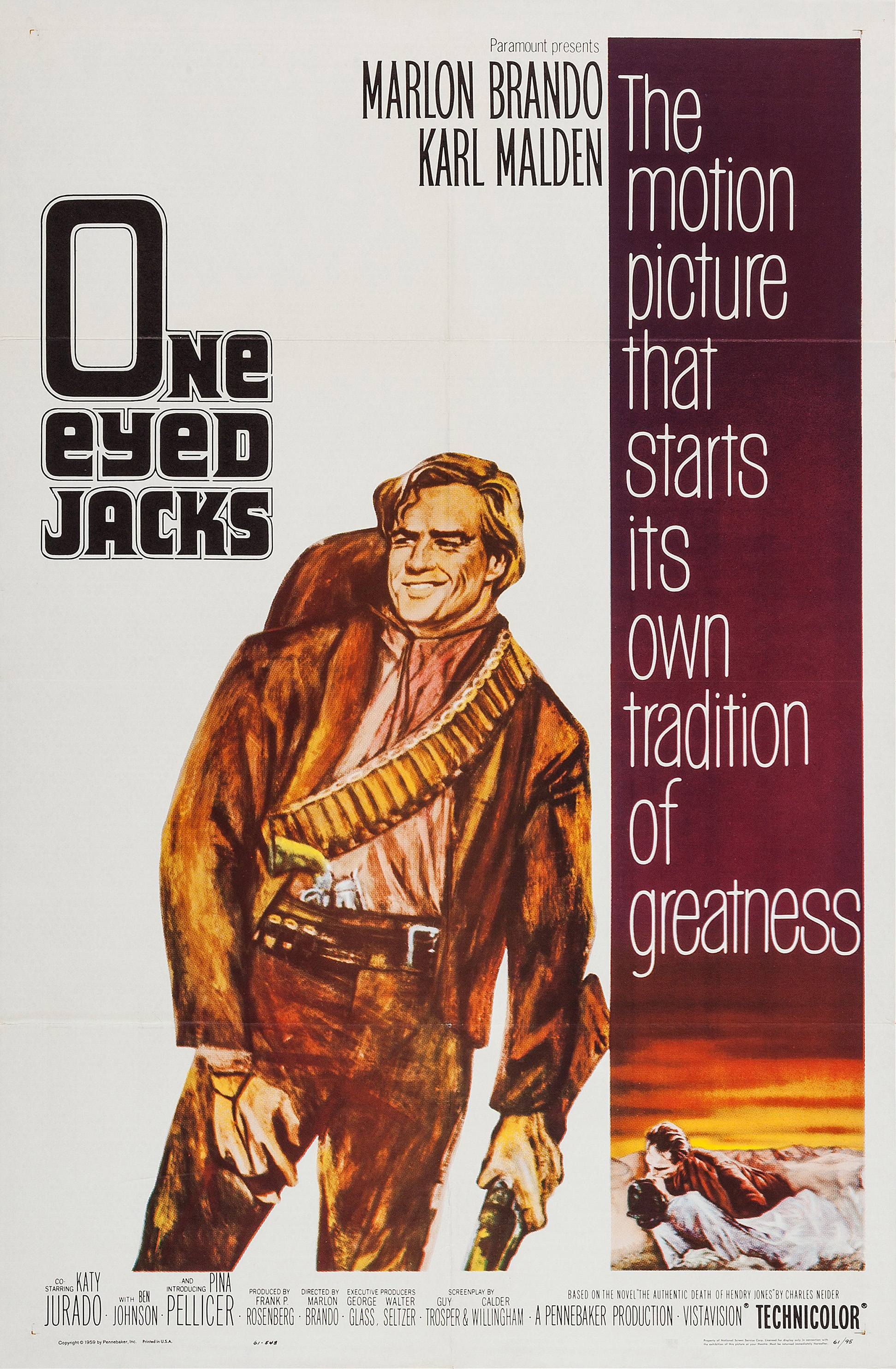
There are really only two reasons for anyone to actively seek out One-Eyed Jacks – this first is because it contains one of the rare truly villainous roles played by one of history’s finest character actors, Karl Malden. The second is to bear witness to the first and only film directed by Marlon Brando. Neither are all that effective to justify sitting through this film, which exists somewhere between the realm of hopelessly imperfect and entirely unnecessary, and makes the experience of working your way through this film something of a chore. It is important to not downplay the fact that there are some promising qualities to this film – a relatively interesting storyline, a sense of pioneering the revisionist western which was only recently starting to gain momentum after it was clear traditional westerns were winding down in popularity, and some decent camerawork that gives it some merit. However, it’s simply impossible to see One-Eyed Jacks as anything other than a missed opportunity to be a bold and ambitious work – if anything, had Brando and the rest of his collaborators actually taken a few risks and done something that at least stood out, there would be some degree of admiration behind this film, with the chance of failure being outweighed by the intention to do something different. The problems underlying One-Eyed Jacks is that it is quite simply not all that compelling or interesting enough to stand as anything other than a novelty – and whether you want to view it as a minor work of revisionist western, or a vanity project for its enigmatic star, or simply just an attempt to infuse new life into a dying genre, this film just doesn’t work in the ways that it should, especially when it becomes very clear that its flaccidity is entirely unintentional, and that it really isn’t going to go anywhere worth journeying towards.
This isn’t to say there isn’t a good film lurking somewhere in One-Eyed Jacks – the original production plans had a screenplay by Rob Serling and Sam Peckinpah, who were two very different artists who would’ve undoubtedly brought something special to the genre. It was also intended to be directed by Stanley Kubrick, who certainly would’ve found a way to make this an unforgettable western. The relative failure of the film comes in the fact that the reigns were passed down to individuals who may not have been capable of exploring it to its full potential, even if they appeared to be experienced. Hypothetical situations are a tricky concept, so there’s no proof that Kubrick or anyone else initially involved would’ve improved it – but it seems much likelier that whatever was intended wasn’t going to end up being a cheap attempt at somehow both replicating the success of decades of work in the genre, and the simultaneous dismissal of all of it for the sake of having some edge to it. It’s difficult to consider One-Eyed Jacks as a bad film, because there are so many moving parts that went into the composition of this film, some degree of difficulty was going to be present. Unfortunately, it turned out to harm the film more than it did prove it to be anything close to a memorable achievement – for every merit, there’s a major flaw that invalidates it, creating a film that inspires nothing passionate on either side of the divide, instead evoking nothing but uncomfortable ambivalence. More bland than actively terrible, One-Eyed Jacks just doesn’t work all that well as a film, and at a staggering 140 minutes, it’s far too long an ordeal for a viewer to find any real value in, being an overlong and convoluted bundle of ideas that never reach any discernible point of interest.
As a novelty, there is some interest in One-Eyed Jacks, particularly in how it’s the sole directorial effort of Marlon Brando, was always already an established star by the time the film went into production and was seeking out more of a challenge, which came with the detachment of Kubrick from this project. Despite being an actor whose reputation hinted at some degree of self-centred vanity in his approach to his career, One-Eyed Jacks does seem to find him putting in some effort – the problem is, there really isn’t enough material there for him to make an effective film based on his paltry experience behind the camera. The simple truth is that Brando was far too interesting an artist to be wasting his time on this film, whether in the leading role or as the person shepherding it forward. His performance is solid but unremarkable – he gives the kind of portrayal that fits very well in this kind of western (and which would probably be considered a great performance if given by another actor), but for someone whose entire career was defined by pushing the envelope, even when it wasn’t necessary, Brando’s choice to play this part with a kind of passivity was unexpected to say the very least, especially from an actor of such intimidating talent and stature. At the very least, we can praise Brando for not overacting, but the part would’ve been fundamentally more interesting had it found some complexity in a relatively conventional character. As mentioned at the start, Karl Malden is Brando’s co-lead, playing the villainous Dad Longworth – and unlike Brando, Malden seems to be going for something at least, and while the film may not give him all that much to do, it’s still impressive that he managed to extract something meaningful from a character that could’ve so easily been a weak archetype, but in Malden’s capable hands became something quite enduring.
Another significant problem with One-Eyed Jacks is that it simply just doesn’t feel like an essential work, which can be found in the fact that the underlying story is just not all that remarkable in itself – the plot centres on a pair of bandits that are split up after escaping a robbery, with one being captured and the other abandoning his partner and eventually becoming a well-regarded lawmaker, and who eventually becomes the target of his former friend’s fury when he leaves prison. It’s a conventional storyline that doesn’t feel all that remarkable but is interesting enough to be turned into something compelling. Considering the initial scribes for the film were Serling and Peckinpah, the former being someone with masterful control of multiple genres, the latter an artist who essentially established the concept of revisionist westerns, there was some potential somewhere in One-Eyed Jacks, which just doesn’t come through in the final product. Instead, we’re given something that runs about forty minutes too long, seems to be insistent on reaching some point that simply doesn’t seem feasible, and takes far too many diversions before culminating in a climax so rushed and lacklustre, we’re left utterly confused. One-Eyed Jacks spends two hours building suspense, and twenty minutes de-escalating it, but in a way that seems too frantic to actually leave any impression. It doesn’t help that the journey there is filled with a blend of overwrought conversations between characters that ring as entirely false, and action sequences that are bordering on incompetent, being so out-of-step with the rest of the film, which actually may have benefitted with a complete elision of these moments.
Moreover, the idea that One-Eyed Jacks is somehow some definitive entry into the genre of the revisionist western becomes even less plausible when we see how this is a film that really isn’t doing something we hadn’t seen before. More cynicism and a lot more violence may be the hallmarks of the genre, but it does very little in convincing one that this is anything special. Brando was a gifted actor, and his efforts in taking over the production of this film are valiant in intention, misguided in execution. Had he been more intent on doing something unique, rather than something safe, we may have gotten a fundamentally less-conventional film that may have not been good at all, but at least worth noting. One-Eyed Jacks is just a limp excuse of a genre film that does virtually nothing in moving this story forward, and instead relies far too heavily on the propulsions of its enigmatic director’s reputation for quality, and the general belief that audiences will flock to see a subversive western that was made by Marlon Brando. It’s a shame that this film wasn’t a lot better – there was so much promise pulsating throughout the film, but it either seemed too oblivious to notice it, or singularly uninterested in making use of it, since it required some degree of effort, which this film simply doesn’t offer. Ultimately, One-Eyed Jacks is a film that can comfortably be skipped – its not good enough to deserve attention, nor is it bad enough to warrant witnessing it first-hand. Instead, it is nothing more than an unremarkable western that runs too long, says too little and just leaves us wanting so much more than we got, which is perhaps the most unfortunate part of a film that had the potential to be substantially better.
 The Postmodern Pelican